Norwegian National Advisory Unit on Concurrent Substance Abuse and Mental Health Disorders, Innlandet Hospital Trust, P.O. Box 104, 2381, Brumunddal, Norway.
Faculty of Social and Health Sciences, Inland Norway University of Applied Sciences, Elverum, Norway.
BMC Psychiatry. 2021 May 11;21(1):244. doi: 10.1186/s12888-021-03252-9.
Smoking is still prevalent among people with substance use disorders. The objective of this study was to investigate the prevalence of smoking among patients in treatment for substance use disorders and to analyze the effect of smoking both at baseline and follow-up on drop-out, mental health and quality of life.
One hundred and twenty-eight inpatients (26% female), mainly with alcohol use disorder, staying at three different rehabilitation clinics in Eastern Norway, were interviewed at admission, and at 6 weeks and 6 months follow-up. The interview contained mental health-related problems, trauma, questions on alcohol and other substances and quality of life. Non-parametric tests were used to test group differences and unadjusted and adjusted linear regression to test the associations between smoking and the main outcome variables, while logistic regression was used to test the association between smoking and drop-out.
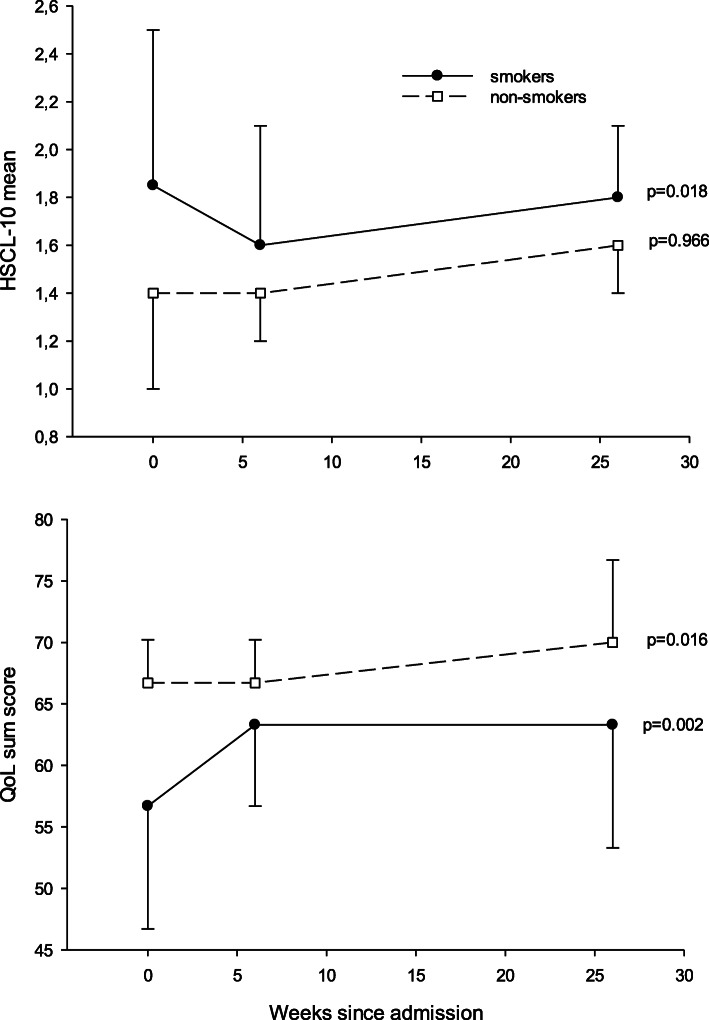
At admission, 75% were daily smokers. Compared to non-smokers at baseline, the smokers had higher drop-out rates (37% vs. 13%), more mental distress, and lower quality of life from baseline up to 6 months follow-up. Those quitting smoking while admitted improved in mental distress and quality of life at the same rate as non-smokers. Alcohol-related factors did not differ between smokers and non-smokers.
Smoking was associated with mental distress, quality of life and treatment drop-out among patients in primary alcohol use disorder treatment. The results indicate that smoking cessation should be recommended as an integral part of alcohol use treatment both before and during inpatient treatment to reduce drop-out.
吸烟在物质使用障碍患者中仍然很普遍。本研究的目的是调查治疗物质使用障碍患者中的吸烟流行率,并分析吸烟在基线和随访时对脱落、心理健康和生活质量的影响。
128 名住院患者(26%为女性),主要患有酒精使用障碍,分别来自挪威东部的三个不同康复诊所,在入院时以及 6 周和 6 个月随访时接受了访谈。访谈内容包括心理健康相关问题、创伤、酒精和其他物质问题以及生活质量。非参数检验用于检验组间差异,未调整和调整的线性回归用于检验吸烟与主要结局变量之间的关联,而逻辑回归用于检验吸烟与脱落之间的关联。
入院时,75%的患者为每日吸烟者。与基线时不吸烟的患者相比,吸烟者的脱落率更高(37%比 13%),心理健康问题更多,生活质量从基线到 6 个月随访时更低。在住院期间戒烟的患者,其心理健康问题和生活质量的改善程度与不吸烟者相同。与吸烟相关的酒精相关因素在吸烟者和不吸烟者之间没有差异。
吸烟与初级酒精使用障碍治疗患者的心理健康问题、生活质量和治疗脱落有关。结果表明,应建议在酒精使用治疗的前后阶段将戒烟作为治疗的一个组成部分,以减少脱落。