Department of Nursing, Yonsei University Graduate School, Seoul, Republic of Korea.
Department of Nursing, Kyungnam University College of Health Sciences, Changwon, Republic of Korea.
Lipids Health Dis. 2021 May 11;20(1):49. doi: 10.1186/s12944-021-01472-2.
The triglyceride glucose (TyG) index is a noninsulin-based marker for insulin resistance (IR) in general practice. Although smoking and heavy drinking have been regarded as major risk factors for various chronic diseases, there is limited evidence regarding the combined effects of smoking and alcohol consumption on IR. This study aimed to investigate the relationship between the TyG index and smoking and alcohol consumption using two Korean population-based datasets.
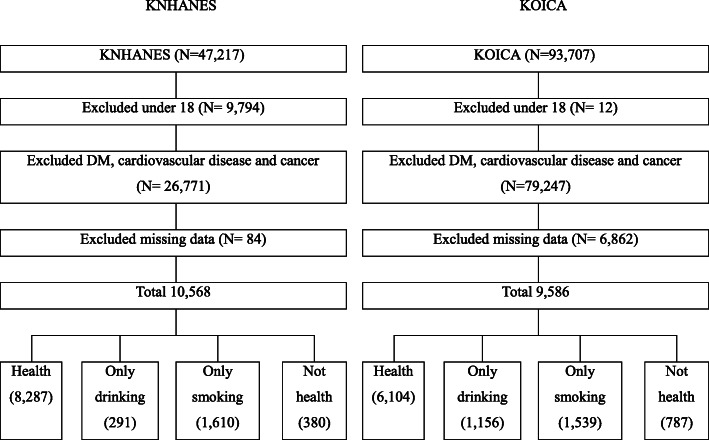
This study included 10,568 adults in the Korean National Health and Nutrition Examination Survey (KNHANES) and 9586 adults in the Korean Initiatives on Coronary Artery Calcification (KOICA) registry datasets. Multivariate logistic analysis was conducted to explore the relationship between smoking and alcohol consumption and the TyG index. To assess the predictive value of smoking and alcohol consumption on high TyG index, the area under the curve (AUC) were compared and net reclassification improvement (NRI) and integrated discrimination improvement (IDI) analyses were derived.
The combined effect of smoking and alcohol consumption was an independent risk factor of a higher TyG index in the KNHANES (adjusted odds ratio: 4.33, P < .001) and KOICA (adjusted odds ratio: 1.94, P < .001) datasets. Adding smoking and alcohol consumption to the multivariate logistic models improved the model performance for the TyG index in the KNHANES (AUC: from 0.817 to 0.829, P < .001; NRI: 0.040, P < .001; IDI: 0.017, P < .001) and KOICA (AUC: from 0.822 to 0.826, P < .001; NRI: 0.025, P = .006; IDI: 0.005, P < .001) datasets.
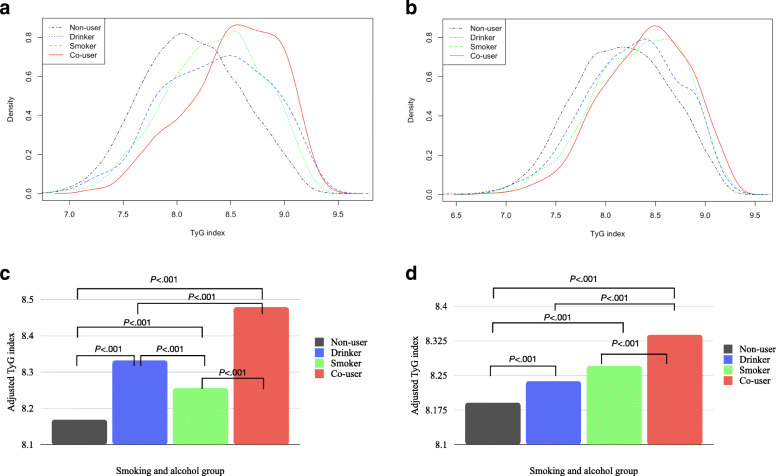
Smoking and alcohol consumption were independently associated with the TyG index. Concurrent smokers and alcohol consumers were more likely to have a TyG index that was ≥8.8 and higher than the TyG indices of non-users and those who exclusively consumed alcohol or smoking tobacco.
三酰甘油葡萄糖(TyG)指数是一种基于非胰岛素的胰岛素抵抗(IR)标志物,在一般实践中得到广泛应用。尽管吸烟和大量饮酒已被认为是各种慢性疾病的主要危险因素,但关于吸烟和饮酒对 IR 的综合影响的证据有限。本研究旨在使用两个韩国人群为基础的数据集来探讨 TyG 指数与吸烟和饮酒之间的关系。
本研究纳入了韩国国家健康和营养检查调查(KNHANES)中的 10568 名成年人和韩国动脉粥样硬化冠状动脉钙化倡议(KOICA)登记处的 9586 名成年人。使用多变量逻辑分析来探讨吸烟和饮酒与 TyG 指数之间的关系。为了评估吸烟和饮酒对高 TyG 指数的预测价值,比较了曲线下面积(AUC)并得出净重新分类改进(NRI)和综合判别改进(IDI)分析。
在 KNHANES(调整后的优势比:4.33,P<0.001)和 KOICA(调整后的优势比:1.94,P<0.001)数据集中,吸烟和饮酒的合并效应是 TyG 指数升高的独立危险因素。将吸烟和饮酒纳入多变量逻辑模型可提高 KNHANES(AUC:从 0.817 增加至 0.829,P<0.001;NRI:0.040,P<0.001;IDI:0.017,P<0.001)和 KOICA(AUC:从 0.822 增加至 0.826,P<0.001;NRI:0.025,P=0.006;IDI:0.005,P<0.001)数据集中 TyG 指数的模型性能。
吸烟和饮酒与 TyG 指数独立相关。同时吸烟和饮酒的人群 TyG 指数≥8.8 的可能性更高,高于非使用者和仅吸烟或饮酒者的 TyG 指数。