Institute of Psychology, University of Münster, Münster, Germany.
Psychol Med. 2021 Jun;51(8):1260-1270. doi: 10.1017/S0033291721001641. Epub 2021 May 12.
Research indicates that higher study quality may be associated with smaller treatment effects. Yet, knowledge about the association between study quality and treatment efficacy for posttraumatic stress disorder (PTSD) is limited. We aimed at evaluating the efficacy of psychological interventions for adult PTSD and the association between study quality and treatment effects.
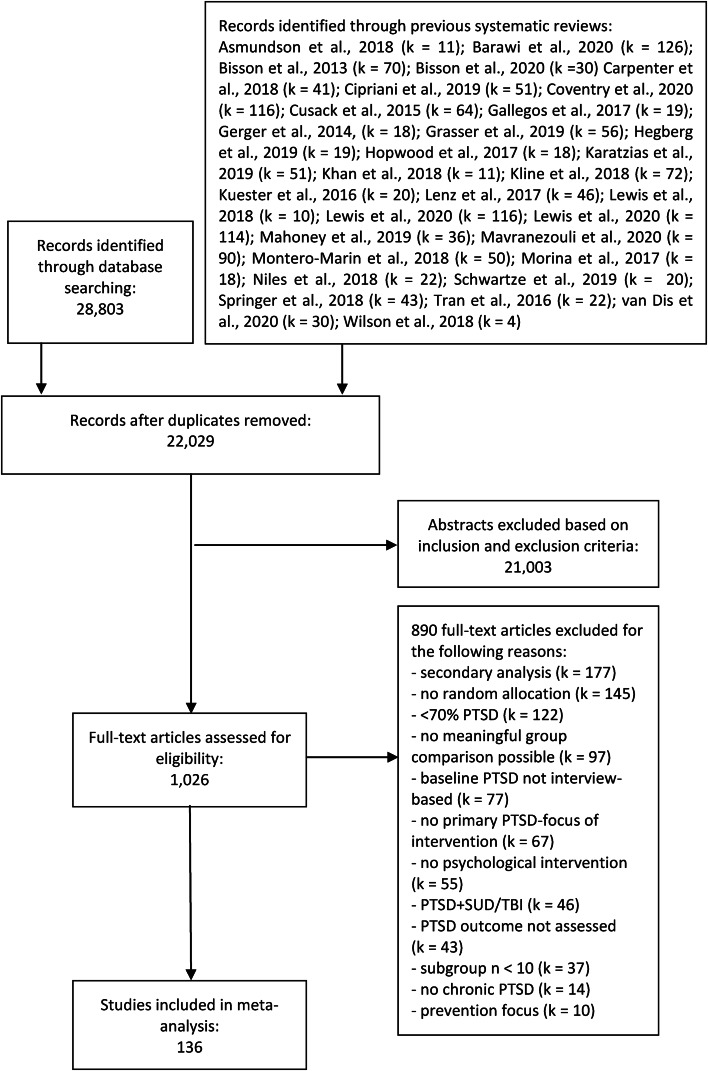
We conducted a systematic search to identify randomized controlled trials (RCTs) that examined the efficacy of psychological interventions for chronic PTSD symptoms in adult samples with at least 70% of patients being diagnosed with PTSD by means of a structured interview. We assessed study quality using the following eight criteria from prior research: ⩾ 50, all patients met criteria for PTSD, a treatment manual was used, therapists were trained, treatment integrity was checked, intent-to-treat analyses were applied, randomization was conducted by an independent party, and treatment outcome was conducted by blind assessors.
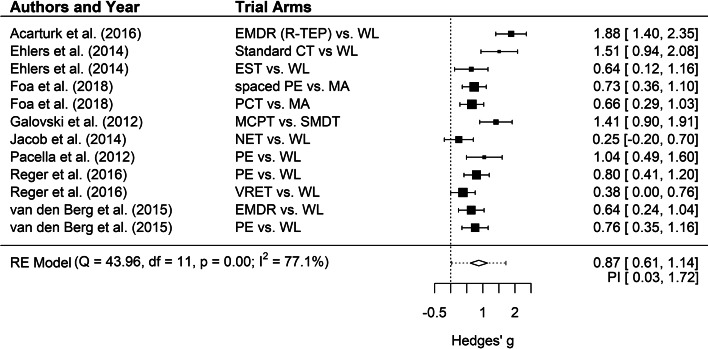
The search resulted in 136 RCTs with 8978 patients. Active treatment conditions were largely effective in reducing PTSD symptoms at posttreatment and follow-up (Hedges' = 1.09 and 0.81, respectively) when compared to passive control conditions. The comparison to active control conditions at posttreatment and follow-up resulted in medium effect sizes. A total of 14 trials met all study quality criteria and these trials produced large effect sizes when compared to passive control conditions at posttreatment and follow-up.
Overall, study quality was not significantly associated with effect size. The findings indicate that psychological interventions can effectively reduce PTSD symptoms irrespective of study quality.
研究表明,较高的研究质量可能与较小的治疗效果相关。然而,对于创伤后应激障碍(PTSD)的研究质量与治疗效果之间的关联,我们的了解有限。我们旨在评估心理干预对成人 PTSD 的疗效以及研究质量与治疗效果之间的关系。
我们进行了系统搜索,以确定在至少 70%的患者通过结构化访谈被诊断为 PTSD 的成年样本中,检查心理干预对慢性 PTSD 症状疗效的随机对照试验(RCT)。我们使用先前研究中的以下八项标准评估研究质量: ⩾ 50,所有患者均符合 PTSD 标准,使用治疗手册,治疗师接受培训,检查治疗完整性,采用意向治疗分析,由独立方进行随机分组,以及由盲法评估人员进行治疗结果评估。
搜索结果共 136 项 RCT,涉及 8978 名患者。与被动对照条件相比,积极治疗条件在治疗后和随访时均能显著降低 PTSD 症状(Hedges' ⁇ = 1.09 和 0.81)。与治疗后和随访时的积极对照条件相比,比较结果显示中等效应量。共有 14 项试验符合所有研究质量标准,与被动对照条件相比,这些试验在治疗后和随访时产生了较大的效应量。
总体而言,研究质量与效应量无显著关联。研究结果表明,心理干预可以有效减轻 PTSD 症状,无论研究质量如何。