Division of Rheumatology, Immunology and Allergy, Brigham and Women's Hospital, Boston, Massachusetts, USA
Division of Pharmacoepidemiology and Pharmacoeconomics, Department of Medicine, Brigham and Women's Hospital, Boston, Massachusetts, USA.
BMJ Open. 2021 May 11;11(5):e045074. doi: 10.1136/bmjopen-2020-045074.
To examine the effects of prescription sleep medications on patient-reported sleep disturbances.
Retrospective cohort.
Longitudinal cohort of community-dwelling women in the USA.
Racially and ethnically diverse middle-aged women who reported a sleep disturbance.
New users of prescription sleep medications propensity score matched to women not starting sleep medications.
Self-reported sleep disturbance during the previous 2 weeks-difficulty initiating sleep, waking frequently and early morning awakening-using a 5-point Likert scale, ranging from no difficulty on any night (rating 1) to difficulty on 5 or more nights a week (rating 5). Sleep disturbances were compared at 1 year (primary outcome) and 2 years of follow-up.
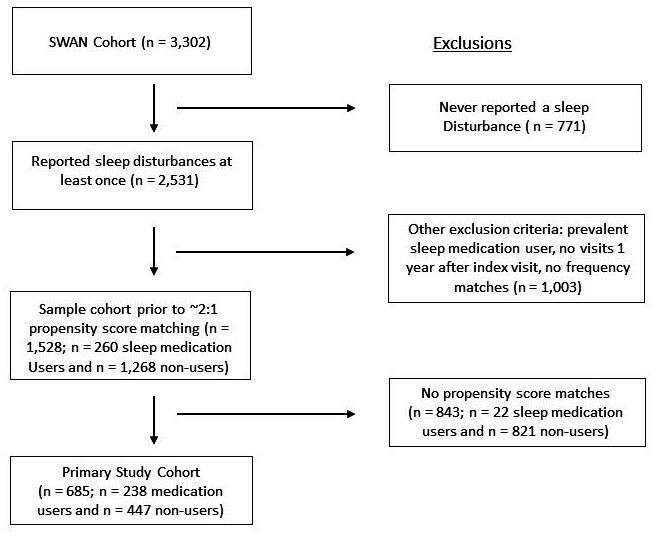
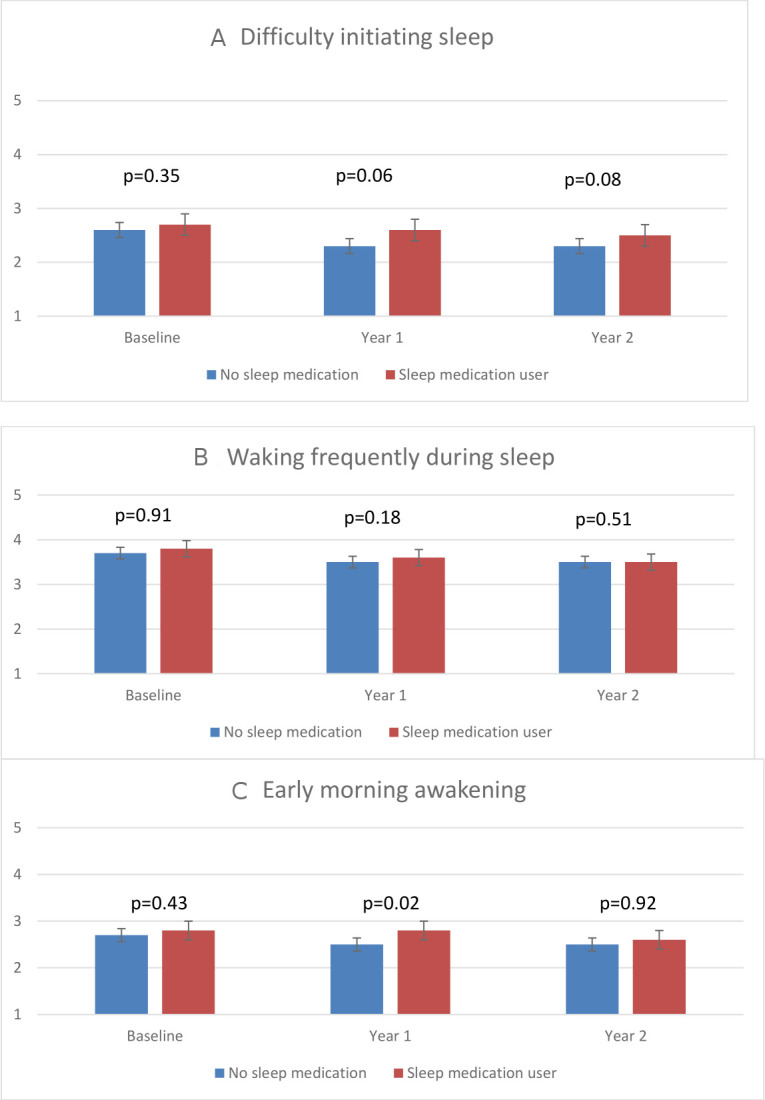
238 women who started sleep medications were matched with 447 non-users. Participants had a mean age of 49.5 years and approximately half were white. At baseline, sleep disturbance ratings were similar: medication users had a mean score for difficulty initiating sleep of 2.7 (95% CI 2.5 to 2.9), waking frequently 3.8 (95% CI 3.6 to 3.9) and early morning awakening 2.8 (95% CI 2.6 to 3.0); non-users ratings were 2.6 (95% CI 2.5 to 2.7), 3.7 (95% CI 3.6 to 3.9) and 2.7 (95% CI 2.6 to 2.8), respectively. After 1 year, ratings for medication users were 2.6 (95% CI 2.4 to 2.8) for initiating sleep, 3.6 (95% CI 3.4 to 3.8) for waking frequently and 2.8 (95% CI 2.6 to 3.0) for early morning awakening; for non-users, the mean ratings were 2.3 (95% CI 2.2 to 2.5), 3.5 (95% CI 3.3 to 3.6) and 2.5 (95% CI 2.3 to 2.6), respectively. None of the 1 year changes were statistically significant nor were they different between medication users and non-users. Two-year follow-up results were consistent, without statistically significant reductions in sleep disturbance in medication users compared with non-users.
These analyses suggest that women who initiated sleep medications rated their sleep disturbances similar after 1 and 2 years. The effectiveness of long-term sleep medication use should be re-examined.
考察处方助眠药物对患者报告的睡眠障碍的影响。
回顾性队列研究。
美国社区居住的女性纵向队列。
报告存在睡眠障碍的不同种族和民族的中年女性。
使用倾向评分匹配方法,将新使用处方助眠药物的患者与未开始使用睡眠药物的患者进行匹配。
使用 5 分李克特量表评估过去 2 周的自报睡眠障碍,范围从每晚无任何困难(评分 1)到每周 5 天或以上有困难(评分 5)。在 1 年(主要结局)和 2 年随访时比较睡眠障碍。
238 名开始使用睡眠药物的患者与 447 名未使用者相匹配。参与者的平均年龄为 49.5 岁,约一半为白人。基线时,睡眠障碍评分相似:药物使用者入睡困难的平均评分为 2.7(95%CI 2.5 至 2.9),频繁醒来为 3.8(95%CI 3.6 至 3.9),早醒为 2.8(95%CI 2.6 至 3.0);未使用者的评分分别为 2.6(95%CI 2.5 至 2.7)、3.7(95%CI 3.6 至 3.9)和 2.7(95%CI 2.6 至 2.8)。1 年后,药物使用者入睡的评分分别为 2.6(95%CI 2.4 至 2.8)、频繁醒来的评分为 3.6(95%CI 3.4 至 3.8)和早醒的评分为 2.8(95%CI 2.6 至 3.0);未使用者的平均评分分别为 2.3(95%CI 2.2 至 2.5)、3.5(95%CI 3.3 至 3.6)和 2.5(95%CI 2.3 至 2.6)。1 年的变化均无统计学意义,且药物使用者和未使用者之间无差异。两年随访结果一致,与未使用者相比,药物使用者的睡眠障碍无统计学意义的改善。
这些分析表明,服用睡眠药物的女性在 1 年和 2 年后对自己的睡眠障碍的评估相似。应重新评估长期使用睡眠药物的效果。