Neuroscience Institute, New York University School of Medicine, New York, NY, USA.
Institute of Clinical Neuroscience and Medical Psychology, Medical Faculty, Heinrich Heine University Düsseldorf, Düsseldorf, Germany.
Nat Commun. 2021 May 11;12(1):2643. doi: 10.1038/s41467-021-22632-z.
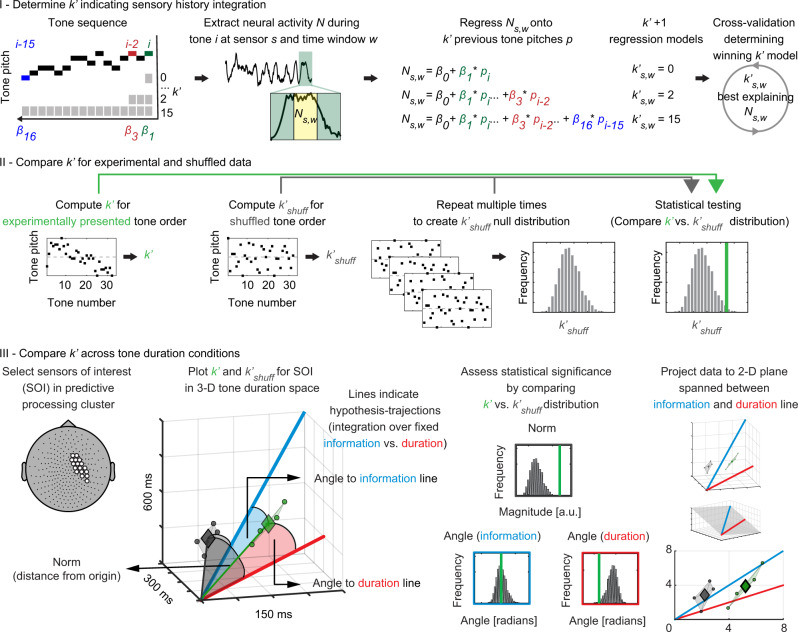
Prediction of future sensory input based on past sensory information is essential for organisms to effectively adapt their behavior in dynamic environments. Humans successfully predict future stimuli in various natural settings. Yet, it remains elusive how the brain achieves effective prediction despite enormous variations in sensory input rate, which directly affect how fast sensory information can accumulate. We presented participants with acoustic sequences capturing temporal statistical regularities prevalent in nature and investigated neural mechanisms underlying predictive computation using MEG. By parametrically manipulating sequence presentation speed, we tested two hypotheses: neural prediction relies on integrating past sensory information over fixed time periods or fixed amounts of information. We demonstrate that across halved and doubled presentation speeds, predictive information in neural activity stems from integration over fixed amounts of information. Our findings reveal the neural mechanisms enabling humans to robustly predict dynamic stimuli in natural environments despite large sensory input rate variations.
基于过去的感觉信息预测未来的感觉输入对于生物体在动态环境中有效适应行为是至关重要的。人类在各种自然环境中成功地预测未来的刺激。然而,尽管感觉输入率有很大的变化,这直接影响了感觉信息的积累速度,大脑如何实现有效的预测仍然难以捉摸。我们向参与者展示了捕捉到自然界中普遍存在的时间统计规律的声学序列,并使用 MEG 研究了预测计算的神经机制。通过参数化地改变序列呈现速度,我们检验了两个假设:神经预测依赖于在固定时间段或固定信息量上整合过去的感觉信息。我们证明,在呈现速度减半和加倍的情况下,神经活动中的预测信息源自固定信息量上的整合。我们的发现揭示了神经机制,使人类能够在自然环境中对动态刺激进行稳健预测,尽管感觉输入率变化很大。