Department of Surgery and Immunobiology and Transplant Science Center, Houston Methodist, Houston, TX, USA.
Department of Laboratory Medicine, State Key Laboratory of Oncology in South China, Collaborative Innovation Center for Cancer Medicine, Sun Yat-sen University Cancer Center, Guangzhou, China.
Nat Commun. 2021 May 11;12(1):2681. doi: 10.1038/s41467-021-23003-4.
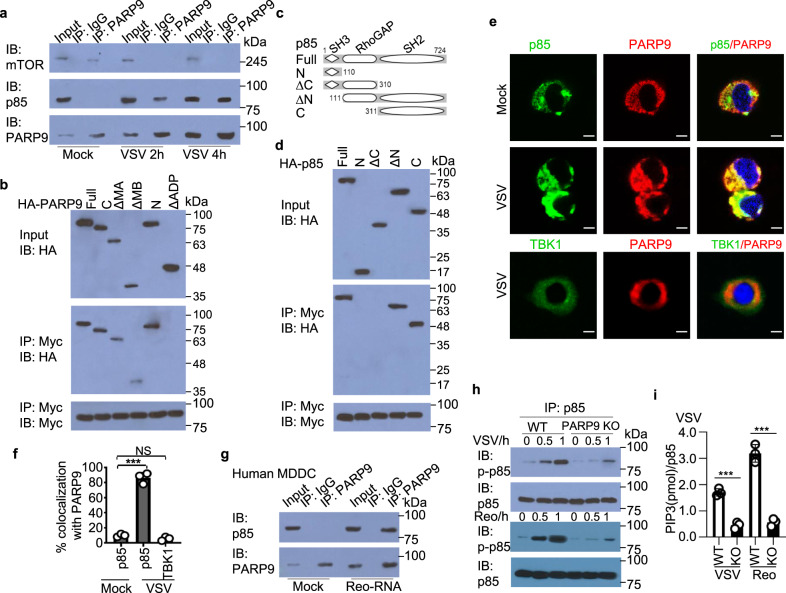
Innate immune cells are critical in protective immunity against viral infections, involved in sensing foreign viral nucleic acids. Here we report that the poly(ADP-ribose) polymerase 9 (PARP9), a member of PARP family, serves as a non-canonical sensor for RNA virus to initiate and amplify type I interferon (IFN) production. We find knockdown or deletion of PARP9 in human or mouse dendritic cells and macrophages inhibits type I IFN production in response to double strand RNA stimulation or RNA virus infection. Furthermore, mice deficient for PARP9 show enhanced susceptibility to infections with RNA viruses because of the impaired type I IFN production. Mechanistically, we show that PARP9 recognizes and binds viral RNA, with resultant recruitment and activation of the phosphoinositide 3-kinase (PI3K) and AKT3 pathway, independent of mitochondrial antiviral-signaling (MAVS). PI3K/AKT3 then activates the IRF3 and IRF7 by phosphorylating IRF3 at Ser385 and IRF7 at Ser437/438 mediating type I IFN production. Together, we reveal a critical role for PARP9 as a non-canonical RNA sensor that depends on the PI3K/AKT3 pathway to produce type I IFN. These findings may have important clinical implications in controlling viral infections and viral-induced diseases by targeting PARP9.
先天免疫细胞在抗病毒感染的保护性免疫中至关重要,它们参与感知外来的病毒核酸。在这里,我们报告多聚(ADP-核糖)聚合酶 9(PARP9),作为 PARP 家族的一员,作为 RNA 病毒的非经典传感器,启动并放大 I 型干扰素(IFN)的产生。我们发现敲低或敲除人源或鼠源树突状细胞和巨噬细胞中的 PARP9,会抑制其对双链 RNA 刺激或 RNA 病毒感染的 I 型 IFN 产生。此外,PARP9 缺陷的小鼠由于 I 型 IFN 产生受损,对 RNA 病毒感染的敏感性增强。在机制上,我们发现 PARP9 识别并结合病毒 RNA,导致磷酸肌醇 3-激酶(PI3K)和 AKT3 途径的募集和激活,这独立于线粒体抗病毒信号(MAVS)。PI3K/AKT3 然后通过磷酸化 IRF3 的 Ser385 和 IRF7 的 Ser437/438 激活 IRF3 和 IRF7,从而介导 I 型 IFN 的产生。总之,我们揭示了 PARP9 作为一种非经典 RNA 传感器的关键作用,该作用依赖于 PI3K/AKT3 途径产生 I 型 IFN。这些发现可能对通过靶向 PARP9 控制病毒感染和病毒诱导的疾病具有重要的临床意义。