Rostro-García Susana, Kamler Jan F, Minge Christin, Caragiulo Anthony, Crouthers Rachel, Groenenberg Milou, Gray Thomas N E, In Visattha, Pin Chanratana, Sovanna Prum, Kéry Marc, Macdonald David W
Department of Zoology Wildlife Conservation Research Unit University of Oxford The Recanati-Kaplan Centre Abingdon United Kingdom.
Institute of Ecology and Evolution Friedrich-Schiller University of Jena Germany.
Ecol Evol. 2021 Mar 30;11(9):4205-4217. doi: 10.1002/ece3.7316. eCollection 2021 May.
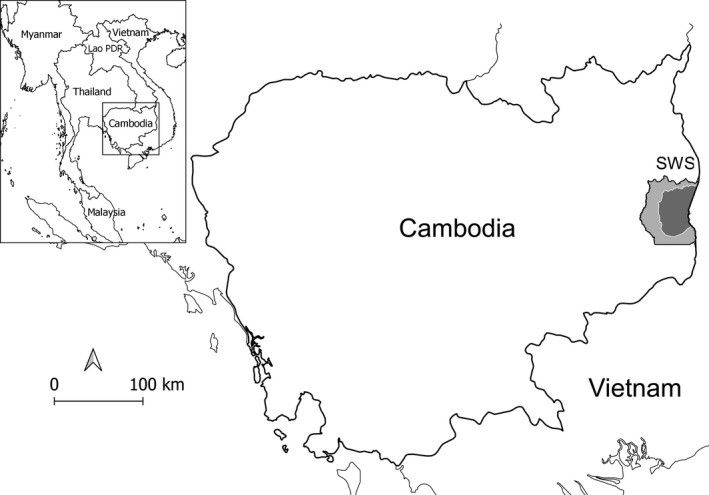
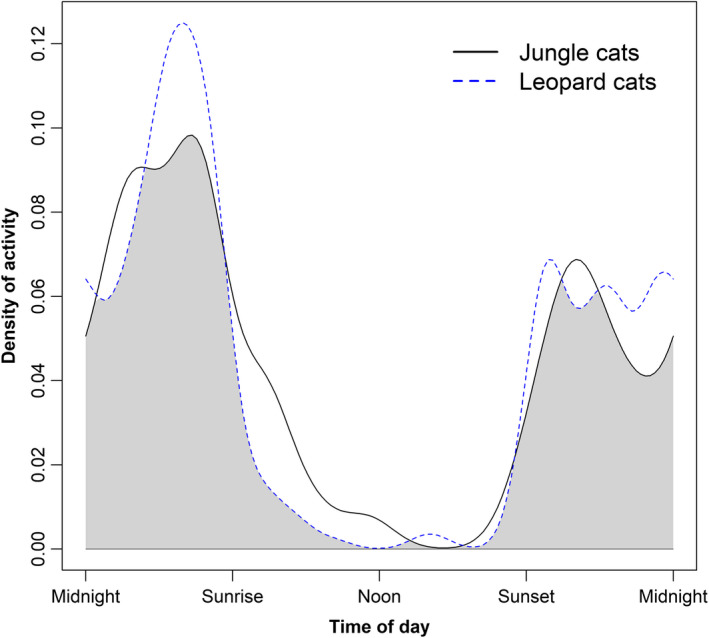
Dry deciduous dipterocarp forests (DDF) cover about 15%-20% of Southeast Asia and are the most threatened forest type in the region. The jungle cat () is a DDF specialist that occurs only in small isolated populations in Southeast Asia. Despite being one of the rarest felids in the region, almost nothing is known about its ecology. We investigated the ecology of jungle cats and their resource partitioning with the more common leopard cats () in a DDF-dominated landscape in Srepok Wildlife Sanctuary, Cambodia. We used camera-trap data collected from 2009 to 2019 and DNA-confirmed scats to determine the temporal, dietary and spatial overlap between jungle cats and leopard cats. The diet of jungle cats was relatively diverse and consisted of murids (56% biomass consumed), sciurids (15%), hares (; 12%), birds (8%), and reptiles (8%), whereas leopard cats had a narrower niche breadth and a diet dominated by smaller prey, primarily murids (73%). Nonetheless, dietary overlap was high because both felid species consumed predominantly small rodents. Both species were primarily nocturnal and had high temporal overlap. Two-species occupancy modelling suggested jungle cats were restricted to DDF and had low occupancy, whereas leopard cats had higher occupancy and were habitat generalists. Our study confirmed that jungle cats are DDF specialists that likely persist in low numbers due to the harsh conditions of the dry season in this habitat, including annual fires and substantial decreases in small vertebrate prey. The lower occupancy and more diverse diet of jungle cats, together with the broader habitat use of leopard cats, likely facilitated the coexistence of these species. The low occupancy of jungle cats in DDF suggests that protection of large areas of DDF will be required for the long-term conservation of this rare felid in Southeast Asia.
干燥落叶龙脑香林(DDF)覆盖了东南亚约15%-20%的面积,是该地区受威胁最严重的森林类型。丛林猫()是一种仅在东南亚小型孤立种群中出现的DDF特化物种。尽管它是该地区最稀有的猫科动物之一,但人们对其生态几乎一无所知。我们在柬埔寨斯雷博克野生动物保护区以DDF为主的景观中,研究了丛林猫的生态以及它们与更常见的豹猫()的资源分配情况。我们使用了2009年至2019年收集的相机陷阱数据和经DNA确认的粪便,来确定丛林猫和豹猫在时间、饮食和空间上的重叠情况。丛林猫的饮食相对多样,包括鼠类(消耗生物量的56%)、松鼠(15%)、野兔(;12%)、鸟类(8%)和爬行动物(8%),而豹猫的生态位宽度较窄,饮食以较小的猎物为主,主要是鼠类(73%)。尽管如此,由于两种猫科动物都主要捕食小型啮齿动物,所以饮食重叠度很高。两种物种主要在夜间活动,时间重叠度高。两种物种的占有率模型表明,丛林猫仅限于DDF且占有率低,而豹猫占有率较高且是栖息地泛化种。我们的研究证实,丛林猫是DDF特化物种,由于该栖息地旱季的恶劣条件,包括每年的火灾和小型脊椎动物猎物的大量减少,其数量可能持续处于低位。丛林猫较低的占有率和更多样化的饮食,以及豹猫更广泛的栖息地利用,可能促进了这些物种的共存。丛林猫在DDF中的低占有率表明,为了长期保护东南亚这种珍稀猫科动物,需要保护大片的DDF。