Metabolic Liver Research Program, I. Department of Medicine, University Medical Centre Mainz, Mainz, Germany.
I. Department of Medicine, University Medical Centre Mainz, Mainz, Germany.
Qual Life Res. 2021 Oct;30(10):2853-2861. doi: 10.1007/s11136-021-02850-0. Epub 2021 May 12.
Autoimmune hepatitis (AIH) is a rare chronic liver disease. Impaired health-related quality of life (HRQL) contributes to the overall disease burden. At current, only limited data related to the impact of treatment response on HRQL are available.
The aim of the study was to determine the impact of biochemical remission on HRQL.
Patients with AIH were prospectively enrolled between July 2018 and June 2019. A liver disease-specific tool, the chronic liver disease questionnaire (CLDQ) and the generic EQ-5D-5L were used to quantify HRQL. Treatment response was assessed biochemically by measurement of immunoglobulin G, ALT and AST. The cohort was divided into two groups according to their biochemical remission status in either complete vs. incomplete remission. Clinical as well as laboratory parameters and comorbidities were analysed using univariable and multivariable analysis to identify predictors of poor HRQL.
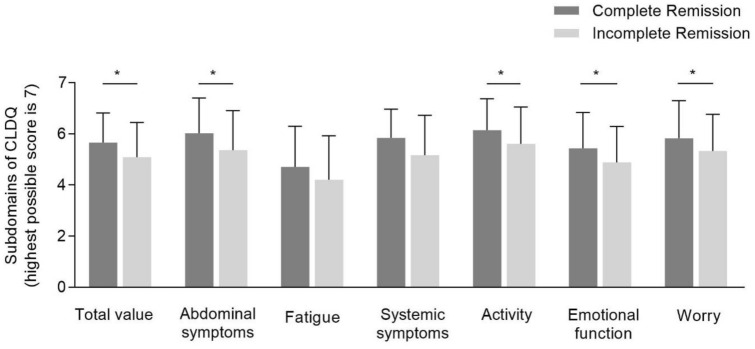
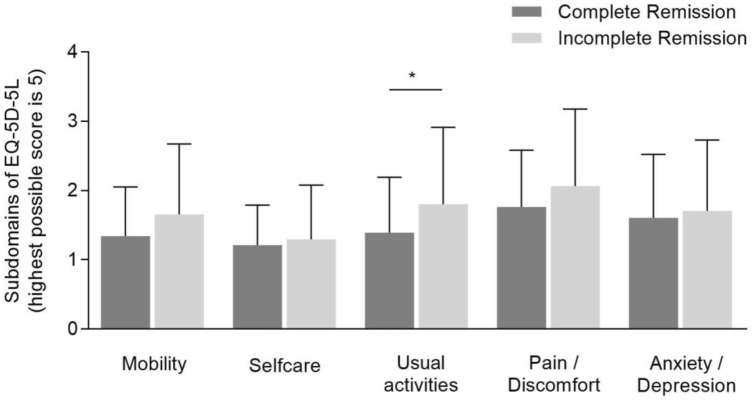
A total of 116 AIH patients were included (median age: 55; 77.6% female), of which 9.5% had liver cirrhosis. In this cohort, 38 (38.4%) showed a complete and 61 (61.6%) an incomplete biochemical remission at study entry. The HRQL was significantly higher in patients with a complete as compared to an incomplete biochemical remission (CLDQ overall score: 5.66 ± 1.15 vs. 5.10 ± 1.35; p = 0.03). In contrast, the generic EQ-5D-5L UI-value was not different between the groups. Multivariable analysis identified AST (p = 0.02) and an incomplete biochemical remission (p = 0.04) as independent predictors of reduced HRQL (CLDQ total value).
Patients with a complete biochemical remission had a significantly higher HRQL. Liver-related quality of life in patients living with AIH is dependent on the response to immunosuppressive treatment.
自身免疫性肝炎(AIH)是一种罕见的慢性肝病。健康相关生活质量(HRQL)受损会增加整体疾病负担。目前,仅有有限的数据涉及治疗反应对 HRQL 的影响。
本研究旨在确定生化缓解对 HRQL 的影响。
2018 年 7 月至 2019 年 6 月期间,前瞻性招募 AIH 患者。采用肝脏疾病特异性工具,即慢性肝病问卷(CLDQ)和通用 EQ-5D-5L 来量化 HRQL。通过免疫球蛋白 G、ALT 和 AST 的测定来评估生化缓解情况。根据生化缓解的完全缓解与不完全缓解,将队列分为两组。使用单变量和多变量分析来分析临床和实验室参数以及合并症,以确定 HRQL 不良的预测因素。
共纳入 116 例 AIH 患者(中位年龄:55 岁;77.6%为女性),其中 9.5%患有肝硬化。在该队列中,38 例(38.4%)患者在研究入组时表现为完全生化缓解,61 例(61.6%)患者表现为不完全生化缓解。与不完全生化缓解相比,完全生化缓解患者的 HRQL 显著更高(CLDQ 总分:5.66±1.15 比 5.10±1.35;p=0.03)。相反,两组之间通用 EQ-5D-5L UI 值没有差异。多变量分析确定 AST(p=0.02)和不完全生化缓解(p=0.04)是 HRQL 降低的独立预测因素(CLDQ 总分)。
完全生化缓解的患者 HRQL 显著更高。自身免疫性肝炎患者的肝脏相关生活质量取决于免疫抑制治疗的反应。