• 文献检索
  • 文档翻译
  • 深度研究
  • 学术资讯
  • Suppr Zotero 插件Zotero 插件
  • 邀请有礼
  • 套餐&价格
  • 历史记录
应用&插件
Suppr Zotero 插件Zotero 插件浏览器插件Mac 客户端Windows 客户端微信小程序
定价
高级版会员购买积分包购买API积分包
服务
文献检索文档翻译深度研究API 文档MCP 服务
关于我们
关于 Suppr公司介绍联系我们用户协议隐私条款
关注我们

Suppr 超能文献

核心技术专利:CN118964589B侵权必究
粤ICP备2023148730 号-1Suppr @ 2026

文献检索

告别复杂PubMed语法,用中文像聊天一样搜索,搜遍4000万医学文献。AI智能推荐,让科研检索更轻松。

立即免费搜索

文件翻译

保留排版,准确专业,支持PDF/Word/PPT等文件格式,支持 12+语言互译。

免费翻译文档

深度研究

AI帮你快速写综述,25分钟生成高质量综述,智能提取关键信息,辅助科研写作。

立即免费体验

1例新型冠状病毒肺炎患者个体化通气的病例报告——流量控制通气需考虑的新可能性和注意事项

A case report of individualized ventilation in a COVID-19 patient - new possibilities and caveats to consider with flow-controlled ventilation.

作者信息

Spraider Patrick, Putzer Gabriel, Breitkopf Robert, Abram Julia, Mathis Simon, Glodny Bernhard, Martini Judith

机构信息

Department of Anaesthesiology and Intensive Care Medicine, Medical University Innsbruck, Innsbruck, Austria.

Department of Radiology, Medical University Innsbruck, Innsbruck, Austria.

出版信息

BMC Anesthesiol. 2021 May 12;21(1):145. doi: 10.1186/s12871-021-01365-y.

DOI:10.1186/s12871-021-01365-y
PMID:33980178
原文链接:https://pmc.ncbi.nlm.nih.gov/articles/PMC8113787/
Abstract

BACKGROUND

Flow-controlled ventilation (FCV) is a novel ventilation method increasingly being used clinically, particularly during the current COVID-19 pandemic. However, the continuous flow pattern in FCV during inspiration and expiration has a significant impact on respiratory parameters and ventilatory settings compared to conventional ventilation modes. In addition, the constant flow combined with direct intratracheal pressure measurement allows determination of dynamic compliance and ventilation settings can be adjusted accordingly, reflecting a personalized ventilation approach.

CASE PRESENTATION

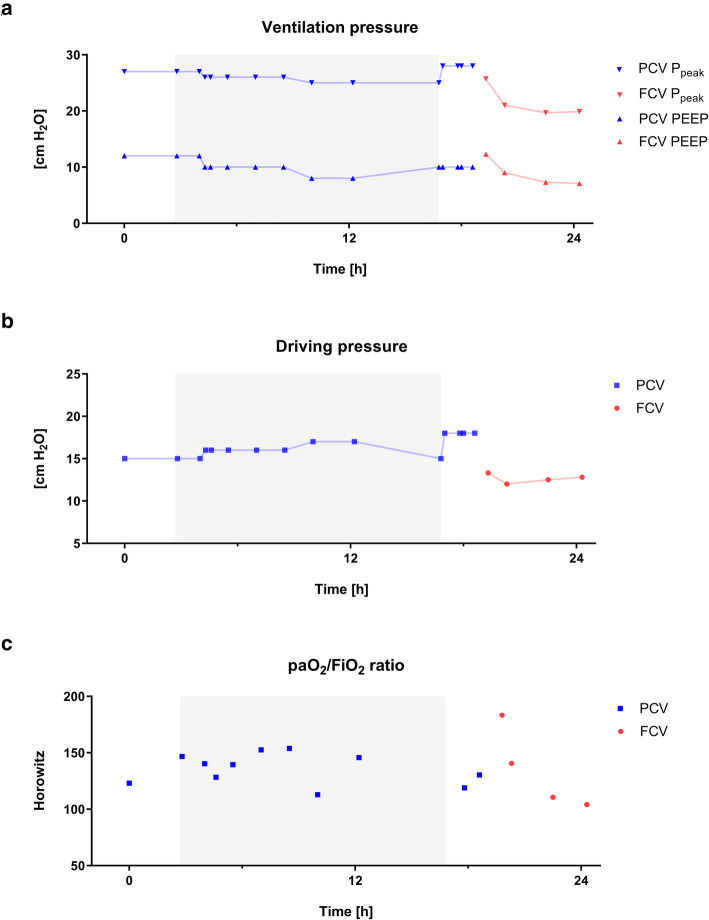
A 50-year old women with confirmed SARS-CoV-2 infection suffering from acute respiratory distress syndrome (ARDS) was admitted to a tertiary medical center. Initial ventilation occurred with best standard of care pressure-controlled ventilation (PCV) and was then switched to FCV, by adopting PCV ventilator settings. This led to an increase in oxygenation by 30 %. Subsequently, to reduce invasiveness of mechanical ventilation, FCV was individualized by dynamic compliance guided adjustment of both, positive end-expiratory pressure and peak pressure; this intervention reduced driving pressure from 18 to 12 cm HO. However, after several hours, compliance further deteriorated which resulted in a tidal volume of only 4.7 ml/kg.

CONCLUSIONS

An individualized FCV approach increased oxygenation parameters in a patient suffering from severe COVID-19 related ARDS. Direct intratracheal pressure measurements allow for determination of dynamic compliance and thus optimization of ventilator settings, thereby reducing applied and dissipated energy. However, although desirable, this personalized ventilation strategy may reach its limits when lung function is so severely impaired that patient's oxygenation has to be ensured at the expense of lung protective ventilation concepts.

摘要

背景

流量控制通气(FCV)是一种临床上越来越常用的新型通气方法,尤其是在当前的新冠疫情期间。然而,与传统通气模式相比,FCV在吸气和呼气过程中的持续气流模式对呼吸参数和通气设置有显著影响。此外,恒定气流与直接气管内压力测量相结合,可以测定动态顺应性,并据此调整通气设置,体现了个性化通气方法。

病例介绍

一名确诊感染严重急性呼吸综合征冠状病毒2(SARS-CoV-2)且患有急性呼吸窘迫综合征(ARDS)的50岁女性被收治入一家三级医疗中心。最初采用最佳标准的压力控制通气(PCV)进行通气,随后通过采用PCV通气设置切换至FCV。这使氧合增加了30%。随后,为降低机械通气的侵入性,通过动态顺应性指导调整呼气末正压和峰值压力,对FCV进行个体化;该干预使驱动压力从18 cm H₂O降至12 cm H₂O。然而,数小时后,顺应性进一步恶化,导致潮气量仅为4.7 ml/kg。

结论

个体化的FCV方法提高了一名患有严重新冠相关ARDS患者的氧合参数。直接气管内压力测量可测定动态顺应性,从而优化通气设置,进而减少施加和耗散的能量。然而,尽管这种个性化通气策略很理想,但当肺功能严重受损以至于必须以牺牲肺保护性通气理念为代价来确保患者氧合时,该策略可能会达到其极限。

https://cdn.ncbi.nlm.nih.gov/pmc/blobs/e626/8114518/337c69005755/12871_2021_1365_Fig3_HTML.jpg
https://cdn.ncbi.nlm.nih.gov/pmc/blobs/e626/8114518/01a20c433994/12871_2021_1365_Fig1_HTML.jpg
https://cdn.ncbi.nlm.nih.gov/pmc/blobs/e626/8114518/d88125db97c8/12871_2021_1365_Fig2_HTML.jpg
https://cdn.ncbi.nlm.nih.gov/pmc/blobs/e626/8114518/337c69005755/12871_2021_1365_Fig3_HTML.jpg
https://cdn.ncbi.nlm.nih.gov/pmc/blobs/e626/8114518/01a20c433994/12871_2021_1365_Fig1_HTML.jpg
https://cdn.ncbi.nlm.nih.gov/pmc/blobs/e626/8114518/d88125db97c8/12871_2021_1365_Fig2_HTML.jpg
https://cdn.ncbi.nlm.nih.gov/pmc/blobs/e626/8114518/337c69005755/12871_2021_1365_Fig3_HTML.jpg

相似文献

1
A case report of individualized ventilation in a COVID-19 patient - new possibilities and caveats to consider with flow-controlled ventilation.1例新型冠状病毒肺炎患者个体化通气的病例报告——流量控制通气需考虑的新可能性和注意事项
BMC Anesthesiol. 2021 May 12;21(1):145. doi: 10.1186/s12871-021-01365-y.
2
Individualized flow-controlled ventilation compared to best clinical practice pressure-controlled ventilation: a prospective randomized porcine study.个体化流量控制通气与最佳临床实践压力控制通气比较:一项前瞻性随机猪研究。
Crit Care. 2020 Nov 25;24(1):662. doi: 10.1186/s13054-020-03325-3.
3
Individualised flow-controlled versus pressure-controlled ventilation in a porcine oleic acid-induced acute respiratory distress syndrome model.个体化流量控制与压力控制通气在猪油酸诱导的急性呼吸窘迫综合征模型中的比较。
Eur J Anaesthesiol. 2023 Jul 1;40(7):511-520. doi: 10.1097/EJA.0000000000001807. Epub 2023 Feb 7.
4
Improved ventilation efficiency due to continuous gas flow compared to decelerating gas flow in mechanical ventilation: results of a porcine trial.与机械通气中的减速气流相比,连续气流可提高通气效率:一项猪试验的结果。
Am J Physiol Lung Cell Mol Physiol. 2023 Jun 1;324(6):L879-L885. doi: 10.1152/ajplung.00235.2022. Epub 2023 May 16.
5
Individualized flow-controlled versus conventional pressure-controlled ventilation in on-pump heart surgery (FLOWVENTIN HEARTSURG): study protocol for a randomized controlled trial.体外循环心脏手术中个体化流量控制与常规压力控制通气(FLOWVENTIN HEARTSURG):一项随机对照试验的研究方案。
Trials. 2023 Mar 16;24(1):195. doi: 10.1186/s13063-023-07201-7.
6
Individualised flow-controlled ventilation versus pressure-controlled ventilation in a porcine model of thoracic surgery requiring one-lung ventilation: A laboratory study.在需要单肺通气的开胸手术猪模型中,个体化流量控制通气与压力控制通气的比较:一项实验室研究。
Eur J Anaesthesiol. 2022 Nov 1;39(11):885-894. doi: 10.1097/EJA.0000000000001745. Epub 2022 Sep 21.
7
Flow controlled ventilation in Acute Respiratory Distress Syndrome associated with COVID-19: A structured summary of a study protocol for a randomised controlled trial.COVID-19 相关急性呼吸窘迫综合征的流量控制通气:一项随机对照试验研究方案的结构化总结。
Trials. 2020 Sep 11;21(1):781. doi: 10.1186/s13063-020-04708-1.
8
Longitudinal changes in compliance, oxygenation and ventilatory ratio in COVID-19 versus non-COVID-19 pulmonary acute respiratory distress syndrome.COVID-19 与非 COVID-19 性急性呼吸窘迫综合征患者顺应性、氧合和通气比值的纵向变化。
Crit Care. 2021 Jul 15;25(1):248. doi: 10.1186/s13054-021-03665-8.
9
Effect of Driving Pressure Change During Extracorporeal Membrane Oxygenation in Adults With Acute Respiratory Distress Syndrome: A Randomized Crossover Physiologic Study.体外膜肺氧合期间成人急性呼吸窘迫综合征驱动压变化的影响:一项随机交叉生理研究。
Crit Care Med. 2020 Dec;48(12):1771-1778. doi: 10.1097/CCM.0000000000004637.
10
Continuous estimation of respiratory system compliance and airway resistance during pressure-controlled ventilation without end-inspiration occlusion.在不进行吸气末阻断的压力控制通气期间连续估计呼吸系统顺应性和气道阻力。
BMC Pulm Med. 2024 May 20;24(1):249. doi: 10.1186/s12890-024-03061-2.

引用本文的文献

1
Individualised flow-controlled ventilation reduces applied mechanical power and improves ventilation efficiency in a porcine intra-abdominal hypertension model.在猪腹腔内高压模型中,个体化流量控制通气可降低施加的机械功率并提高通气效率。
Intensive Care Med Exp. 2024 Mar 7;12(1):27. doi: 10.1186/s40635-024-00608-9.
2
Airway management during unusual tracheal stenosis: A clinical feasibility trial.特殊气管狭窄时的气道管理:一项临床可行性试验。
Laryngoscope Investig Otolaryngol. 2023 Sep 2;8(5):1169-1177. doi: 10.1002/lio2.1151. eCollection 2023 Oct.
3
A new perspective during laryngo-tracheal surgery: the use of an ultra-thin endotracheal tube (Tritube®) and flow-controlled ventilation-a retrospective case series and a review of the literature.

本文引用的文献

1
Pressure Measurements in Flow-Controlled Ventilation.流量控制通气中的压力测量
Crit Care Med. 2020 Dec;48(12):e1359-e1360. doi: 10.1097/CCM.0000000000004561.
2
Individualized flow-controlled ventilation compared to best clinical practice pressure-controlled ventilation: a prospective randomized porcine study.个体化流量控制通气与最佳临床实践压力控制通气比较:一项前瞻性随机猪研究。
Crit Care. 2020 Nov 25;24(1):662. doi: 10.1186/s13054-020-03325-3.
3
Management of COVID-19 Respiratory Distress.新型冠状病毒肺炎呼吸窘迫的管理
喉气管手术的新视角:超薄气管内导管(Tritube®)的应用及流量控制通气——一项回顾性病例系列研究及文献综述
J Anesth Analg Crit Care. 2022 Aug 26;2(1):39. doi: 10.1186/s44158-022-00066-3.
4
Flow-controlled ventilation maintains gas exchange and lung aeration in a pediatric model of healthy and injured lungs: A randomized cross-over experimental study.在健康和受伤肺部的儿科模型中,流量控制通气维持气体交换和肺通气:一项随机交叉实验研究。
Front Pediatr. 2022 Sep 9;10:1005135. doi: 10.3389/fped.2022.1005135. eCollection 2022.
JAMA. 2020 Jun 9;323(22):2329-2330. doi: 10.1001/jama.2020.6825.
4
COVID-19 pneumonia: ARDS or not?新冠肺炎:是否为急性呼吸窘迫综合征?
Crit Care. 2020 Apr 16;24(1):154. doi: 10.1186/s13054-020-02880-z.
5
COVID-19 pneumonia: different respiratory treatments for different phenotypes?新冠肺炎:针对不同表型采用不同的呼吸治疗方法?
Intensive Care Med. 2020 Jun;46(6):1099-1102. doi: 10.1007/s00134-020-06033-2. Epub 2020 Apr 14.
6
Initial ELSO Guidance Document: ECMO for COVID-19 Patients with Severe Cardiopulmonary Failure.最初的体外生命支持组织(ELSO)指导文件:用于患有严重心肺衰竭的COVID-19患者的体外膜肺氧合(ECMO)
ASAIO J. 2020 May;66(5):472-474. doi: 10.1097/MAT.0000000000001173.
7
Surviving Sepsis Campaign: Guidelines on the Management of Critically Ill Adults with Coronavirus Disease 2019 (COVID-19).拯救脓毒症运动:2019 冠状病毒病(COVID-19)危重症成人管理指南。
Crit Care Med. 2020 Jun;48(6):e440-e469. doi: 10.1097/CCM.0000000000004363.
8
Flow-controlled ventilation (FCV) improves regional ventilation in obese patients - a randomized controlled crossover trial.流量控制通气(FCV)改善肥胖患者的区域性通气 - 一项随机对照交叉试验。
BMC Anesthesiol. 2020 Jan 28;20(1):24. doi: 10.1186/s12871-020-0944-y.
9
Flow-Controlled Ventilation Attenuates Lung Injury in a Porcine Model of Acute Respiratory Distress Syndrome: A Preclinical Randomized Controlled Study.流量控制通气减轻急性呼吸窘迫综合征猪模型中的肺损伤:一项临床前随机对照研究。
Crit Care Med. 2020 Mar;48(3):e241-e248. doi: 10.1097/CCM.0000000000004209.
10
Flow-controlled ventilation improves gas exchange in lung-healthy patients- a randomized interventional cross-over study.流量控制通气改善健康肺患者的气体交换:一项随机干预交叉研究。
Acta Anaesthesiol Scand. 2020 Apr;64(4):481-488. doi: 10.1111/aas.13526. Epub 2019 Dec 30.