Department of Clinical Neuroscience, Karolinska Insitutet, Nobels väg 9, 17177, Stockholm, Sweden.
Department of Neuroradiology, Karolinska University Hospital, Stockholm, Sweden.
Mol Brain. 2021 May 12;14(1):81. doi: 10.1186/s13041-021-00789-4.
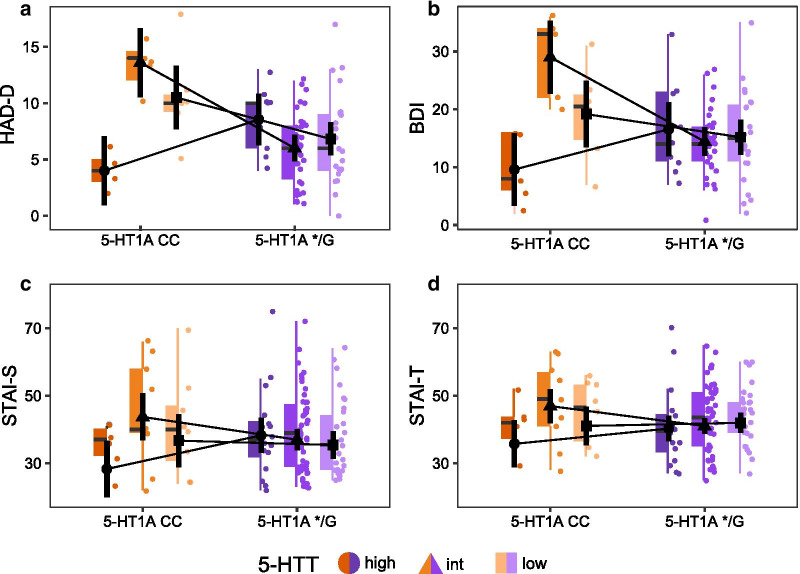
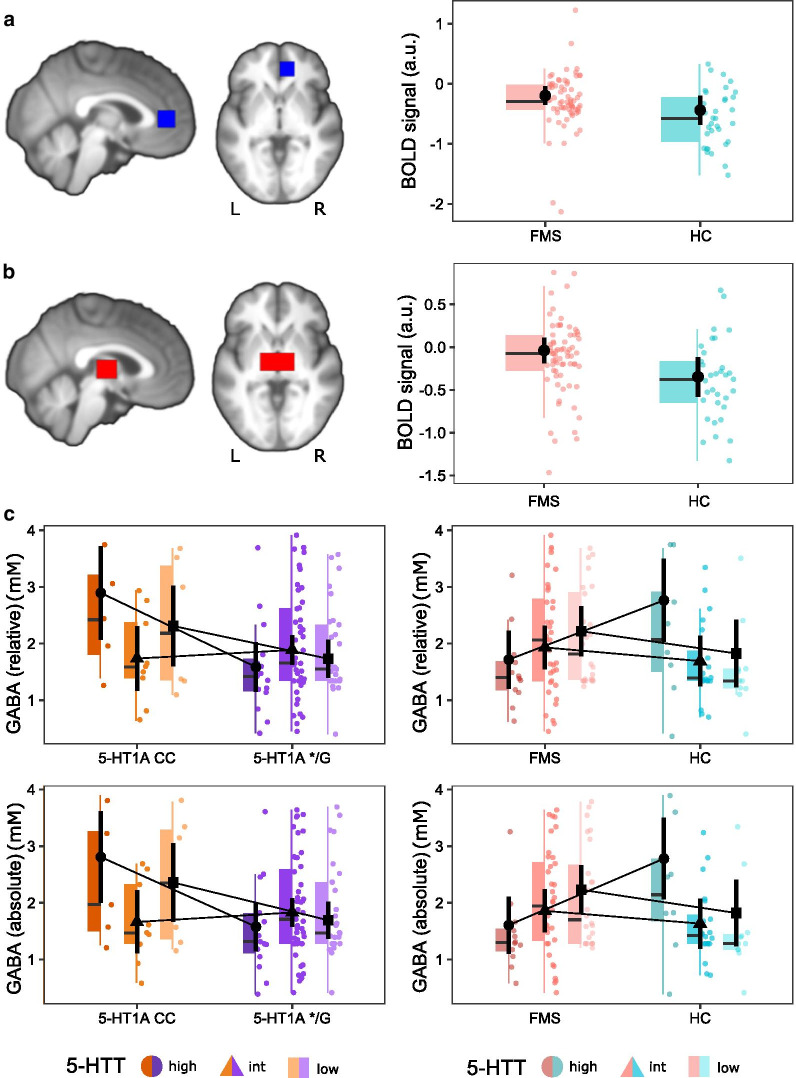
The neurotransmitter serotonin, involved in the regulation of pain and emotion, is critically regulated by the 5-HT autoreceptor and the serotonin transporter (5-HTT). Polymorphisms of these genes affect mood and endogenous pain modulation, both demonstrated to be altered in fibromyalgia subjects (FMS). Here, we tested the effects of genetic variants of the 5-HT receptor (CC/G-carriers) and 5-HTT (high/intermediate/low expression) on mood, pain sensitivity, cerebral processing of evoked pain (functional MRI) and concentrations of GABA and glutamate (MR spectroscopy) in rostral anterior cingulate cortex (rACC) and thalamus in FMS and healthy controls (HC). Interactions between serotonin-relevant genes were found in affective characteristics, with genetically inferred high serotonergic signalling (5-HT CC/5-HTT genotypes) being more favourable across groups. Additionally, 5-HT CC homozygotes displayed higher pain thresholds than G-carriers in HC but not in FMS. Cerebral processing of evoked pressure pain differed between groups in thalamus with HC showing more deactivation than FMS, but was not influenced by serotonin-relevant genotypes. In thalamus, we observed a 5-HT-by-5-HTT and group-by-5-HTT interaction in GABA concentrations, with the 5-HTT high expressing genotype differing between groups and 5-HT genotypes. No significant effects were seen for glutamate or in rACC. To our knowledge, this is the first report of this serotonergic gene-to-gene interaction associated with mood, both among FMS (depression) and across groups (anxiety). Additionally, our findings provide evidence of an association between the serotonergic system and thalamic GABA concentrations, with individuals possessing genetically inferred high serotonergic signalling exhibiting the highest GABA concentrations, possibly enhancing GABAergic inhibitory effects via 5-HT.
神经递质 5-羟色胺参与疼痛和情绪的调节,其活性受到 5-HT 自身受体和 5-HT 转运体(5-HTT)的严格调控。这些基因的多态性会影响情绪和内源性疼痛调节,这两者在纤维肌痛综合征(FMS)患者中均被证明发生了改变。在这里,我们测试了 5-HT 受体(CC/G-载体)和 5-HTT(高/中/低表达)的遗传变异对 FMS 和健康对照组(HC)中情绪、疼痛敏感性、诱发疼痛的大脑处理(功能磁共振成像)以及额前扣带回皮质(rACC)和丘脑中的 GABA 和谷氨酸浓度(磁共振波谱)的影响。在情感特征中发现了与 5-羟色胺相关的基因相互作用,具有遗传推断的高 5-羟色胺信号(5-HT CC/5-HTT 基因型)在所有组中都更为有利。此外,在 HC 中,5-HT CC 纯合子的疼痛阈值高于 G-载体携带者,但在 FMS 中则不然。在丘脑,我们观察到群体间诱发压痛的大脑处理存在 5-HT-5-HTT 和组间-5-HTT 相互作用,与 HC 相比,FMS 表现出更多的去激活,但不受 5-羟色胺相关基因型的影响。在丘脑,我们观察到 GABA 浓度存在 5-HT-5-HTT 和组间-5-HTT 相互作用,5-HTT 高表达基因型在组间存在差异,而 5-HT 基因型则不存在。对于谷氨酸或 rACC,没有观察到显著影响。据我们所知,这是首次报道这种与情绪相关的 5-羟色胺基因-基因相互作用,既存在于 FMS(抑郁)中,也存在于组间(焦虑)中。此外,我们的研究结果提供了证据表明 5-羟色胺系统与丘脑 GABA 浓度之间存在关联,具有遗传推断的高 5-羟色胺信号的个体表现出最高的 GABA 浓度,可能通过 5-HT 增强 GABA 能抑制作用。