Department of Emergency Medicine, Korea University Ansan Hospital, Ansan, Republic of Korea.
Division of Infectious Diseases, Department of Internal Medicine, Korea University Ansan Hospital, Ansan, Republic of Korea.
Sci Rep. 2021 May 12;11(1):10066. doi: 10.1038/s41598-021-89548-y.
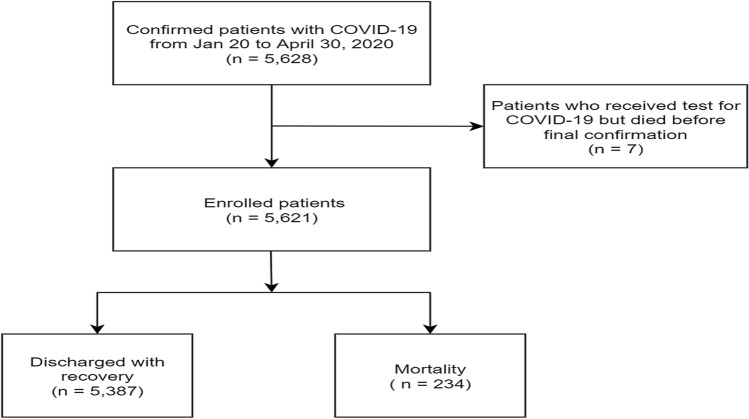
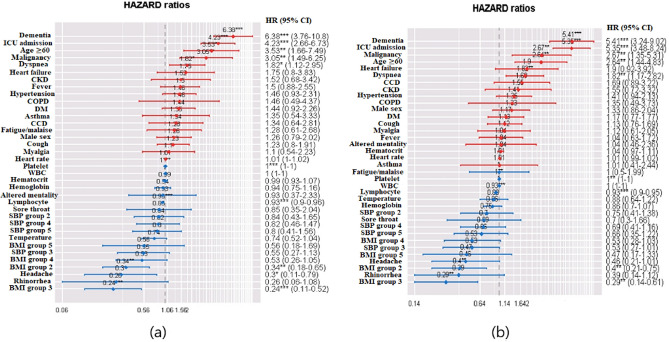
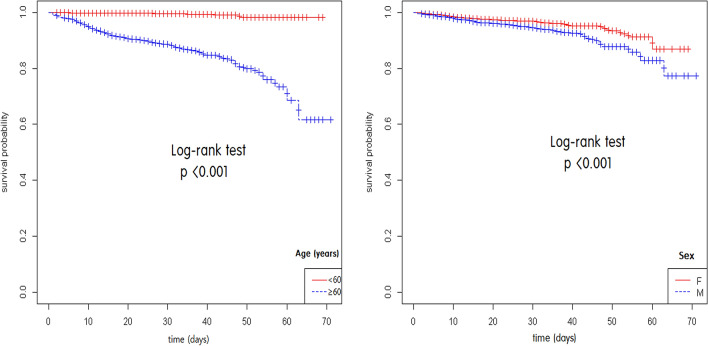
We investigated association between epidemiological and clinical characteristics of coronavirus disease 2019 (COVID-19) patients and clinical outcomes in Korea. This nationwide retrospective cohort study included 5621 discharged patients with COVID-19, extracted from the Korea Disease Control and Prevention Agency (KDCA) database. We compared clinical data between survivors (n = 5387) and non-survivors (n = 234). We used logistic regression analysis and Cox proportional hazards model to explore risk factors of death and fatal adverse outcomes. Increased odds ratio (OR) of mortality occurred with age (≥ 60 years) [OR 11.685, 95% confidence interval (CI) 4.655-34.150, p < 0.001], isolation period, dyspnoea, altered mentality, diabetes, malignancy, dementia, and intensive care unit (ICU) admission. The multivariable regression equation including all potential variables predicted mortality (AUC = 0.979, 95% CI 0.964-0.993). Cox proportional hazards model showed increasing hazard ratio (HR) of mortality with dementia (HR 6.376, 95% CI 3.736-10.802, p < 0.001), ICU admission (HR 4.233, 95% CI 2.661-6.734, p < 0.001), age ≥ 60 years (HR 3.530, 95% CI 1.664-7.485, p = 0.001), malignancy (HR 3.054, 95% CI 1.494-6.245, p = 0.002), and dyspnoea (HR 1.823, 95% CI 1.125-2.954, p = 0.015). Presence of dementia, ICU admission, age ≥ 60 years, malignancy, and dyspnoea could help clinicians identify COVID-19 patients with poor prognosis.
我们研究了 2019 年冠状病毒病 (COVID-19) 患者的流行病学和临床特征与临床结局之间的关系,并在韩国进行了全国性回顾性队列研究。本研究从韩国疾病控制与预防署 (KDCA) 数据库中提取了 5621 名出院的 COVID-19 患者,将其作为研究对象。我们比较了幸存者(n=5387)和非幸存者(n=234)的临床数据。我们使用逻辑回归分析和 Cox 比例风险模型来探讨死亡和致命不良结局的危险因素。死亡率的优势比(OR)随着年龄(≥60 岁)[OR 11.685,95%置信区间(CI)4.655-34.150,p<0.001]、隔离期、呼吸困难、意识改变、糖尿病、恶性肿瘤、痴呆和重症监护病房(ICU)入院而增加。包含所有潜在变量的多变量回归方程预测死亡率(AUC=0.979,95%CI 0.964-0.993)。Cox 比例风险模型显示,痴呆(HR 6.376,95%CI 3.736-10.802,p<0.001)、ICU 入院(HR 4.233,95%CI 2.661-6.734,p<0.001)、年龄≥60 岁(HR 3.530,95%CI 1.664-7.485,p=0.001)、恶性肿瘤(HR 3.054,95%CI 1.494-6.245,p=0.002)和呼吸困难(HR 1.823,95%CI 1.125-2.954,p=0.015)的 HR 值增加与死亡率相关。痴呆、ICU 入院、年龄≥60 岁、恶性肿瘤和呼吸困难的存在有助于临床医生识别 COVID-19 预后不良的患者。