Department of Internal Medicine, School of Medicine, Kyungpook National University, Daegu, Korea.
Daegu Medical Center, Daegu, Korea.
J Korean Med Sci. 2021 Jan 4;36(1):e12. doi: 10.3346/jkms.2021.36.e12.
A coronavirus disease 2019 (COVID-19) outbreak started in February 2020 and was controlled at the end of March 2020 in Daegu, the epicenter of the coronavirus outbreak in Korea. The aim of this study was to describe the clinical course and outcomes of patients with COVID-19 in Daegu.
In collaboration with Daegu Metropolitan City and Korean Center for Diseases Control, we conducted a retrospective, multicenter cohort study. Demographic, clinical, treatment, and laboratory data, including viral RNA detection, were obtained from the electronic medical records and cohort database and compared between survivors and non-survivors. We used univariate and multi-variable logistic regression methods and Cox regression model and performed Kaplan-Meier analysis to determine the risk factors associated with the 28-day mortality and release from isolation among the patients.
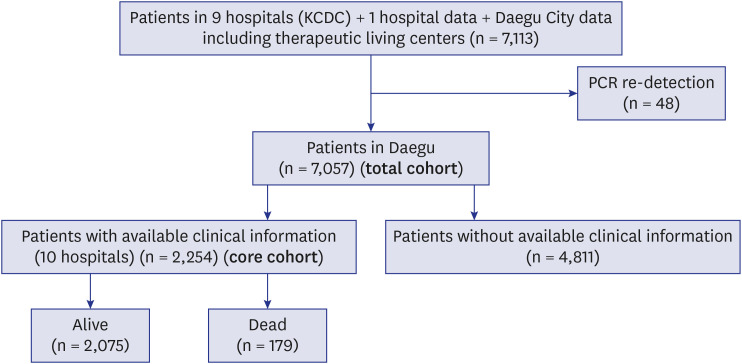
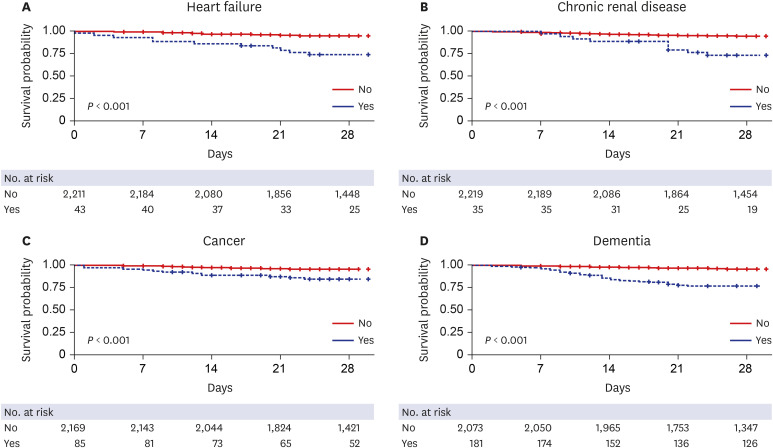
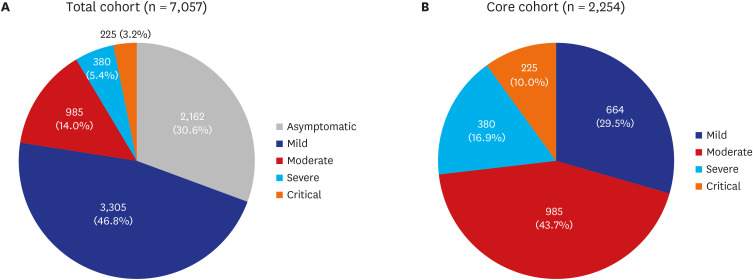
In this study, 7,057 laboratory-confirmed patients with COVID-19 (total cohort) who had been diagnosed from February 18 to July 10, 2020 were included. Of the total cohort, 5,467 were asymptomatic to mild patients (77.4%) (asymptomatic 30.6% and mild 46.8%), 985 moderate (14.0%), 380 severe (5.4%), and 225 critical (3.2%). The mortality of the patients was 2.5% (179/7,057). The Cox regression hazard model for the patients with available clinical information (core cohort) (n = 2,254) showed the risk factors for 28-day mortality: age > 70 (hazard ratio [HR], 4.219, = 0.002), need for O₂ supply at admission (HR, 2.995; = 0.001), fever (> 37.5°C) (HR, 2.808; = 0.001), diabetes (HR, 2.119; = 0.008), cancer (HR, 3.043; = 0.011), dementia (HR, 5.252; = 0.008), neurological disease (HR, 2.084; = 0.039), heart failure (HR, 3.234; = 0.012), and hypertension (HR, 2.160; = 0.017). The median duration for release from isolation was 33 days (interquartile range, 24.0-46.0) in survivors. The Cox proportional hazard model for the long duration of isolation included severity, age > 70, and dementia.
Overall, asymptomatic to mild patients were approximately 77% of the total cohort (asymptomatic, 30.6%). The case fatality rate was 2.5%. Risk factors, including older age, need for O₂ supply, dementia, and neurological disorder at admission, could help clinicians to identify COVID-19 patients with poor prognosis at an early stage.
2020 年 2 月,新型冠状病毒疾病(COVID-19)疫情爆发,3 月底在韩国冠状病毒疫情中心大邱得到控制。本研究旨在描述大邱 COVID-19 患者的临床过程和结局。
我们与大邱市和韩国疾病控制中心合作,进行了一项回顾性、多中心队列研究。从电子病历和队列数据库中获得了人口统计学、临床、治疗和实验室数据,包括病毒 RNA 检测,并比较了幸存者和非幸存者之间的数据。我们使用单变量和多变量逻辑回归方法和 Cox 回归模型,并进行 Kaplan-Meier 分析,以确定与 28 天死亡率和患者隔离释放相关的风险因素。
本研究共纳入了 2020 年 2 月 18 日至 7 月 10 日确诊的 7057 例经实验室确诊的 COVID-19 患者(总队列)。在总队列中,无症状至轻度患者占 77.4%(无症状 30.6%,轻度 46.8%),中度 14.0%,重度 5.4%,危重 3.2%。患者死亡率为 2.5%(179/7057)。具有可用临床信息的患者(核心队列)(n=2254)的 Cox 回归风险模型显示,28 天死亡率的风险因素为:年龄>70 岁(风险比[HR],4.219,P=0.002),入院时需要供氧(HR,2.995;P=0.001),发热(>37.5°C)(HR,2.808;P=0.001),糖尿病(HR,2.119;P=0.008),癌症(HR,3.043;P=0.011),痴呆(HR,5.252;P=0.008),神经疾病(HR,2.084;P=0.039),心力衰竭(HR,3.234;P=0.012)和高血压(HR,2.160;P=0.017)。幸存者隔离释放的中位时间为 33 天(四分位距,24.0-46.0)。包括严重程度、年龄>70 岁和痴呆在内的隔离时间延长的 Cox 比例风险模型。
总体而言,无症状至轻度患者约占总队列的 77%(无症状 30.6%)。病死率为 2.5%。包括年龄较大、需要供氧、痴呆和入院时的神经障碍在内的风险因素,可以帮助临床医生在早期识别预后不良的 COVID-19 患者。