Almuna Rocío, López-Pérez Andrés M, Sarmiento Rosa E, Suzán Gerardo
ECOS (Ecosystem-Complexity-Society) Laboratory, Center for Local Development (CEDEL), Villarrica Campus Pontificia Universidad Católica de Chile Villarrica Chile.
Centro Regional de Investigación para la Sostenibilidad de la Agricultura y los Territorios Rurales_Ceres Pontificia Universidad Católica de Valparaíso Valparaíso Chile.
Vet Rec Open. 2021 May 5;8(1):e7. doi: 10.1002/vro2.7. eCollection 2021 Dec.
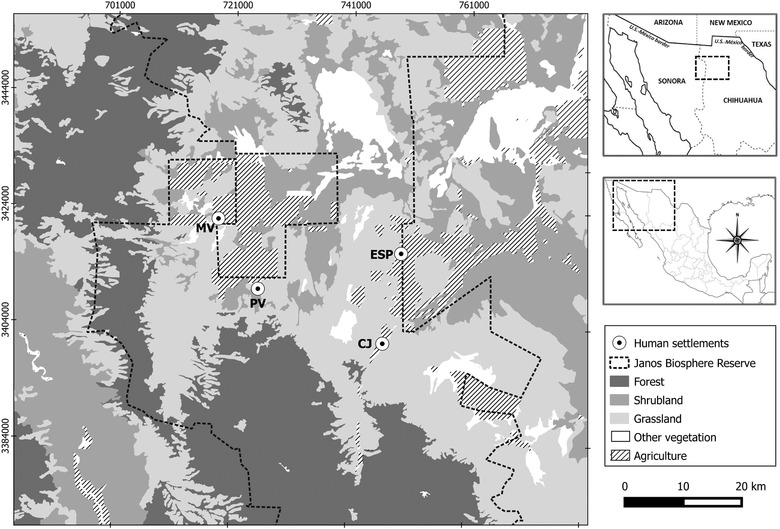
Human population expansion has increased the contact between domestic animals and wildlife, thereby increasing the transmission of infectious diseases including canine distemper virus (CDV). Here, we investigated the risk factors associated with CDV exposure in domestic and wild carnivores from the Janos Biosphere Reserve (JBR), Mexico.
A cross-sectional household questionnaire study was performed in four rural towns to investigate the risk factors associated with the presence of CDV in domestic and wild carnivores from the JBR, Mexico. In addition, we tested serum samples from 70 dogs and three wild carnivores, including one bobcat (Lynx rufus), one striped skunk ( and one gray fox () for CDV antibodies using immunochromatographic and viral neutralization assays.
Overall, 62% of domestic dogs were seropositive for CDV, and the presence of antibodies was significantly higher in free-roaming owned dogs than dogs with restricted movement. Among the wild carnivores, only the bobcat was seropositive. The rate of vaccination against CDV in dogs was low (7%), and there was a high rate of direct interactions between domestic dogs and wild carnivores.
Our serological assays show that CDV is circulating in both domestic dogs and wild carnivores, suggesting cross-species transmission. Our finding of low vaccination rates, high number of unrestrained owned dogs and direct interactions between wildlife and domestic animals reported in the region may be perpetuating the high prevalence of the virus and increasing the risk of CDV transmission between wild and domestic carnivores. Therefore, long-term longitudinal studies are recommended in order to monitor infectious diseases at the domestic-wildlife interface in this highly biodiverse region.
人类人口扩张增加了家畜与野生动物之间的接触,从而增加了包括犬瘟热病毒(CDV)在内的传染病传播。在此,我们调查了墨西哥亚诺斯生物圈保护区(JBR)内家犬和野生食肉动物中与CDV暴露相关的风险因素。
在四个乡村城镇开展了一项横断面家庭问卷调查研究,以调查墨西哥JBR内家犬和野生食肉动物中与CDV存在相关的风险因素。此外,我们使用免疫层析法和病毒中和试验检测了70只家犬和三只野生食肉动物(包括一只短尾猫(Lynx rufus)、一只条纹臭鼬()和一只灰狐())的血清样本中的CDV抗体。
总体而言,62%的家犬CDV血清呈阳性,自由放养的家犬中抗体的存在显著高于活动受限的家犬。在野生食肉动物中,只有短尾猫血清呈阳性。家犬中CDV疫苗接种率较低(7%),家犬与野生食肉动物之间的直接互动率较高。
我们的血清学检测表明,CDV在家犬和野生食肉动物中均有传播,提示存在跨物种传播。我们发现该地区报告的疫苗接种率低、无约束家犬数量多以及野生动物与家畜之间的直接互动可能使病毒的高流行持续存在,并增加了野生和家犬科动物之间CDV传播的风险。因此,建议开展长期纵向研究,以监测这个生物多样性高度丰富地区家畜与野生动物界面的传染病情况。