Lima Shirley Verônica Melo Almeida, de Araújo Karina Conceição Gomes Machado, Nunes Marco Antonio Prado, Nunes Carla
Post-Graduate Program in Health Sciences, Federal University of Sergipe, Brazil.
NOVA National School of Public Health, Universidade NOVA de Lisboa, Portugal.
Heliyon. 2021 Apr 20;7(4):e06788. doi: 10.1016/j.heliyon.2021.e06788. eCollection 2021 Apr.
We characterise the loss to follow-up (locally termed abandoned) of tuberculosis treatment with individual and ecological health determinants and to identify the predictive capacity of these risk factors.
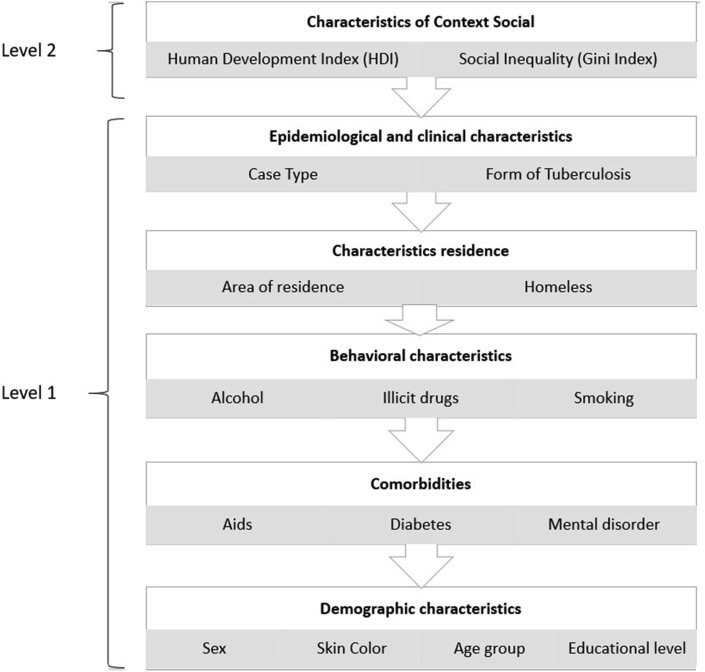
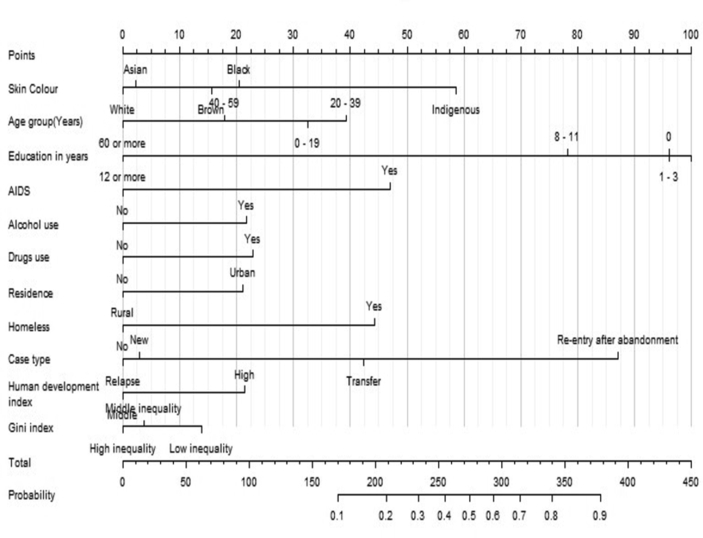
A cohort study with individual and ecological characterisation of patients diagnosed with tuberculosis in Sergipe/Brazil from 2015 to 2018 with either loss to follow-up or completion of treatment as a therapeutic outcome was performed. The examined variables were based on the social determinants of health with descriptive analysis, binary logistic regression, a generalised hierarchical model and graphical presentation using a nomogram.
The loss to follow-up accounted for 18.21% of the 2,449 studied cases. The characteristics revealed that the highest abandonment percentages were people who: were male (20.0%), had black skin colour (20.3%), were aged 20-39 years (21.8%), had 4-7 years of schooling (23.6%), re-entered treatment after abandonment (36.5%), used alcohol (31.0%), used drugs (39.3%), were smokers (26.5%) and were homeless (55.4%). The ecological characteristics showed that individuals living in municipalities with a high human development index (HDI; odds ratio [OR]: 1.91) and high-income inequality (OR: 1.81) had a greater chance of not finishing the treatment. Most of these variables were identified as predictors in the generalised hierarchical model; the receiver operating characteristic curve (ROC) curve had 0.771 precision and 84.0% accuracy.
The group of identified characteristics influenced the loss to follow-up of tuberculosis treatment. This data provides evidence for the early identification of individuals who are at greater risk of abandoning tuberculosis treatment.
我们通过个体和生态健康决定因素来描述结核病治疗失访(当地称为遗弃)情况,并确定这些风险因素的预测能力。
进行了一项队列研究,对2015年至2018年在巴西塞尔希培州被诊断为结核病的患者进行个体和生态特征分析,将治疗失访或完成治疗作为治疗结局。所检查的变量基于健康的社会决定因素,采用描述性分析、二元逻辑回归、广义分层模型以及使用列线图的图形展示。
在2449例研究病例中,失访占18.21%。特征显示,遗弃率最高的人群包括:男性(20.0%)、黑人(20.3%)、年龄在20 - 39岁(21.8%)、受教育4 - 7年(23.6%)、遗弃后重新接受治疗(36.5%)、饮酒者(31.0%)、吸毒者(39.3%)、吸烟者(26.5%)以及无家可归者(55.4%)。生态特征表明,生活在人类发展指数(HDI)高(优势比[OR]:1.91)和收入不平等程度高(OR:1.81)的市的个体未完成治疗的可能性更大。在广义分层模型中,这些变量大多被确定为预测因素;受试者工作特征曲线(ROC)的精度为0.771,准确率为84.0%。
所确定的特征组影响了结核病治疗的失访情况。这些数据为早期识别更有可能遗弃结核病治疗的个体提供了证据。