Program in Health Sciences, Federal University of Sergipe, Brazil Cláudio Batista, s/n, Cidade Nova, Aracaju, SE, 49060-108, Brazil.
Nursing Department, Federal University of Sergipe, Avenida Universitária Marcelo Deda Chagas, 330, Lagarto, SE, 49.400-000, Brazil.
BMC Public Health. 2019 Jul 4;19(1):873. doi: 10.1186/s12889-019-7224-0.
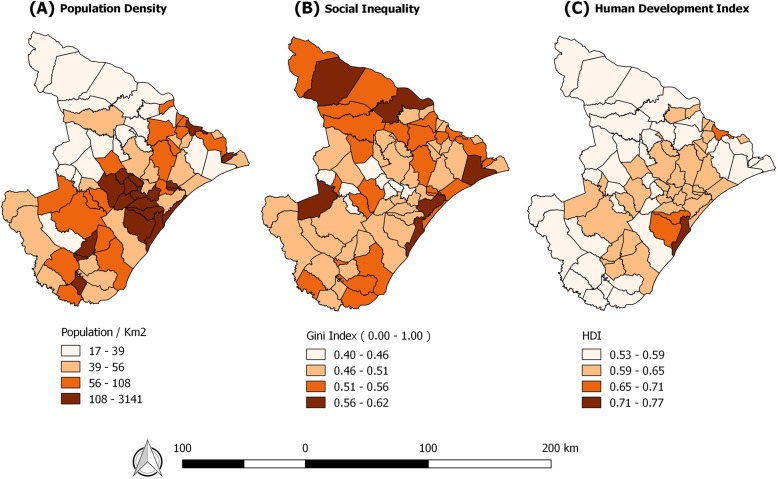
Tuberculosis is an infectious disease caused by Mycobacterium tuberculosis. It is a disease known worldwide for its vulnerability factors, magnitude and mortality. The objective of the study was to analyze the spatial and temporal dynamics of TB in the area of social inequality in northeast Brazil between the years 2001 and 2016.
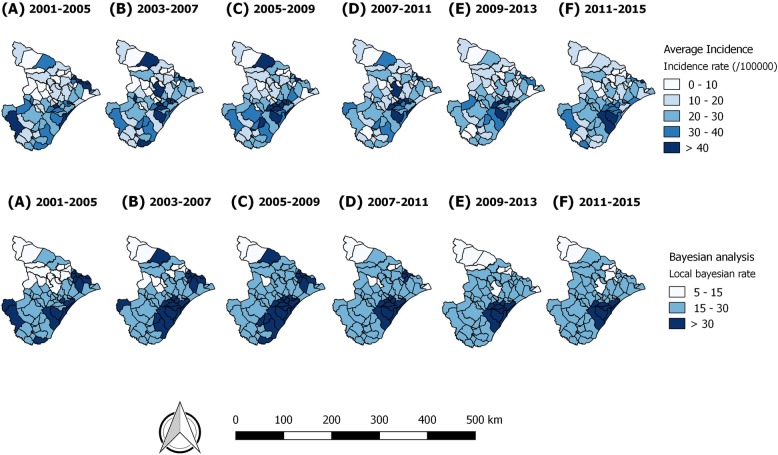
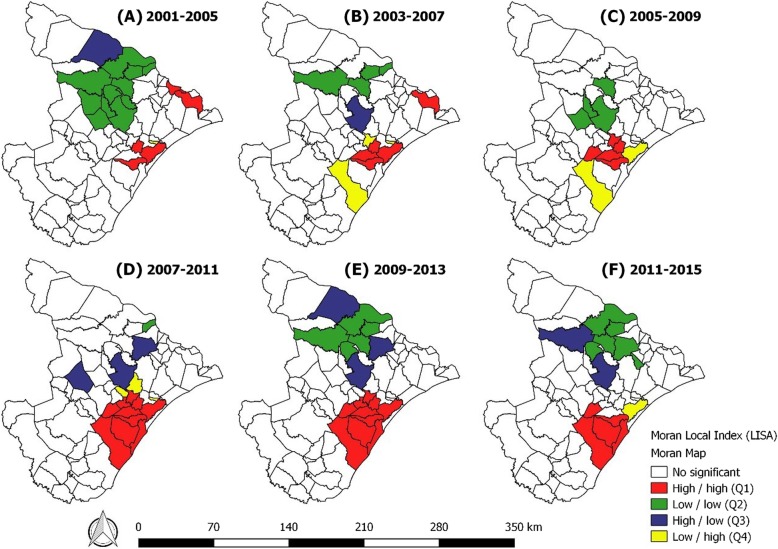
An ecological time series study with the use of spatial analysis techniques was carried out from 2001 to 2016. The units of analysis were the 75 municipalities in the state of Sergipe. Data from the Notification of Injury Information System were used. For the construction of the maps, the cartographic base of the state of Sergipe, obtained at the Instituto Brasileiro de Geografia e Estatística, was used. Georeferenced data were analysed using TerraView 4.2.2 software (Instituto Nacional de Pesquisas Espaciais) and QGis 2.18.2 (Open Source Geospatial Foundation). Spatial analyses included the empirical Bayesian model and the global and local Moran indices. The time trend analyses were performed by the software Joinpoint Regression, Version 4.5.0.1, with the variables of sex, age, cure and abandonment.
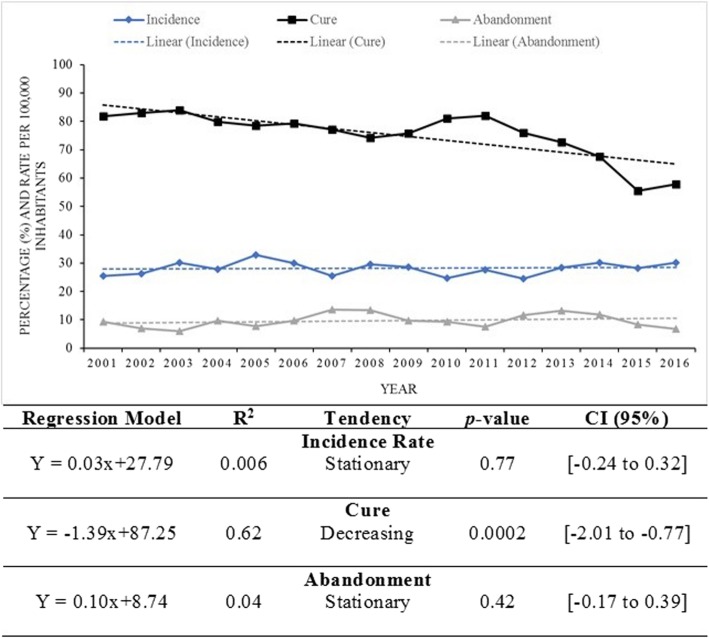
There was an increasing trend of tuberculosis cases in patients under 20 years old and 20-39 years old, especially in males. Cured cases showed a decreasing trend, and cases of treatment withdrawal were stationary. A spatial dependence was observed in almost all analysed territories but with different concentrations. Significant spatial correlations with the formation of clusters in the southeast and northeast of the state were observed. The probability of illness among municipalities was determined not to occur in a random way.
The identification of risk areas and priority groups can help health planning by refining the focus of attention to tuberculosis control. Understanding the epidemiological, spatial and temporal dynamics of tuberculosis can allow for improved targeting of strategies for disease prevention and control.
结核病是由结核分枝杆菌引起的传染病。它是一种在全球范围内因脆弱因素、规模和死亡率而闻名的疾病。本研究的目的是分析 2001 年至 2016 年间巴西东北部社会不平等地区结核病的时空动态。
这是一项利用空间分析技术进行的生态时间序列研究。分析单位是塞尔希培州的 75 个市。使用的是伤害信息系统通报的数据。为了制作地图,使用了巴西地理与统计研究所获得的塞尔希培州制图基础。地理参考数据使用 TerraView 4.2.2 软件(巴西国家空间研究所)和 QGis 2.18.2(开源地理空间基金会)进行分析。空间分析包括经验贝叶斯模型以及全局和局部 Moran 指数。时间趋势分析由 Joinpoint Regression 软件(版本 4.5.0.1)完成,分析的变量包括性别、年龄、治愈和放弃治疗。
20 岁以下和 20-39 岁的结核病患者病例数呈上升趋势,尤其是男性。治愈病例呈下降趋势,放弃治疗病例呈稳定趋势。几乎所有分析的地区都观察到了空间依赖性,但浓度不同。在该州东南部和东北部观察到与聚类形成有关的显著空间相关性。各城市的发病概率似乎并非随机发生。
确定风险地区和重点人群可以帮助卫生规划,将注意力更集中于结核病控制。了解结核病的流行病学、时空动态有助于有针对性地制定疾病预防和控制策略。