Chowdhuri Srijita Paul, Das Benu Brata
Laboratory of Molecular Biology, School of Biological Sciences, Indian Association for the Cultivation of Science, 2A & B, Raja S. C. Mullick Road, Jadavpur, Kolkata 700032, India.
NAR Cancer. 2021 Feb 1;3(1):zcab003. doi: 10.1093/narcan/zcab003. eCollection 2021 Mar.
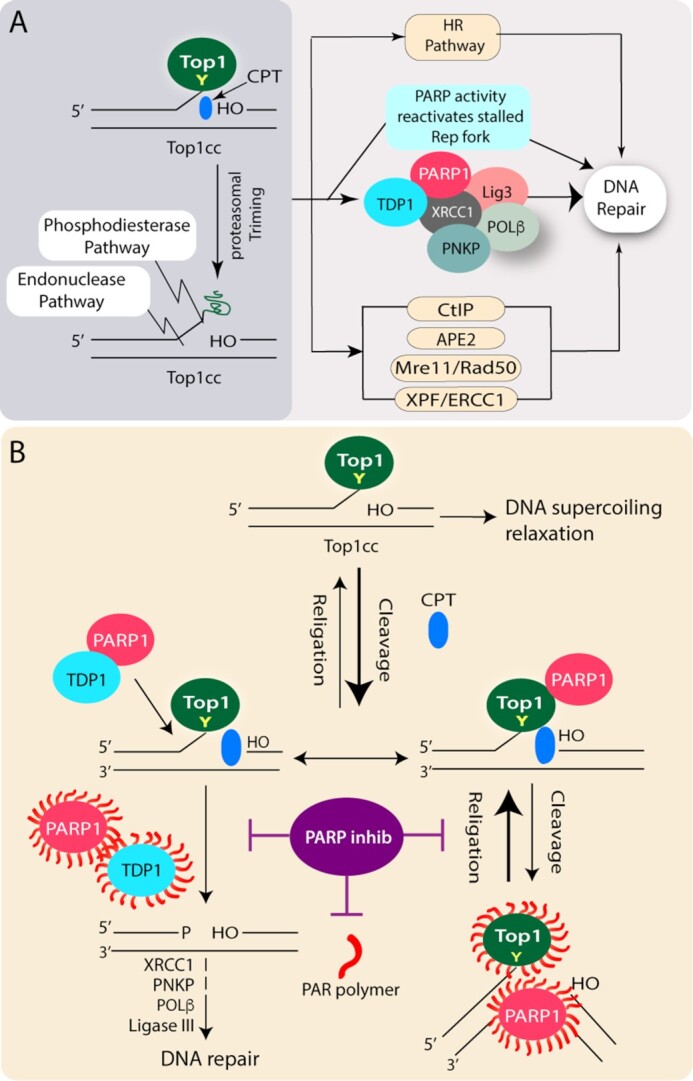
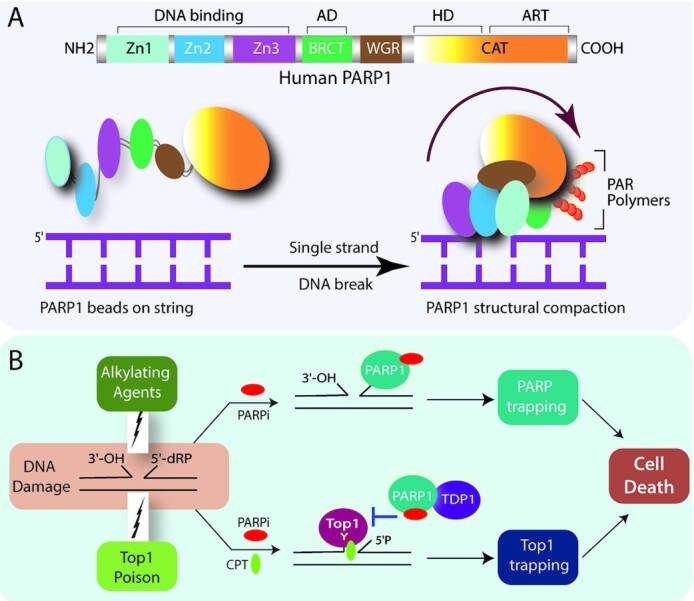
Selective trapping of human topoisomerase 1 (Top1) on the DNA (Top1 cleavage complexes; Top1cc) by specific Top1-poisons triggers DNA breaks and cell death. Poly(ADP-ribose) polymerase 1 (PARP1) is an early nick sensor for trapped Top1cc. New mechanistic insights have been developed in recent years to rationalize the importance of PARP1 beyond the repair of Top1-induced DNA breaks. This review summarizes the progress in the molecular mechanisms of trapped Top1cc-induced DNA damage, PARP1 activation at DNA damage sites, PAR-dependent regulation of Top1 nuclear dynamics, and PARP1-associated molecular network for Top1cc repair. Finally, we have discussed the rationale behind the synergy between the combination of Top1 poison and PARP inhibitors in cancer chemotherapies, which is independent of the 'PARP trapping' phenomenon.
特定的拓扑异构酶1(Top1)毒物将人类拓扑异构酶1(Top1)选择性捕获在DNA上(Top1切割复合物;Top1cc)会引发DNA断裂和细胞死亡。聚(ADP - 核糖)聚合酶1(PARP1)是捕获的Top1cc的早期切口传感器。近年来已形成了新的机制见解,以阐明PARP1除修复Top1诱导的DNA断裂之外的重要性。本综述总结了捕获的Top1cc诱导DNA损伤的分子机制、DNA损伤位点处PARP1的激活、PAR对Top1核动力学的依赖性调节以及用于Top1cc修复的PARP1相关分子网络方面的进展。最后,我们讨论了Top1毒物与PARP抑制剂联合用于癌症化疗时协同作用背后的原理,这种协同作用与“PARP捕获”现象无关。