Department of Critical Care Medicine, Taian Municipal Hospital, Tai'an, Shandong 271000, P.R. China.
Department of Critical Care Medicine, The First Affiliated Hospital of Chengdu Medical College, Chengdu, Sichuan 610500, P.R. China.
Mol Med Rep. 2021 Jul;24(1). doi: 10.3892/mmr.2021.12149. Epub 2021 May 13.
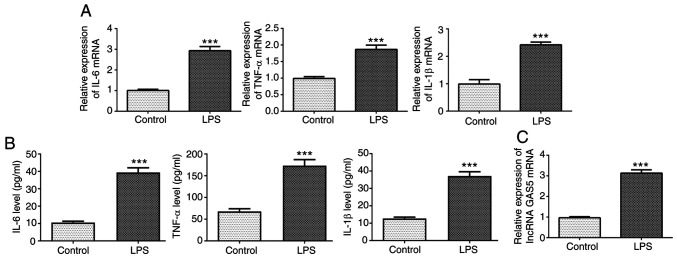
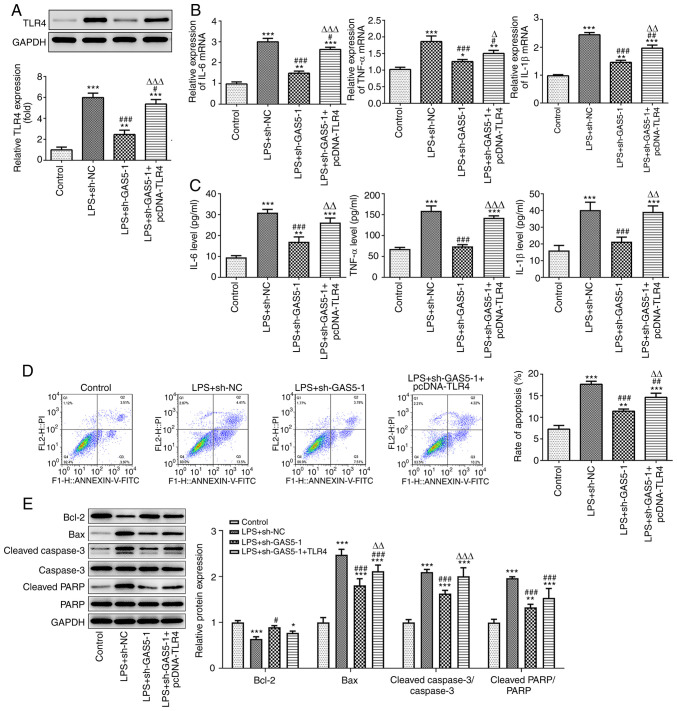
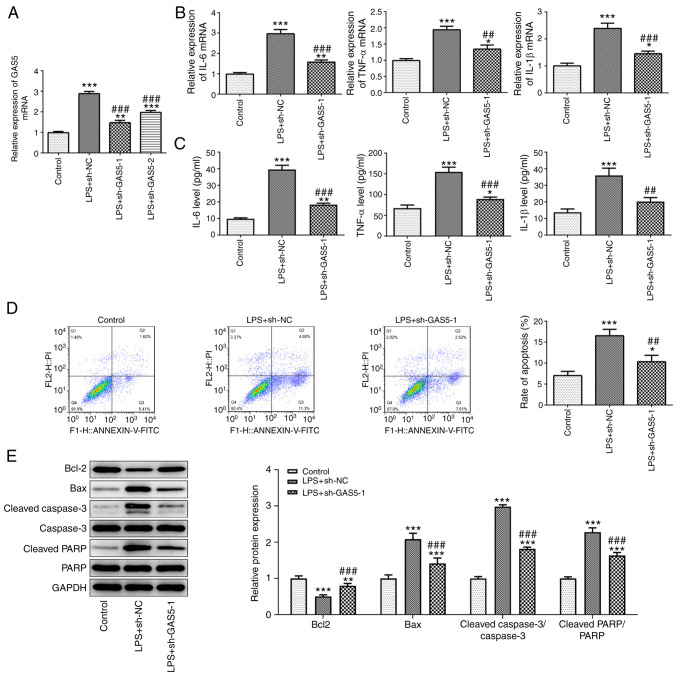
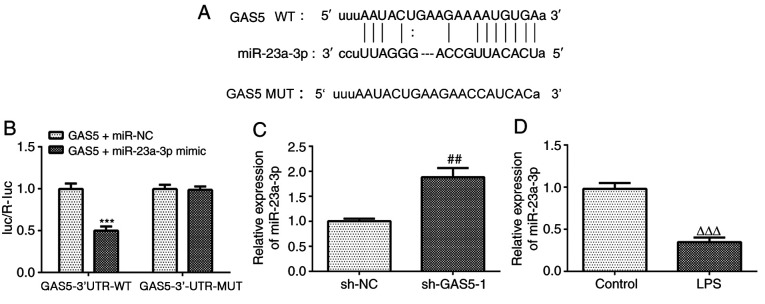
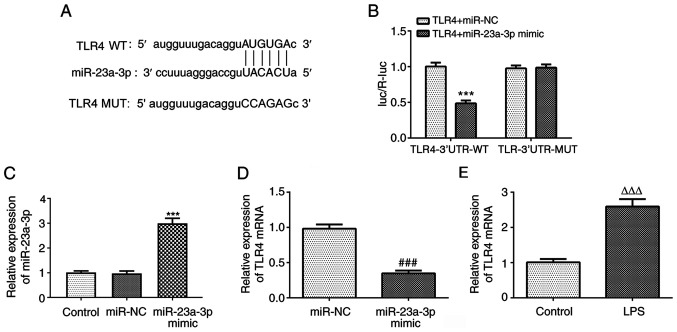
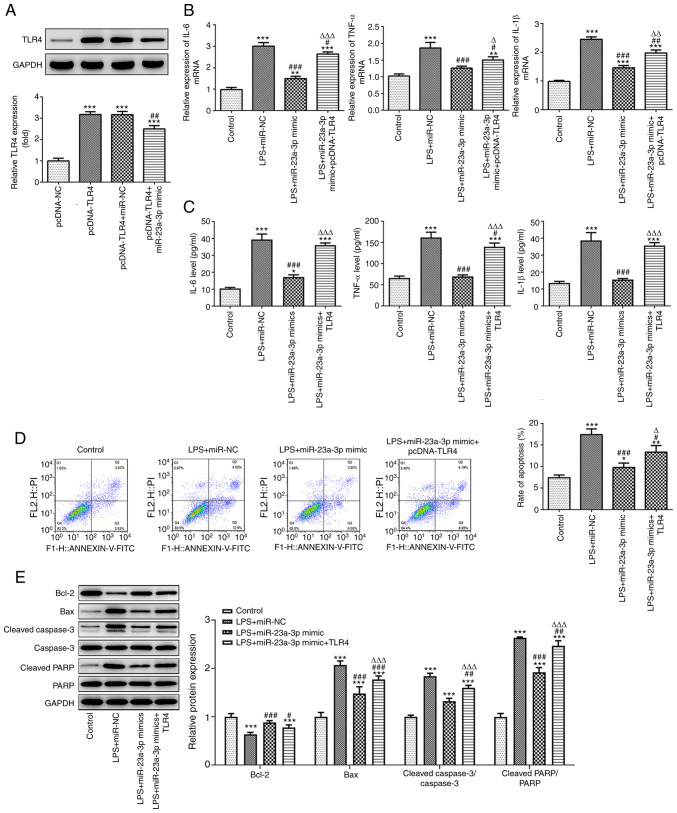
Sepsis is a syndrome characterized by organ dysfunction and an abnormal immune response to infection. A growing body of research has shown the importance of long non‑coding RNAs (lncRNAs) in tumorigenesis, virus replication, inflammatory injury and other pathological processes. The aim of the present study was to explore the role and potential mechanism of the lncRNA growth arrest‑specific 5 (GAS5) in the lipopolysaccharide (LPS)‑induced inflammation and apoptosis of THP‑1 cells. An sepsis model was established by treating THP‑1 cells with LPS. Apoptosis was detected by flow cytometry. The expression levels of IL‑6, IL‑1β and TNF‑α were detected using reverse transcription‑quantitative PCR (RT‑qPCR) and ELISA, and those of GAS5, microRNA (miR)‑23a‑3p and Toll‑like receptor 4 (TLR4) were detected by RT‑qPCR. The changes in the biological activity of THP‑1 cells induced by the silencing of GAS5 and overexpression of miR‑23a‑3p and TLR4 were investigated. The relationships among GAS5, miR‑23a‑3p and TLR4 were analyzed using luciferase reporter assays. The results revealed that LPS increased the expression of GAS5 in THP‑1 cells, and GAS5 knockdown effectively inhibited inflammation and cell apoptosis in the LPS‑induced sepsis model. In addition, the results of the luciferase reporter assays indicated that both GAS5 and TLR4 directly target miR‑23a‑3p. The expression of miR‑23a‑3p was downregulated whereas that of TLR4 was upregulated in the septic cells. Further experiments showed that the overexpression of TLR4 attenuated the suppressive effects of miR‑23a‑3p overexpression and GAS5 knockdown on LPS‑induced inflammation and apoptosis. In conclusion, the present study indicates that GAS5 strengthens LPS‑induced inflammation and apoptosis via the miR‑23a‑3p/TLR4 pathway.
脓毒症是一种以器官功能障碍和对感染的异常免疫反应为特征的综合征。越来越多的研究表明,长非编码 RNA(lncRNA)在肿瘤发生、病毒复制、炎症损伤等病理过程中具有重要作用。本研究旨在探讨 lncRNA 生长停滞特异性 5(GAS5)在脂多糖(LPS)诱导的 THP-1 细胞炎症和凋亡中的作用及潜在机制。通过用 LPS 处理 THP-1 细胞建立脓毒症模型。通过流式细胞术检测细胞凋亡。采用逆转录-定量 PCR(RT-qPCR)和 ELISA 检测白细胞介素-6(IL-6)、白细胞介素-1β(IL-1β)和肿瘤坏死因子-α(TNF-α)的表达水平,采用 RT-qPCR 检测 GAS5、微小 RNA(miR)-23a-3p 和 Toll 样受体 4(TLR4)的表达水平。研究了沉默 GAS5 和过表达 miR-23a-3p 和 TLR4 对 THP-1 细胞生物学活性的影响。采用荧光素酶报告基因检测分析 GAS5、miR-23a-3p 和 TLR4 之间的关系。结果显示,LPS 增加了 THP-1 细胞中 GAS5 的表达,GAS5 敲低可有效抑制 LPS 诱导的脓毒症模型中的炎症和细胞凋亡。此外,荧光素酶报告基因检测结果表明,GAS5 和 TLR4 均可直接靶向 miR-23a-3p。脓毒症细胞中 miR-23a-3p 的表达下调,而 TLR4 的表达上调。进一步的实验表明,TLR4 的过表达减弱了 miR-23a-3p 过表达和 GAS5 敲低对 LPS 诱导的炎症和凋亡的抑制作用。综上所述,本研究表明,GAS5 通过 miR-23a-3p/TLR4 通路增强 LPS 诱导的炎症和凋亡。