Beth Israel Deaconess Medical Center and Harvard Medical School, Boston, Massachusetts, and Harvard College, Cambridge, Massachusetts.
Beth Israel Deaconess Medical Center, Harvard Medical School, Boston, Massachusetts.
Arthritis Rheumatol. 2021 Nov;73(11):2052-2058. doi: 10.1002/art.41787. Epub 2021 Sep 29.
Autoimmune diseases affect women disproportionately more than men. Estrogen is implicated in immune cell dysfunction, yet its precise molecular roles are not fully known. We recently identified new roles for serine/arginine-rich splicing factor 1 (SRSF1) in T cell function and autoimmunity. SRSF1 levels are decreased in T cells from patients with systemic lupus erythematosus (SLE) and are associated with active disease and comorbidity. However, the molecular mechanisms that control SRSF1 expression are unknown. Srsf1 messenger RNA (mRNA) has a long 3'-untranslated region (3'-UTR), suggesting posttranscriptional control. This study was undertaken to investigate the role of estrogen and posttranscriptional mechanisms of SRSF1 regulation in T cells and SLE.
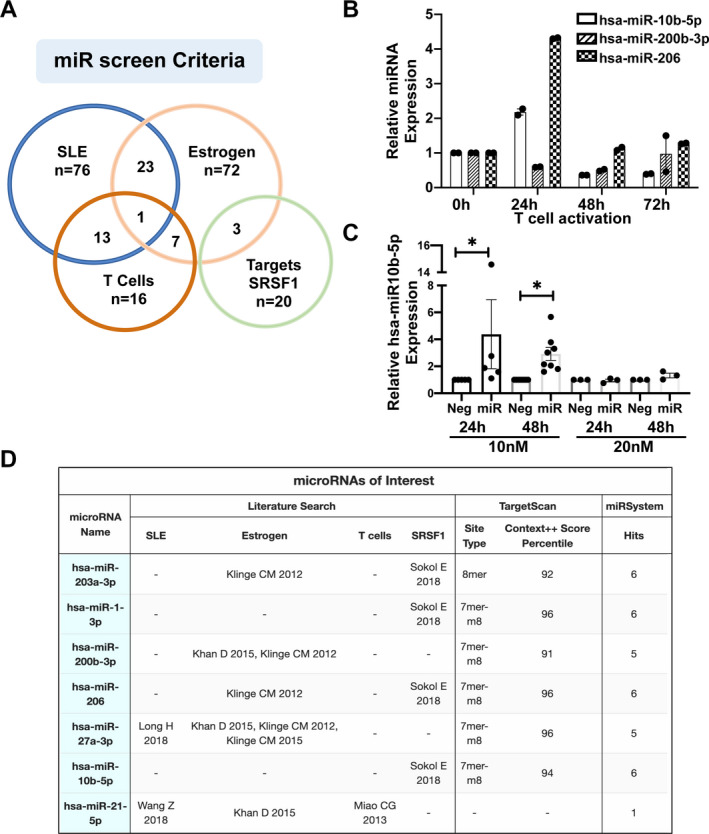
In silico bioinformatics analysis of Srsf1-3'-UTR revealed multiple microRNA (miRNA; miR)-binding sites. Additional screening and literature searches narrowed down hsa-miR-10b-5p for further study. Peripheral blood T cells from healthy individuals and SLE patients were evaluated for mRNA and miRNA expression by quantitative reverse transcription-polymerase chain reaction, and SRSF1 protein levels were assessed by immunoblotting. T cells were cultured with β-estradiol, and transient transfections were used to overexpress miRNAs. Luciferase assays were used to measure 3'-UTR activity.
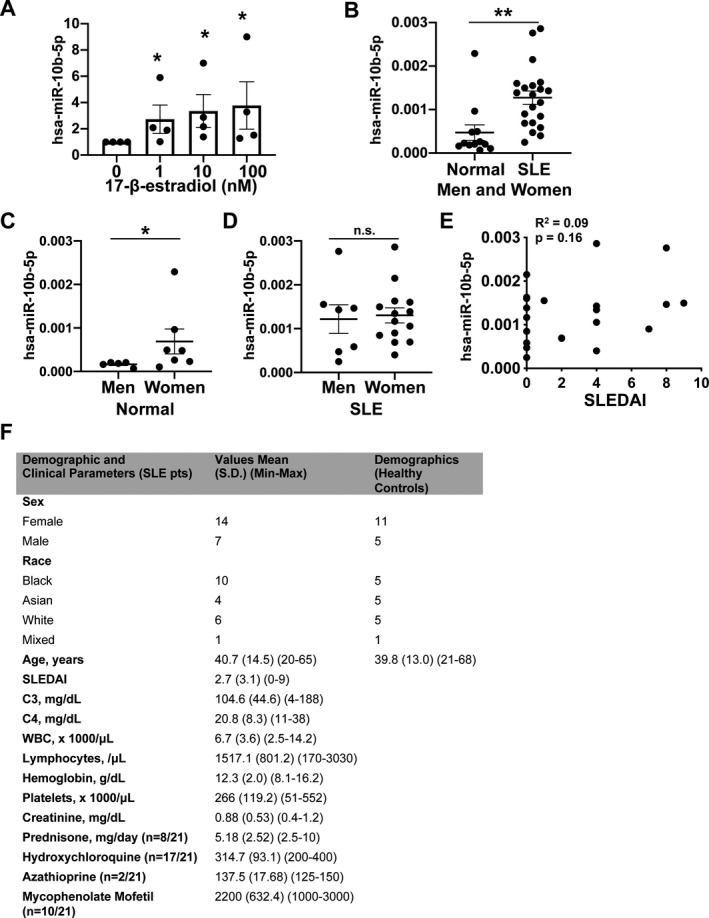
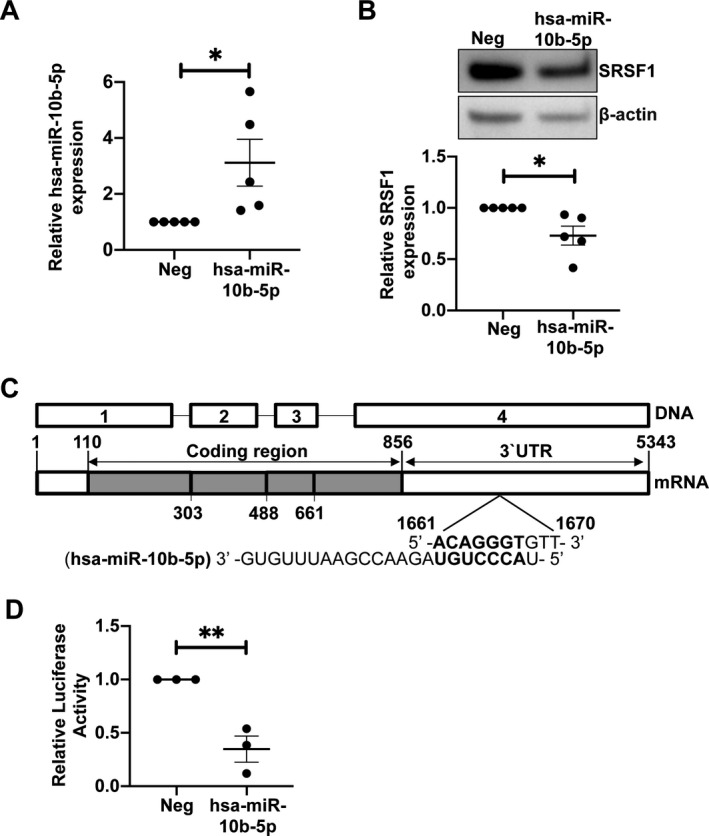
We demonstrated that estrogen increased hsa-miR-10b-5p expression in human T cells, and hsa-miR-10b-5p down-regulated SRSF1 protein expression. Mechanistically, hsa-mir-10b-5p regulated SRSF1 posttranscriptionally via control of its 3'-UTR activity. Importantly, hsa-miR-10b-5p expression levels were elevated in T cells from healthy women compared to healthy men and also elevated in T cells from SLE patients.
We identified a previously unrecognized molecular link between estrogen and gene regulation in immune cells, with potential relevance to systemic autoimmune disease.
自身免疫性疾病对女性的影响明显大于男性。雌激素被认为与免疫细胞功能障碍有关,但它的确切分子作用尚不完全清楚。我们最近发现了丝氨酸/精氨酸丰富的剪接因子 1(SRSF1)在 T 细胞功能和自身免疫中的新作用。系统性红斑狼疮(SLE)患者的 T 细胞中 SRSF1 水平降低,与疾病活动和合并症相关。然而,控制 SRSF1 表达的分子机制尚不清楚。Srsf1 信使 RNA(mRNA)具有长的 3'-非翻译区(3'-UTR),提示存在转录后调控。本研究旨在探讨雌激素和 SRSF1 调节的转录后机制在 T 细胞和 SLE 中的作用。
Srsf1-3'-UTR 的计算机生物信息学分析显示了多个 microRNA(miRNA;miR)结合位点。进一步的筛选和文献检索将 hsa-miR-10b-5p 缩小为进一步研究的对象。通过定量逆转录聚合酶链反应评估健康个体和 SLE 患者的外周血 T 细胞的 mRNA 和 miRNA 表达,并用免疫印迹法评估 SRSF1 蛋白水平。用β-雌二醇培养 T 细胞,并进行瞬时转染以过表达 miRNA。用荧光素酶测定法测量 3'-UTR 活性。
我们证明雌激素增加了人 T 细胞中的 hsa-miR-10b-5p 表达,hsa-miR-10b-5p 下调了 SRSF1 蛋白表达。从机制上讲,hsa-mir-10b-5p 通过控制其 3'-UTR 活性对 SRSF1 进行转录后调控。重要的是,与健康男性相比,健康女性的 T 细胞中 hsa-miR-10b-5p 的表达水平升高,SLE 患者的 T 细胞中也升高。
我们发现了雌激素与免疫细胞中基因调控之间以前未被认识的分子联系,这与系统性自身免疫性疾病有关。