Limb Lengthening and Complex Reconstruction Service, Department of Orthopaedic Surgery, Hospital for Special Surgery, Weill Medical College Cornell University, New York, NY, USA.
Department of Orthopaedic Surgery, Kasr Al-Ainy School of Medicine, Cairo University, Cairo, Egypt.
Arch Orthop Trauma Surg. 2022 Dec;142(12):3555-3561. doi: 10.1007/s00402-021-03943-8. Epub 2021 May 13.
Magnetic internal lengthening nails (MILNs) have been used for femoral lengthening to avoid complications associated with external fixation. The titanium version of the MILN (PRECICE) has been in use since 2011 but had limitations (50-75 lb) in post-operative weight bearing. A new stainless-steel version of the MILN (STRYDE) allows 150-250 lb of post-operative weight bearing. The aim is to compare the outcomes of using these two different MILNs for both unilateral and bilateral femoral lengthening.
A single-center, retrospective cohort study was conducted in which patients' records were reviewed from the period from January 2017 to March 2020. A total of 66 femoral lengthening procedures were included in the study and were divided into two groups: STRYDE group (30 femora) and PRECICE group (36 femora). Outcomes assessed were the 6-months post-operative Limb Deformity-Scoliosis Research Society (LD-SRS) Score, adjacent joint range of motion (ROM), average distraction rate, bone healing index (BHI), and complications.
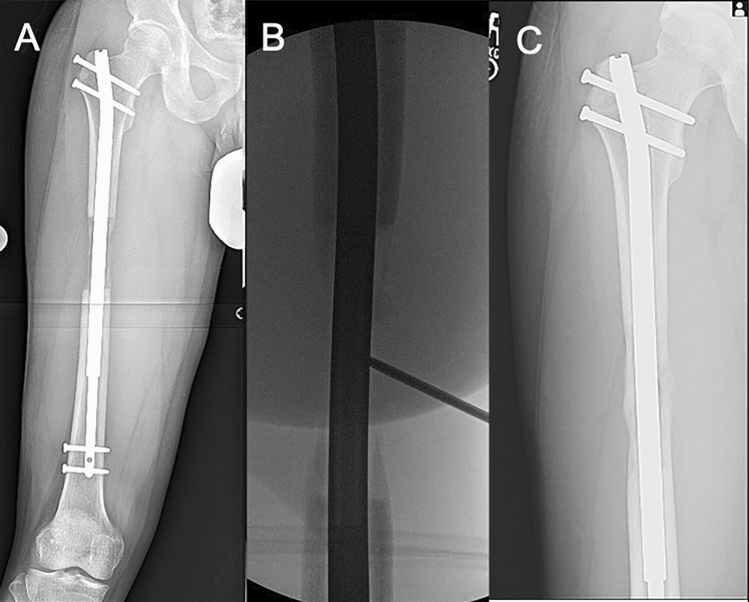
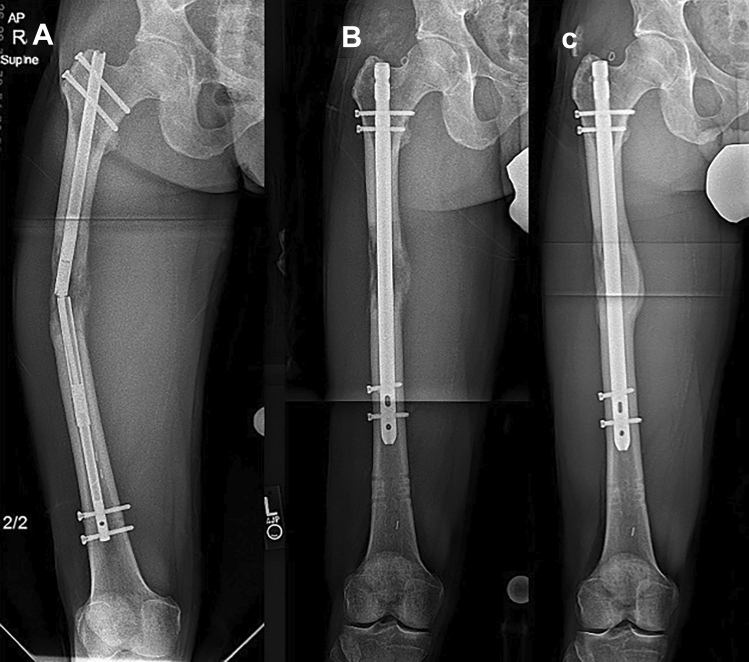
No statistically significant difference was found between the two groups in regard to the (LD-SRS) score, hip ROM, or knee ROM. Statistically significant differences were found between the two groups in regard to BHI (average of 0.84 months/cm and 0.67 months/cm for STRYDE and PRECICE, respectively) and distraction rate (average of 0.6 mm/day and 0.9 mm/day for STRYDE and PRECICE, respectively). No mechanical nail complications were reported in the STRYDE group compared to three events of nail failure in the PRECICE group. One femur in the PRECICE group needed BMAC injection for delayed healing compared to four femurs in the STRYDE group.
The STRYDE MILN yields comparable functional results to those of PRECICE MILN and shows fewer mechanical nail complications. However, STRYDE MILN requires a slower distraction rate and yields slower healing (larger BHI).
Level III, Therapeutic study.
磁内延长钉(MILN)已用于股骨延长,以避免与外固定相关的并发症。MILN 的钛版本(PRECICE)自 2011 年以来一直在使用,但在术后承重方面存在限制(50-75 磅)。MILN 的新型不锈钢版本(STRYDE)允许术后承重 150-250 磅。目的是比较使用这两种不同的 MILN 进行单侧和双侧股骨延长的结果。
这是一项单中心回顾性队列研究,对 2017 年 1 月至 2020 年 3 月期间的患者记录进行了回顾。共有 66 例股骨延长手术纳入研究,并分为两组:STRYDE 组(30 例股骨)和 PRECICE 组(36 例股骨)。评估的结果是术后 6 个月的肢体畸形-脊柱侧凸研究协会(LD-SRS)评分、相邻关节活动范围(ROM)、平均牵伸率、骨愈合指数(BHI)和并发症。
两组在 LD-SRS 评分、髋关节 ROM 或膝关节 ROM 方面无统计学差异。两组在 BHI(STRYDE 组平均为 0.84 个月/cm,PRECICE 组为 0.67 个月/cm)和牵伸率(STRYDE 组平均为 0.6mm/天,PRECICE 组为 0.9mm/天)方面存在统计学差异。与 PRECICE 组的 3 例钉失败事件相比,STRYDE 组无机械钉并发症报告。与 STRYDE 组的 4 例股骨相比,PRECICE 组的 1 例股骨需要 BMAC 注射治疗延迟愈合。
STRYDE MILN 的功能结果与 PRECICE MILN 相当,且机械钉并发症较少。然而,STRYDE MILN 需要较慢的牵伸率,且愈合较慢(较大的 BHI)。
III 级,治疗研究。