Physician Assistant Leadership and Learning Academy (PALLA), University of Maryland Baltimore Graduate School, 620 West Lexington Street, Baltimore, MD, USA.
BMC Med Educ. 2021 May 14;21(1):274. doi: 10.1186/s12909-021-02725-5.
As most health professions in the United States have adopted clinical or practice doctorates, there has been an ongoing debate on whether physician assistants (PAs) should transition from a master's to a doctorate as the terminal degree. The authors examined perceived risks, benefits and impact of transitioning to an entry-level PA doctoral degree.
A multi-prong, mixed-methods approach was used that included a literature review and collecting quantitative and qualitative data using a survey and interviews. Bivariate analysis and binomial logistic regression were performed to evaluate relationships between perceptions/perspectives on an entry-level PA doctoral degree and the anticipated impact of it causing more harm than good to the PA profession. Deductive content analysis was used to analyze the qualitative data.
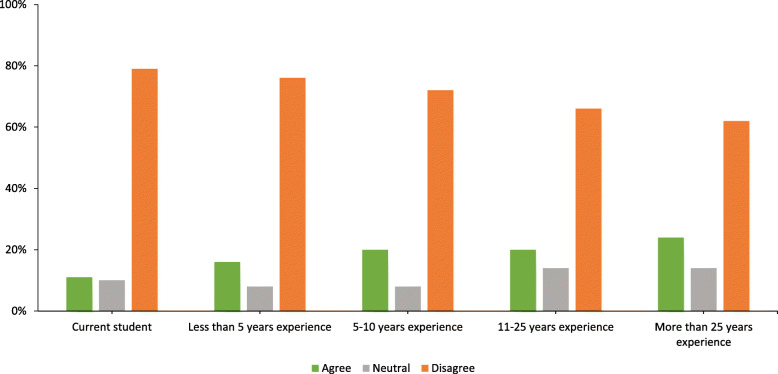
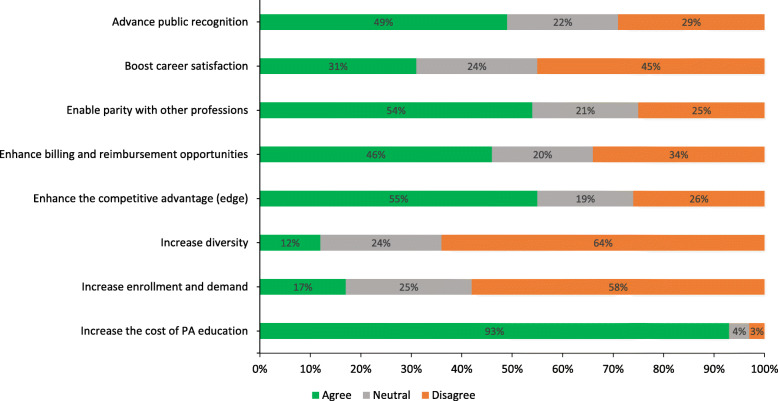
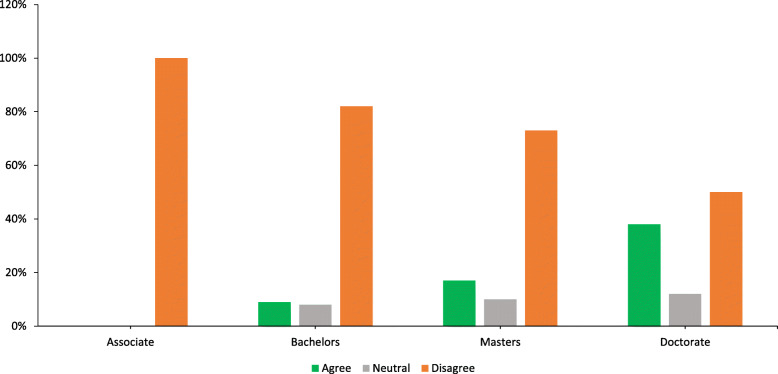
Of 636 PA clinicians and students (46% response rate), 457 (72%) disagreed that an entry-level PA doctoral degree should be required. More than half of the respondents (54%) agreed that it should be offered but not required and 380 respondents (60%) agreed that an entry-level doctoral degree would cause more harm than good. Race, educational attainment, occupation, and length of practice as a PA were significantly associated with having a perception of causing more harm. There was strong positive association between the perception of a doctoral degree causing more harm with expectations of having a negative impact on the availability of clinical training sites (OR = 4.39, p < .05). The most commonly cited benefits were parity with other professions and competitive advantage, whereas the perceived risks were increased cost for education, decreased diversity in the profession, and negative impact on the PA/physician relationship.
The major takeaway of our study was that perceived benefits and risks are strongly influenced by the lens of the stakeholder. While the majority of PAs and students appear to be not in favor mainly due to the potential harm, the proportion of those in favor is not insignificant and their views should not be ignored. Addressing concerns with key stakeholders could help the PA profession to transition to a doctoral degree with minimal adverse impact.
由于美国大多数健康职业都采用临床或实践博士学位,因此一直存在着关于助理医师(PA)是否应该从硕士学位过渡到博士学位作为终端学位的争论。作者研究了过渡到入门级 PA 博士学位的感知风险、收益和影响。
采用多方面、混合方法,包括文献综述以及通过调查和访谈收集定量和定性数据。进行了双变量分析和二项逻辑回归,以评估对入门级 PA 博士学位的看法和对该学位可能对 PA 职业造成更多伤害而非益处的预期影响之间的关系。采用演绎内容分析法分析定性数据。
在 636 名 PA 临床医生和学生(46%的回复率)中,有 457 名(72%)不同意要求获得入门级 PA 博士学位。超过一半的受访者(54%)认为应该提供但不要求获得该学位,有 380 名受访者(60%)认为入门级博士学位会造成更多伤害。种族、教育程度、职业和作为 PA 的从业年限与认为会造成更多伤害的看法显著相关。认为博士学位会造成更多伤害的看法与对临床培训基地可用性产生负面影响的预期之间存在强烈的正相关(OR=4.39,p<.05)。最常被引用的好处是与其他专业平等和竞争优势,而感知风险则是教育成本增加、专业多样性降低以及对 PA/医生关系的负面影响。
我们研究的主要收获是,利益和风险的感知受到利益相关者视角的强烈影响。尽管大多数 PA 和学生似乎主要由于潜在伤害而不赞成,但赞成的比例并非微不足道,他们的观点不应被忽视。与主要利益相关者解决关切问题,有助于 PA 专业过渡到博士学位,而对不利影响最小。