Spine Center, Department of Orthopaedics, The First Affiliated Hospital of USTC, Division of Life Sciences and Medicine, University of Science and Technology of China, No.17, Lujiang Road, Hefei, Anhui, 230001, People's Republic of China.
Stem Cell Res Ther. 2021 May 13;12(1):286. doi: 10.1186/s13287-021-02362-1.
Mesenchymal stem cell-derived small extracellular vesicles (MSC-sEVs) have emerged as a promising new therapeutic strategy for intervertebral disc degeneration (IVDD). However, the drawbacks of MSCs, including their invasive access, the donor age, and their limited proliferative capacity, hinder the quantity and quality of MSC-sEVs. Induced pluripotent stem cell-derived MSCs (iMSCs) provide an indefinite source of MSCs with well-defined phenotype and function. This study aimed to investigate the therapeutic effect of sEVs derived from iMSC (iMSC-sEVs) on IVDD and explore the underlying molecular mechanisms.
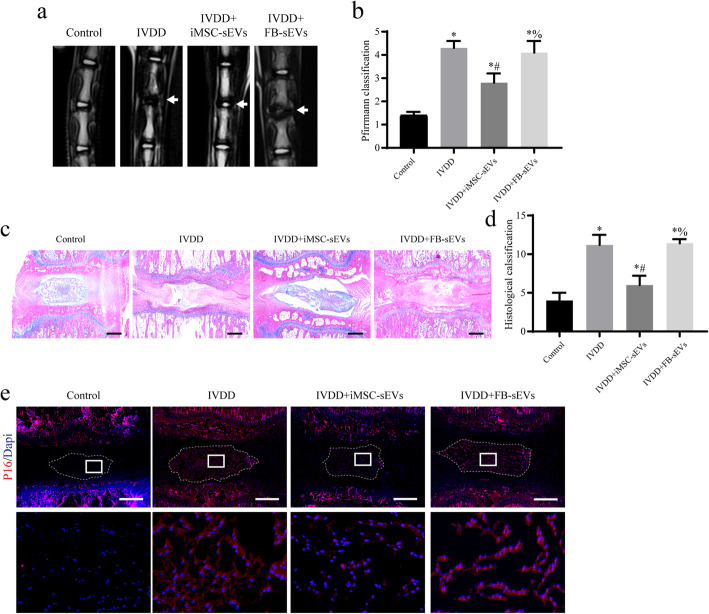
IVDD models were established by puncturing discs from the tails of rats. Then, iMSC-sEVs were injected into the punctured discs. The degeneration of punctured discs was assessed using MRI and HE and immunofluorescence staining. The age-related phenotypes were used to determine the effects of iMSC-sEVs on senescent nucleus pulposus cells (NPCs) in vitro. Western blotting was used to detect the expression of Sirt6. miRNA sequencing analysis was used to find miRNAs that potentially mediate the activation of Sirt6.
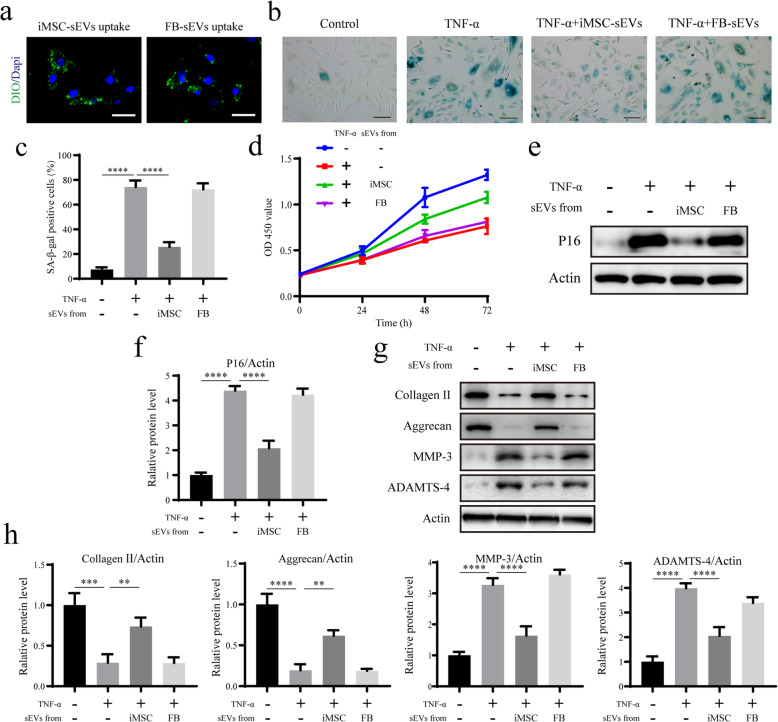
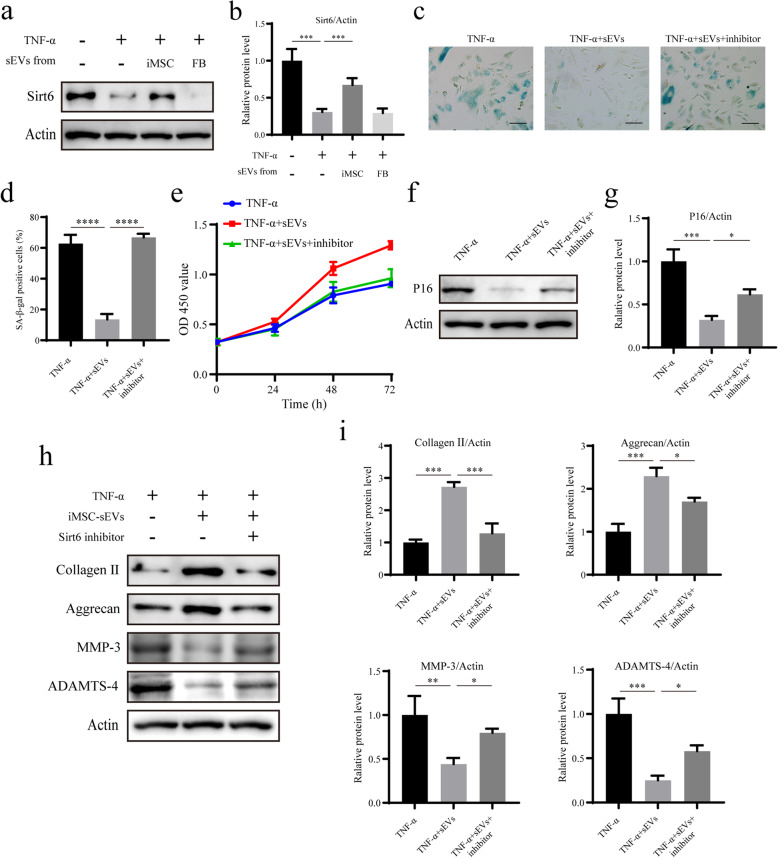
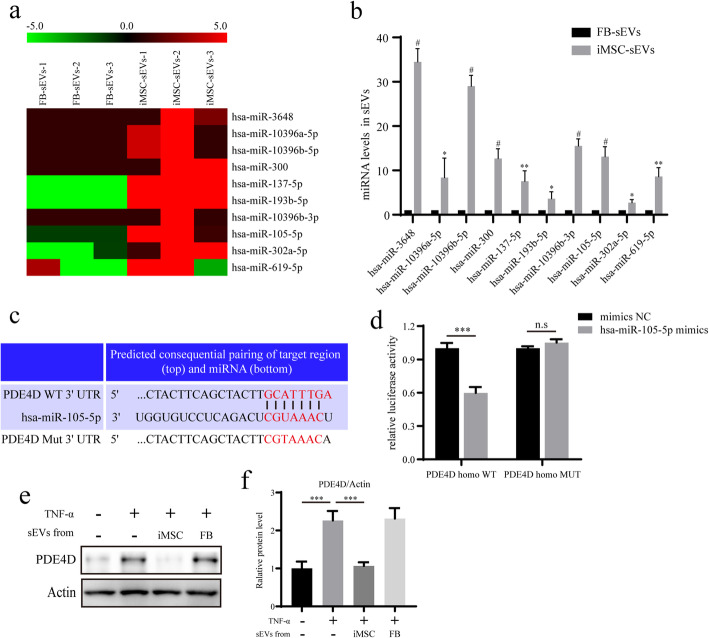
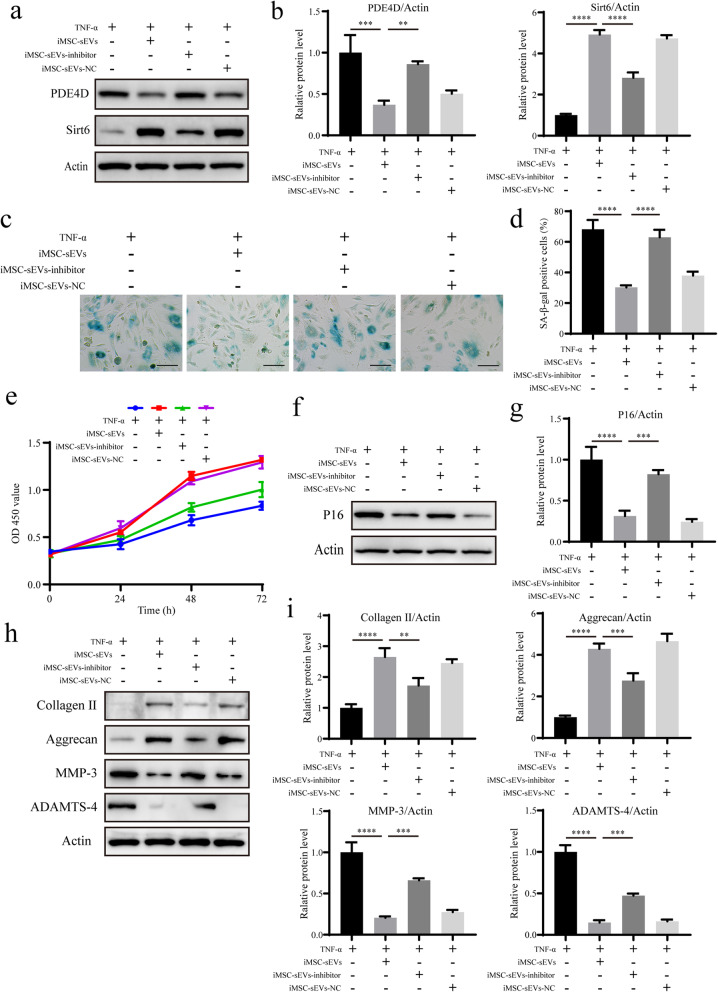
After intradiscally injecting iMSC-sEVs, NPC senescence and IVDD were significantly improved. iMSC-sEVs could rejuvenate senescent NPCs and restore the age-related function by activating the Sirt6 pathway in vitro. Further, microRNA sequence analysis showed that iMSC-sEVs were highly enriched in miR-105-5p, which played a pivotal role in the iMSC-sEV-mediated therapeutic effect by downregulating the level of the cAMP-specific hydrolase PDE4D and could lead to Sirt6 activation.
iMSC-sEVs could rejuvenate the senescence of NPCs and attenuate the development of IVDD. iMSC-sEVs exerted their anti-ageing effects by delivering miR-105-5p to senescent NPCs and activating the Sirt6 pathway. Our findings indicate that iMSCs are a promising MSC candidate for obtaining sEVs on a large scale, while avoiding several defects related to the present applications of MSCs, and that iMSC-sEVs could be a novel cell-free therapeutic tool for the treatment of IVDD.
间充质干细胞衍生的小细胞外囊泡(MSC-sEVs)已成为治疗椎间盘退变(IVDD)的一种有前途的新治疗策略。然而,间充质干细胞的缺点,包括其侵入性获取、供体年龄和有限的增殖能力,限制了 MSC-sEVs 的数量和质量。诱导多能干细胞衍生的间充质干细胞(iMSCs)为间充质干细胞提供了一种无限的来源,具有明确的表型和功能。本研究旨在探讨 iMSC-sEVs 对 IVDD 的治疗作用,并探讨其潜在的分子机制。
通过从大鼠尾部穿刺椎间盘建立 IVDD 模型,然后将 iMSC-sEVs 注入穿刺的椎间盘。通过 MRI 和 HE 以及免疫荧光染色评估穿刺椎间盘的退变。使用衰老相关表型来确定 iMSC-sEVs 对衰老的髓核细胞(NPCs)的体外作用。Western blot 用于检测 Sirt6 的表达。miRNA 测序分析用于寻找可能介导 Sirt6 激活的 miRNA。
iMSC-sEVs 经椎间盘内注射后,NPC 衰老和 IVDD 显著改善。iMSC-sEVs 可通过体外激活 Sirt6 途径使衰老的 NPC 年轻化并恢复与年龄相关的功能。此外,miRNA 序列分析表明,iMSC-sEVs 富含 miR-105-5p,通过下调 cAMP 特异性水解酶 PDE4D 的水平,在 iMSC-sEV 介导的治疗作用中发挥关键作用,并可导致 Sirt6 激活。
iMSC-sEVs 可使 NPC 衰老年轻化并减轻 IVDD 的发展。iMSC-sEVs 通过将 miR-105-5p 递送至衰老的 NPCs 并激活 Sirt6 途径发挥其抗衰老作用。我们的研究结果表明,iMSCs 是获得大规模 sEVs 的一种有前途的 MSC 候选物,同时避免了与目前 MSC 应用相关的几个缺陷,并且 iMSC-sEVs 可能成为治疗 IVDD 的新型无细胞治疗工具。