Department of Biological and Biomedical Sciences, Aga Khan University, Karachi, Pakistan.
Department of Biology, College of Science, University of Hafr Al Batin, Hafr Al Batin, Saudi Arabia.
Sci Rep. 2021 May 13;11(1):10290. doi: 10.1038/s41598-021-89724-0.
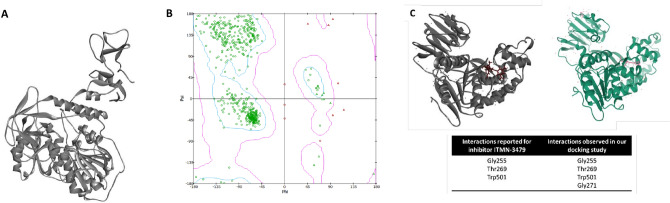
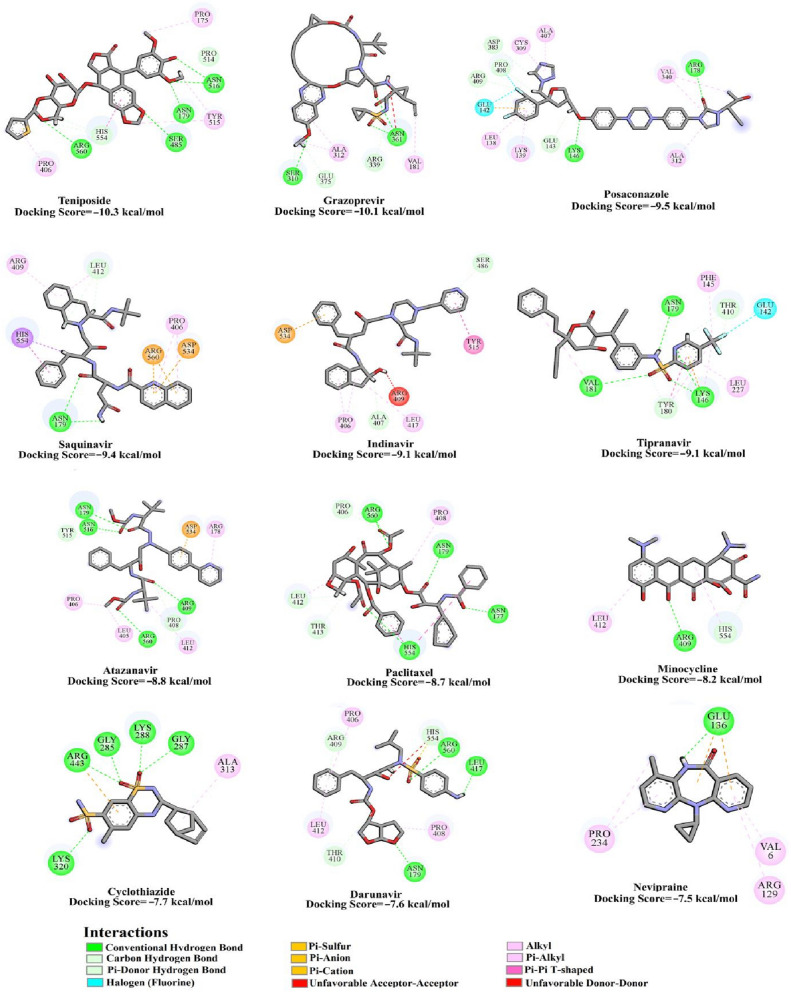
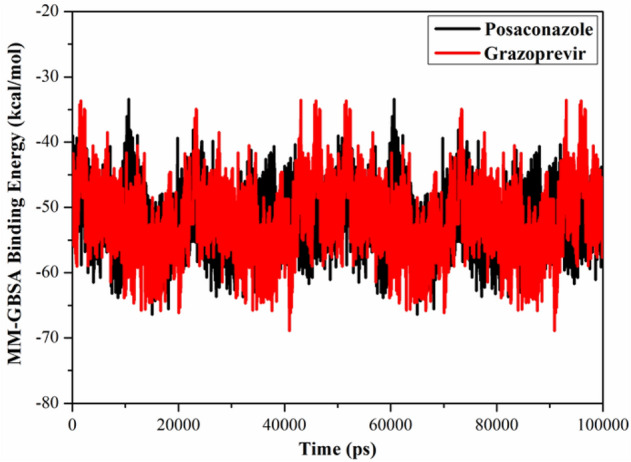
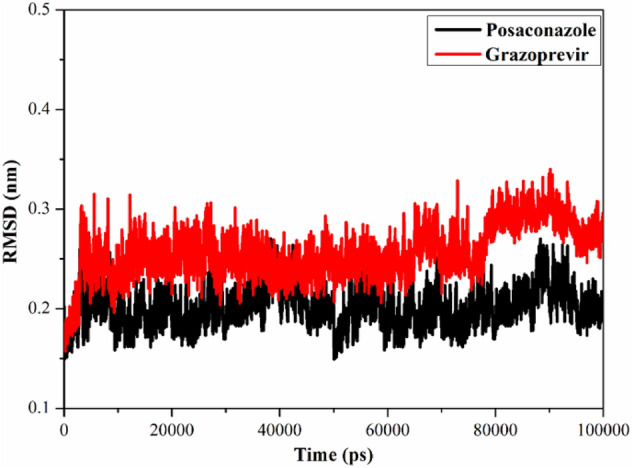
As the Severe Acute Respiratory Syndrome Coronavirus-2 (SARS-CoV-2) pandemic engulfs millions worldwide, the quest for vaccines or drugs against the virus continues. The helicase protein of SARS-CoV-2 represents an attractive target for drug discovery since inhibition of helicase activity can suppress viral replication. Using in silico approaches, we have identified drugs that interact with SARS-CoV-2 helicase based on the presence of amino acid arrangements matching binding sites of drugs in previously annotated protein structures. The drugs exhibiting an RMSD of ≤ 3.0 Å were further analyzed using molecular docking, molecular dynamics (MD) simulation, and post-MD analyses. Using these approaches, we found 12 drugs that showed strong interactions with SARS-CoV-2 helicase amino acids. The analyses were performed using the recently available SARS-CoV-2 helicase structure (PDB ID: 5RL6). Based on the MM-GBSA approach, out of the 12 drugs, two drugs, namely posaconazole and grazoprevir, showed the most favorable binding energy, - 54.8 and - 49.1 kcal/mol, respectively. Furthermore, of the amino acids found conserved among all human coronaviruses, 10/11 and 10/12 were targeted by, respectively, grazoprevir and posaconazole. These residues are part of the crucial DEAD-like helicase C and DEXXQc_Upf1-like/ DEAD-like helicase domains. Strong interactions of posaconazole and grazoprevir with conserved amino acids indicate that the drugs can be potent against SARS-CoV-2. Since the amino acids are conserved among the human coronaviruses, the virus is unlikely to develop resistance mutations against these drugs. Since these drugs are already in use, they may be immediately repurposed for SARS-CoV-2 therapy.
随着严重急性呼吸系统综合症冠状病毒 2(SARS-CoV-2)的大流行席卷全球数百万人,人们继续寻求针对该病毒的疫苗或药物。SARS-CoV-2 的解旋酶蛋白是药物发现的一个有吸引力的靶标,因为抑制解旋酶活性可以抑制病毒复制。我们使用计算机模拟方法,根据药物在先前注释的蛋白质结构中的结合位点的氨基酸排列,鉴定了与 SARS-CoV-2 解旋酶相互作用的药物。对于 RMSD 小于等于 3.0Å 的药物,我们进一步使用分子对接、分子动力学(MD)模拟和 MD 后分析进行了分析。使用这些方法,我们发现了 12 种与 SARS-CoV-2 解旋酶氨基酸显示强相互作用的药物。分析是使用最近获得的 SARS-CoV-2 解旋酶结构(PDB ID:5RL6)进行的。基于 MM-GBSA 方法,在 12 种药物中,两种药物即泊沙康唑和格拉替雷显示出最有利的结合能,分别为-54.8 和-49.1 kcal/mol。此外,在所有人类冠状病毒中发现的保守氨基酸中,10/11 和 10/12 分别被格拉替雷和泊沙康唑靶向。这些残基是关键的 DEAD 样解旋酶 C 和 DEXXQc_Upf1 样/DEAD 样解旋酶结构域的一部分。泊沙康唑和格拉替雷与保守氨基酸的强烈相互作用表明,这些药物可能对 SARS-CoV-2 有效。由于这些氨基酸在人类冠状病毒中是保守的,病毒不太可能对这些药物产生耐药性突变。由于这些药物已经在使用中,它们可能会立即被重新用于 SARS-CoV-2 的治疗。