
登革病毒I型:基于定量构效关系的回归模型开发,用于预测靶向登革病毒非结构(NS)蛋白的抑制剂
i-DENV: development of QSAR based regression models for predicting inhibitors targeting non-structural (NS) proteins of dengue virus.
作者信息
Gautam Sakshi, Thakur Anamika, Kumar Manoj
机构信息
Virology Unit and Bioinformatics Centre, Council of Scientific and Industrial Research (CSIR) - Institute of Microbial Technology, and Academy of Scientific and Innovative Research (AcSIR), Ghaziabad, India.
出版信息
Front Pharmacol. 2025 Jun 26;16:1605722. doi: 10.3389/fphar.2025.1605722. eCollection 2025.
INTRODUCTION
Dengue virus (DENV) is a significant global arboviral threat with fatal potential, currently lacking effective antiviral treatments or a universally applicable vaccine. In response to this unmet need, we developed the "i-DENV" web server to facilitate structure-based drug prediction targeting key viral proteins.
METHODS
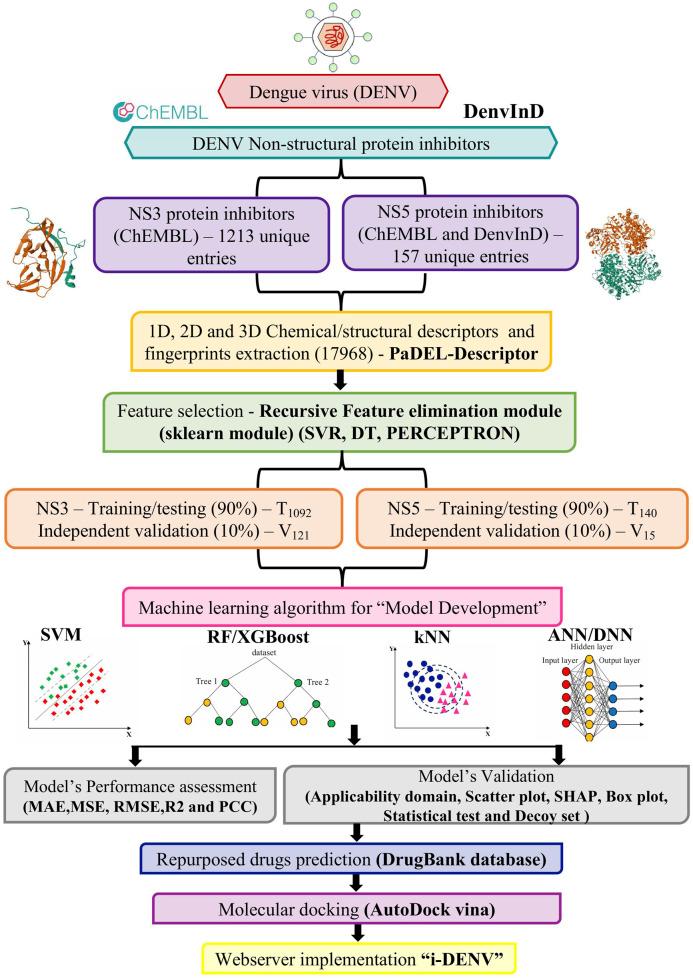
The i-DENV platform focuses on the NS3 protease and NS5 polymerase of DENV using machine learning techniques (MLTs) and quantitative structure-activity relationship (QSAR) modeling. A total of 1213 and 157 unique compounds, along with their IC50 values targeting NS3 and NS5 respectively, were retrieved from the ChEMBL and DenvInD databases. Molecular descriptors and fingerprints were computed and used to train multiple regression-based MLTs, including SVM, RF, kNN, ANN, XGBoost, and DNN, with ten-fold cross-validation.
RESULTS
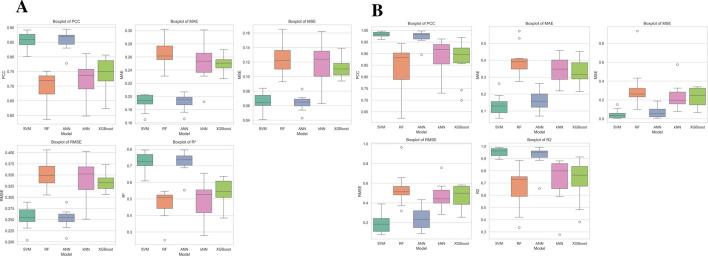
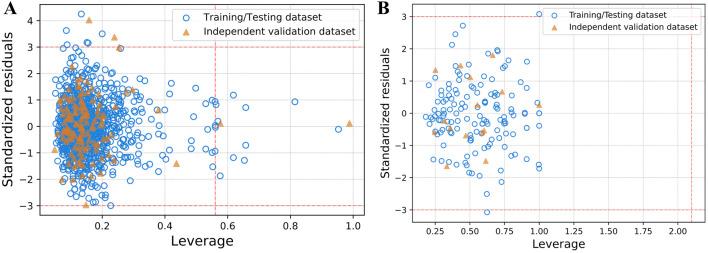
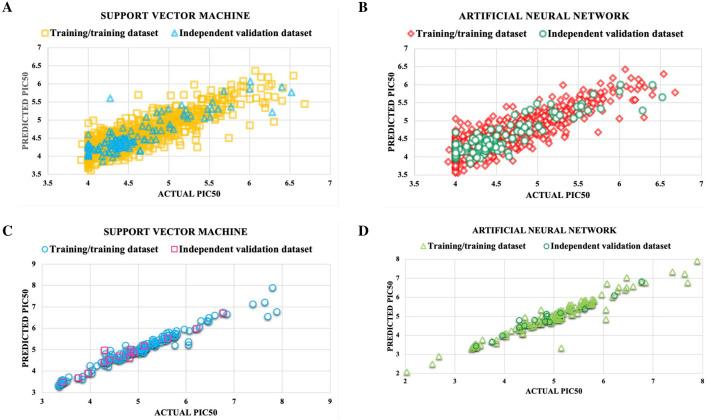
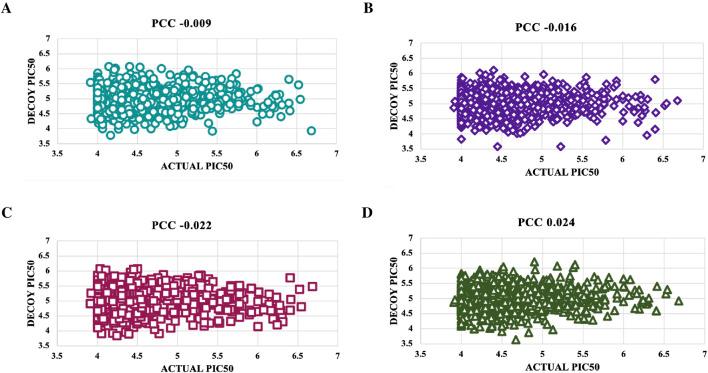
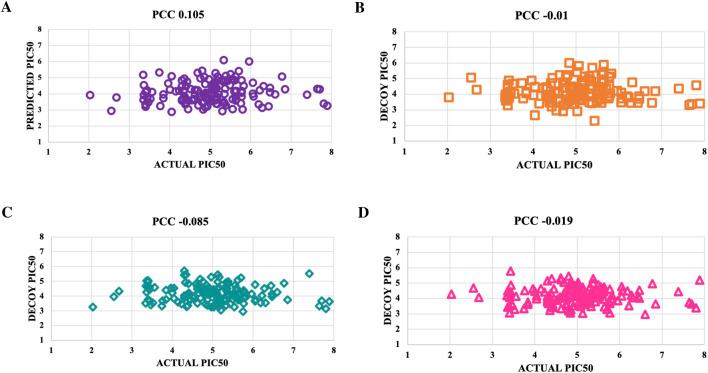
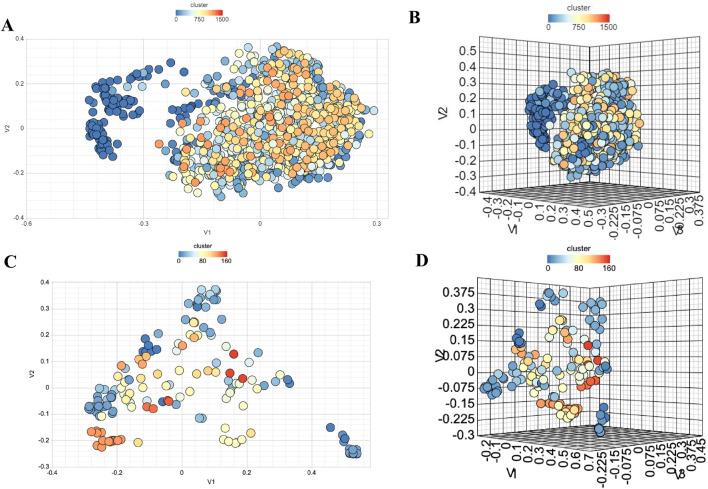
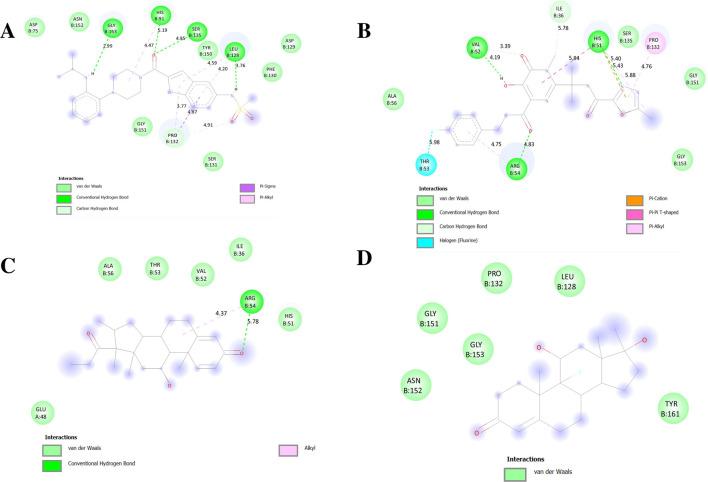
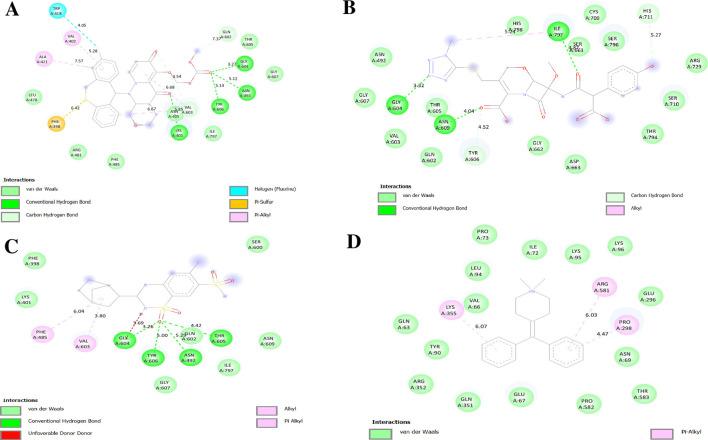
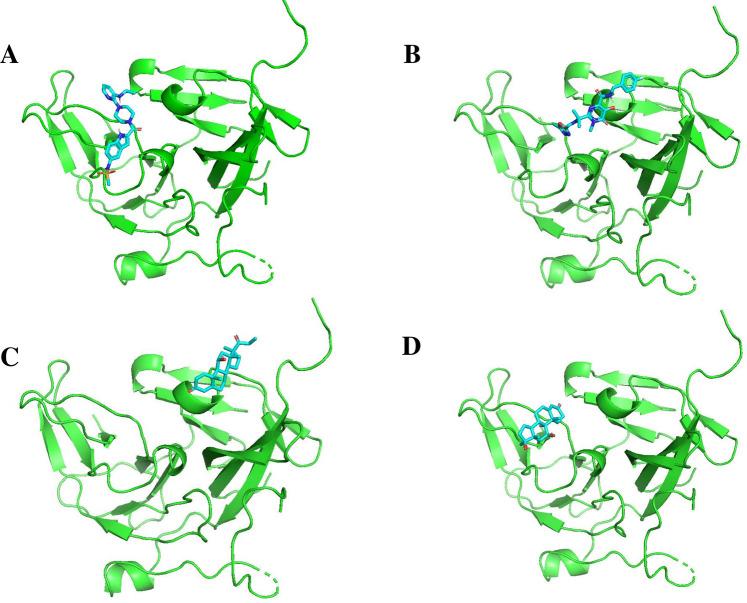
The best-performing SVM and ANN models achieved Pearson correlation coefficients (PCCs) of 0.857/0.862 (NS3) and 0.982/0.964 (NS5) on training/testing sets, and 0.870/0.894 (NS3) and 0.970/0.977 (NS5) on independent validation sets. Model robustness was supported through scatter plots, chemical clustering, statistical analyses, decoy set etc. Virtual screening identified Micafungin, Oritavancin, and Iodixanol as top hits for NS2B/NS3 protease, and Cangrelor, Eravacycline, and Baloxavir marboxil for NS5 polymerase. Molecular docking further confirmed strong binding affinities of these compounds.
DISCUSSION
Our findings suggest these repurposed drugs as promising antiviral candidates against DENV. However, further and studies are essential to validate their therapeutic potential. The i-DENV web server is freely accessible at http://bioinfo.imtech.res.in/manojk/idenv/, offering a structure-specific drug prediction platform for DENV research and antiviral drug discovery.
引言
登革热病毒(DENV)是一种具有致命潜力的重大全球虫媒病毒威胁,目前缺乏有效的抗病毒治疗方法或普遍适用的疫苗。为满足这一未被满足的需求,我们开发了“i-DENV”网络服务器,以促进针对关键病毒蛋白的基于结构的药物预测。
方法
i-DENV平台利用机器学习技术(MLTs)和定量构效关系(QSAR)建模,聚焦于登革热病毒的NS3蛋白酶和NS5聚合酶。分别从ChEMBL和DenvInD数据库中检索了总共1213种和157种独特化合物及其针对NS3和NS5的IC50值。计算分子描述符和指纹,并用于训练基于多元回归的MLTs,包括支持向量机(SVM)、随机森林(RF)、k近邻(kNN)、人工神经网络(ANN)、极端梯度提升(XGBoost)和深度神经网络(DNN),采用十折交叉验证。
结果
表现最佳的SVM和ANN模型在训练/测试集上针对NS3/NS5的皮尔逊相关系数(PCC)分别为0.857/0.862(NS3)和0.982/0.964(NS5),在独立验证集上为0.870/0.894(NS3)和0.970/0.977(NS5)。通过散点图、化学聚类、统计分析、诱饵集等支持了模型的稳健性。虚拟筛选确定米卡芬净、奥利万星和碘克沙醇为NS2B/NS3蛋白酶的顶级命中物,坎格雷洛拉、依拉环素和巴洛沙韦酯为NS5聚合酶的顶级命中物。分子对接进一步证实了这些化合物的强结合亲和力。
讨论
我们的研究结果表明,这些重新利用的药物是有前途的抗登革热病毒候选药物。然而,进一步的研究对于验证它们的治疗潜力至关重要。i-DENV网络服务器可在http://bioinfo.imtech.res.in/manojk/idenv/免费访问,为登革热病毒研究和抗病毒药物发现提供了一个基于结构的药物预测平台。

 Zotero 插件