Ma Suk-Ling, Chen Lu Hua, Lee Chi-Chiu, Lai Kelly Y C, Hung Se-Fong, Tang Chun-Pan, Ho Ting-Pong, Shea Caroline, Mo Flora, Mak Timothy S H, Sham Pak-Chung, Leung Patrick W L
Department of Psychiatry, The Chinese University of Hong Kong, Hong Kong, China.
Centre for PanorOmic Sciences - Genomics and Bioinformatics Cores, The University of Hong Kong, Hong Kong, China.
Front Neurosci. 2021 Apr 27;15:649588. doi: 10.3389/fnins.2021.649588. eCollection 2021.
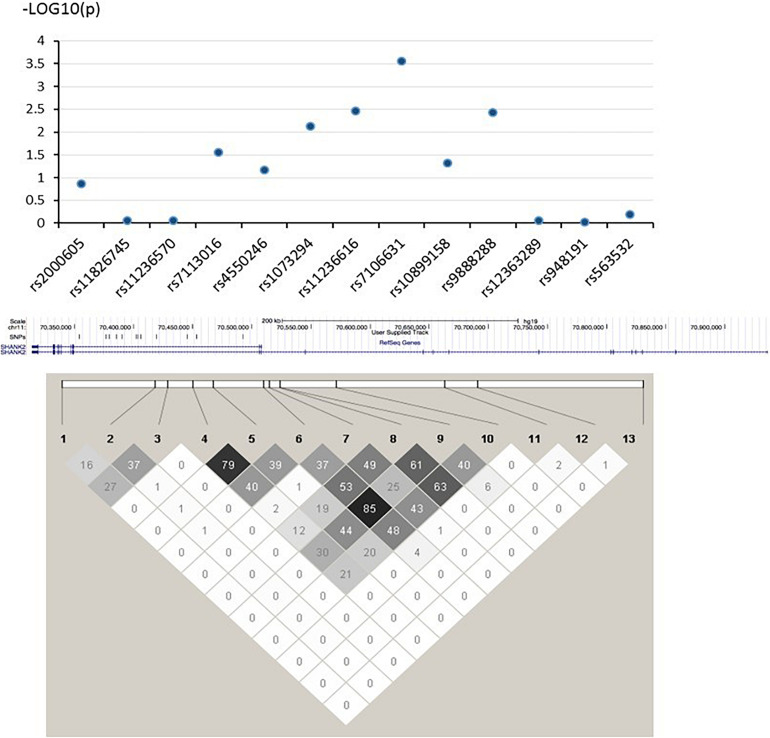
Recent findings indicated a high comorbidity between attention-deficit/hyperactivity disorder (ADHD) and autism spectrum disorder (ASD), as well as shared genetic influences on them. The latter might contribute at least partly to the former clinical scenario. This study aimed at investigating whether genes were potential pleiotropic genes to the two said disorders, underlying their genetic overlap. This study recruited 298 boys with ADHD (including 256 family trios of 1 ADHD boy and his 2 biological parents), 134 boys with ASD, 109 boys with both ADHD and ASD, and 232 typically developing boys as community controls. They were aged between 6 and 11 years old. There was no significant difference in allele frequency of a number of single nucleotide polymorphisms (SNPs) in / between the three clinical groups (ADHD, ASD, and ADHD + ASD) and between the two control groups (community controls and pseudo-controls), respectively. The three clinical groups and the two control groups were thus, respectively, combined. A comparison between the two aggregated samples identified significant evidence of disease association for three SNPs with both ADHD and ASD, even after multiple testing correction: rs11236616 ( = 0.762, permuted = 0.0376), rs7106631 ( = 0.720, permuted = 0.0034), and rs9888288 ( = 0.770, permuted = 0.0407). Comparisons among individual groups pointed to a similar trend of findings. could be considered a potential pleiotropic gene underlying the genetic overlap between ADHD and ASD. This might contribute partly to their high comorbidity in the afflicted children.
最近的研究结果表明,注意力缺陷多动障碍(ADHD)与自闭症谱系障碍(ASD)之间存在高度共病性,以及它们之间存在共同的遗传影响。后者可能至少部分地导致了前者的临床情况。本研究旨在调查基因是否是上述两种疾病的潜在多效性基因,这是它们遗传重叠的基础。本研究招募了298名患有ADHD的男孩(包括256个由1名ADHD男孩及其2名亲生父母组成的家庭三联体)、134名患有ASD的男孩、109名同时患有ADHD和ASD的男孩以及232名发育正常的男孩作为社区对照。他们的年龄在6至11岁之间。在三个临床组(ADHD、ASD和ADHD + ASD)之间以及两个对照组(社区对照和假对照组)之间,一些单核苷酸多态性(SNP)的等位基因频率没有显著差异。因此,分别将三个临床组和两个对照组进行合并。对这两个合并样本的比较发现,即使经过多次检验校正,仍有三个SNP与ADHD和ASD都存在显著的疾病关联证据:rs11236616( = 0.762,置换后 = 0.0376)、rs7106631( = 0.720,置换后 = 0.0034)和rs9888288( = 0.770,置换后 = 0.0407)。各个组之间的比较也指向了类似的发现趋势。 可被视为ADHD和ASD之间遗传重叠的潜在多效性基因。这可能部分地导致了患病儿童中它们的高共病性。