Bakin Evgeny A, Stanevich Oksana V, Danilenko Daria M, Lioznov Dmitry A, Kulikov Alexander N
Pavlov First Saint Petersburg State Medical University, L'va Tolstogo str. 6-8, Saint Petersburg, 197022 Russia.
Smorodintsev Research Institute of Influenza, Prof. Popov str. 15/17, Saint Petersburg, 197376 Russia.
Health Inf Sci Syst. 2021 May 11;9(1):21. doi: 10.1007/s13755-021-00150-y. eCollection 2021 Dec.
The COVID-19 pandemic showed an urgent need for decision support systems to help doctors at a time of stress and uncertainty. However, significant differences in hospital conditions, as well as skepticism of doctors about machine learning algorithms, limit their introduction into clinical practice. Our goal was to test and apply the principle of "patient-like-mine" decision support in rapidly changing conditions of a pandemic.
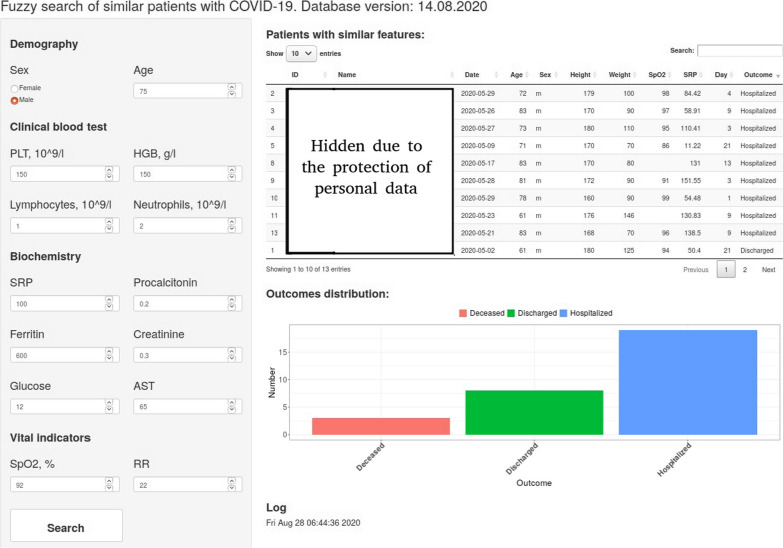
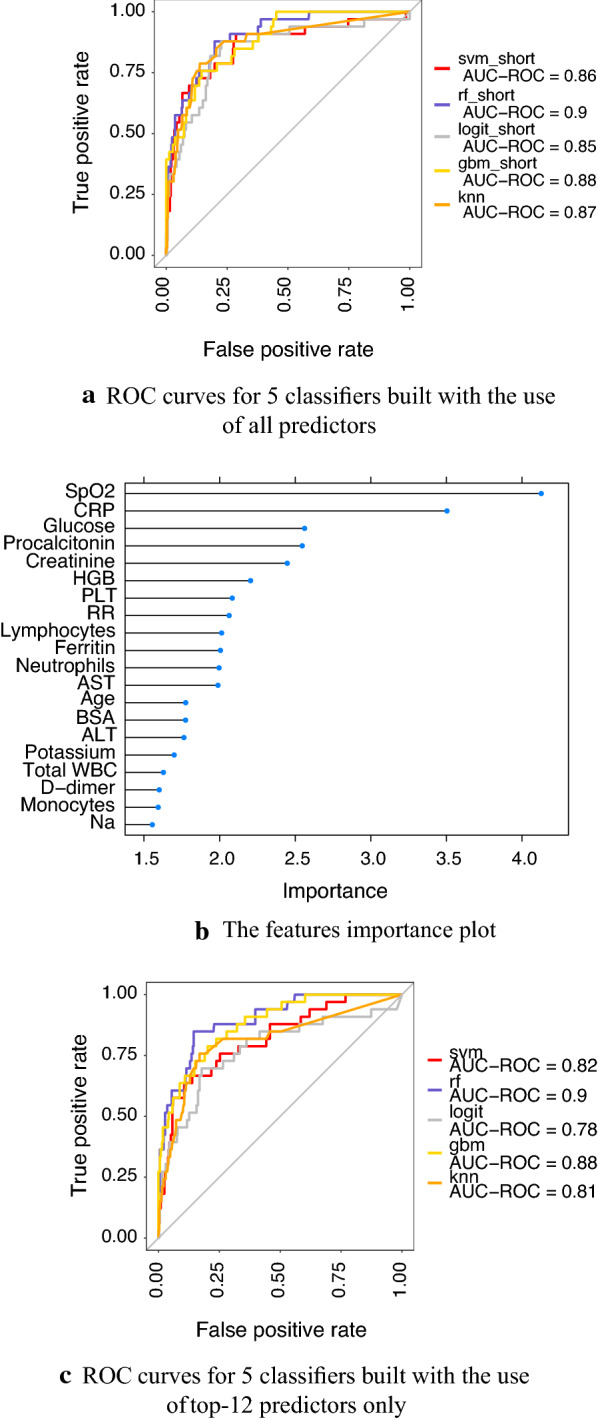
In the developed system we implemented a fuzzy search that allows a doctor to compare their medical case with similar cases recorded in their medical center since the beginning of the pandemic. Various distance metrics were tried for obtaining clinically relevant search results. With the use of R programming language, we designed the first version of the system in approximately a week. A set of features for the comparison of the cases was selected with the use of random forest algorithm implemented in Caret. Shiny package was chosen for the design of GUI.
The deployed tool allowed doctors to quickly estimate the current conditions of their patients by means of studying the most similar previous cases stored in the local health information system. The extensive testing of the system during the first wave of COVID-19 showed that this approach helps not only to draw a conclusion about the optimal treatment tactics and to train medical staff in real-time but also to optimize patients' individual testing plans.
This project points to the possibility of rapid prototyping and effective usage of "patient-like-mine" search systems at the time of a pandemic caused by a poorly known pathogen.
2019冠状病毒病疫情表明,在压力和不确定性时期,迫切需要决策支持系统来帮助医生。然而,医院条件的显著差异以及医生对机器学习算法的怀疑,限制了它们在临床实践中的应用。我们的目标是在疫情迅速变化的情况下,测试并应用“像我的患者一样”的决策支持原则。
在开发的系统中,我们实施了模糊搜索,使医生能够将他们的医疗案例与自疫情开始以来在其医疗中心记录的类似案例进行比较。尝试了各种距离度量方法以获得临床相关的搜索结果。使用R编程语言,我们在大约一周内设计了系统的第一个版本。使用在Caret中实现的随机森林算法选择了一组用于案例比较的特征。选择Shiny包来设计图形用户界面。
部署的工具使医生能够通过研究本地健康信息系统中存储的最相似的先前案例,快速评估患者的当前状况。在2019冠状病毒病第一波疫情期间对该系统进行的广泛测试表明,这种方法不仅有助于得出最佳治疗策略的结论并实时培训医务人员,还有助于优化患者的个人检测计划。
该项目指出了在由未知病原体引起的疫情期间快速原型制作和有效使用“像我的患者一样”搜索系统的可能性。