Bu Te, Popovic Stevo, Huang Huiqing, Fu Tao, Gardasevic Jovan
Faculty of Sport and Physical Education, Hunan Normal University, Changsha, China.
Faculty for Sport and Physical Education, University of Montenegro, Niksic, Montenegro.
Front Pediatr. 2021 Apr 27;9:671504. doi: 10.3389/fped.2021.671504. eCollection 2021.
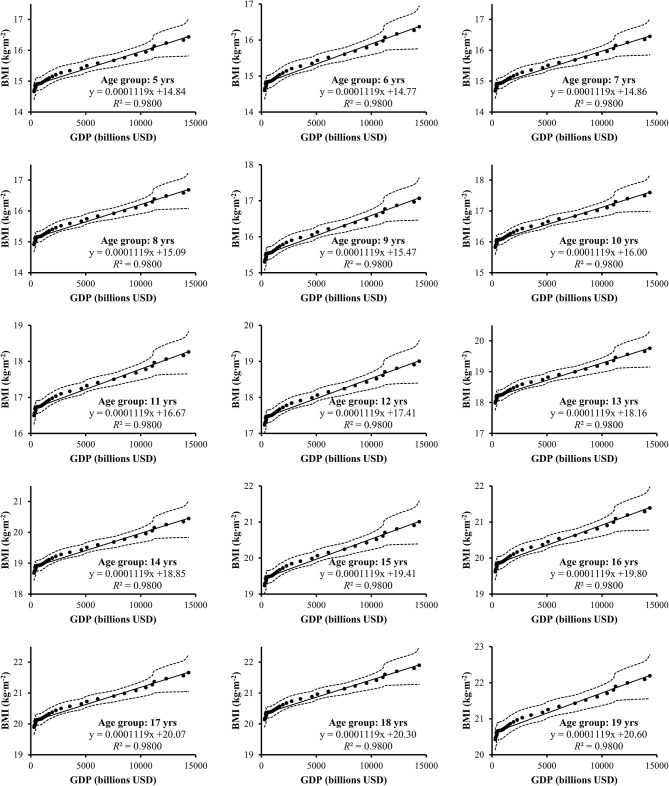
Obesity represents a major risk factor for population health. No studies have evaluated how economic expansion impacts the prevalence of obesity. The purpose of this study was to assess the relationship between national economic development and body mass index (BMI) in Chinese children and adolescents. Data of mean BMI in children and adolescents aged 5-19 from 1986 to 2019 were extracted from an international database of cardiometabolic risk factors. Chinese economic development was quantified by the gross domestic product (GDP), which was extracted from the International Monetary Fund. The relationships between GDP and BMI were assessed in 1-year age groups for ages 5-19 years. In addition, the linear regression from the main data and estimated GDP growth allowed the projections of mean BMI for each age group between 2020 and 2025. The results suggest there was a linear increase in BMI over years, which means that there has been a steady increase in BMI over the economic expansion. Overall, 97% of the variance (Pearson correlation coefficient) of BMI in boys can be explained by the GDP expansion, and the same pattern (98% of the variance) occurred in girls. Projected mean BMI were provided for constructing future national strategies to prevent overweight and obesity in youth. In conclusion, BMI in children and adolescents aged 5-19 trended upwards between 1986 and 2019. Our analyses for the first time suggest that globalization has a major impact on BMI in China. Economic expansion was highly predictive of BMI increases.
肥胖是影响公众健康的主要风险因素。尚无研究评估经济扩张如何影响肥胖率。本研究旨在评估中国儿童和青少年的国民经济发展与体重指数(BMI)之间的关系。从一个国际心血管代谢风险因素数据库中提取了1986年至2019年5至19岁儿童和青少年的平均BMI数据。中国经济发展以国内生产总值(GDP)来量化,该数据取自国际货币基金组织。对5至19岁的1岁年龄组评估了GDP与BMI之间的关系。此外,根据主要数据和估计的GDP增长进行线性回归,得出了2020年至2025年各年龄组的平均BMI预测值。结果表明,多年来BMI呈线性上升,这意味着在经济扩张期间BMI一直在稳步上升。总体而言,男孩BMI的97%的方差(皮尔逊相关系数)可由GDP扩张来解释,女孩也出现了相同的模式(98%的方差)。提供了预测的平均BMI,以构建未来预防青少年超重和肥胖的国家战略。总之,1986年至2019年期间,5至19岁儿童和青少年的BMI呈上升趋势。我们的分析首次表明,全球化对中国的BMI有重大影响。经济扩张对BMI的增加具有高度预测性。