Fan Yi, Cui Chen, Li Peiran, Bi Ruiye, Lyu Ping, Li Yanxi, Zhu Songsong
State Key Laboratory of Oral Diseases, National Clinical Research Center for Oral Diseases, Department of Cariology and Endodontics, West China Hospital of Stomatology, Sichuan University, Chengdu, China.
Hospital of Stomatology, Guanghua School of Stomatology, Sun Yat-sen University, Guangdong Province Key Laboratory of Stomatology, Guangzhou, China.
Front Cell Dev Biol. 2021 Apr 27;9:665995. doi: 10.3389/fcell.2021.665995. eCollection 2021.
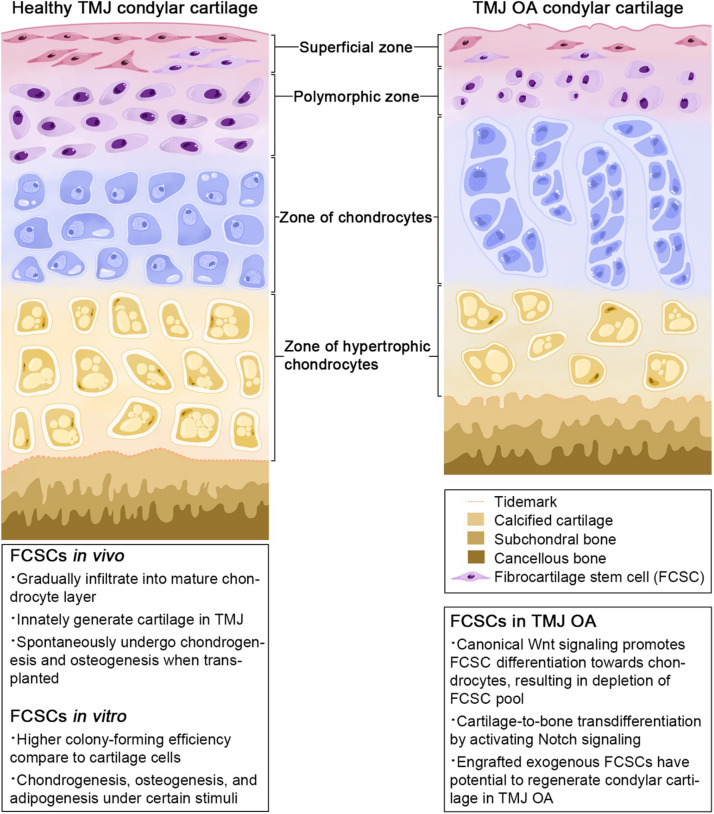
Temporomandibular disorders (TMD) are diseases involving the temporomandibular joint (TMJ), masticatory muscles, and osseous components. TMD has a high prevalence, with an estimated 4.8% of the U.S. population experiencing signs and symptoms, and represents a financial burden to both individuals and society. During TMD progression, the most frequently affected site is the condylar cartilage. Comprising both fibrous and cartilaginous tissues, condylar cartilage has restricted cell numbers but lacks a vascular supply and has limited regenerative properties. In 2016, a novel stem cell niche containing a reservoir of fibrocartilage stem cells (FCSCs) was discovered in the condylar cartilage of rats. Subsequently, FCSCs were identified in mouse, rabbit, and human condylar cartilage. Unlike mesenchymal stem cells or other tissue-specific stem/progenitor cells, FCSCs play a unique role in the development and regeneration of fibrocartilage. More importantly, engraftment treatment of FCSCs has been successfully applied in animal models of TMD. In this context, FCSCs play a major role in the regeneration of newly formed cartilage. Furthermore, FCSCs participate in the regeneration of intramembranous bone by interacting with endothelial cells in bone defects. This evidence highlights the potential of FCSCs as an ideal stem cell source for the regeneration of oral maxillofacial tissue. This review is intended to detail the current knowledge of the characteristics and function of FCSCs in the TMJ, as well as the potential therapeutic applications of FCSCs. A deep understanding of the properties of FCSCs can thus inform the development of promising, biologically based strategies for TMD in the future.
颞下颌关节紊乱病(TMD)是涉及颞下颌关节(TMJ)、咀嚼肌和骨成分的疾病。TMD患病率很高,估计有4.8%的美国人口出现相关体征和症状,对个人和社会都造成了经济负担。在TMD进展过程中,最常受影响的部位是髁突软骨。髁突软骨由纤维组织和软骨组织组成,细胞数量有限,缺乏血管供应,再生能力有限。2016年,在大鼠髁突软骨中发现了一个含有纤维软骨干细胞(FCSCs)库的新型干细胞生态位。随后,在小鼠、兔子和人类的髁突软骨中也鉴定出了FCSCs。与间充质干细胞或其他组织特异性干/祖细胞不同,FCSCs在纤维软骨的发育和再生中发挥着独特作用。更重要的是,FCSCs的移植治疗已成功应用于TMD动物模型。在这种情况下,FCSCs在新形成软骨的再生中起主要作用。此外,FCSCs通过与骨缺损处的内皮细胞相互作用参与膜内骨的再生。这一证据凸显了FCSCs作为口腔颌面组织再生理想干细胞来源的潜力。本综述旨在详细阐述目前关于FCSCs在颞下颌关节中的特征和功能的知识,以及FCSCs的潜在治疗应用。因此,深入了解FCSCs的特性可为未来开发有前景的、基于生物学的TMD治疗策略提供依据。