Grzeskowiak Remigiusz M, Rifkin Rebecca E, Croy Elizabeth G, Steiner Richard C, Seddighi Reza, Mulon Pierre-Yves, Adair Henry S, Anderson David E
Department of Large Animal Clinical Sciences, College of Veterinary Medicine, The University of Tennessee, Knoxville, Knoxville, TN, United States.
Front Surg. 2021 Apr 27;8:637268. doi: 10.3389/fsurg.2021.637268. eCollection 2021.
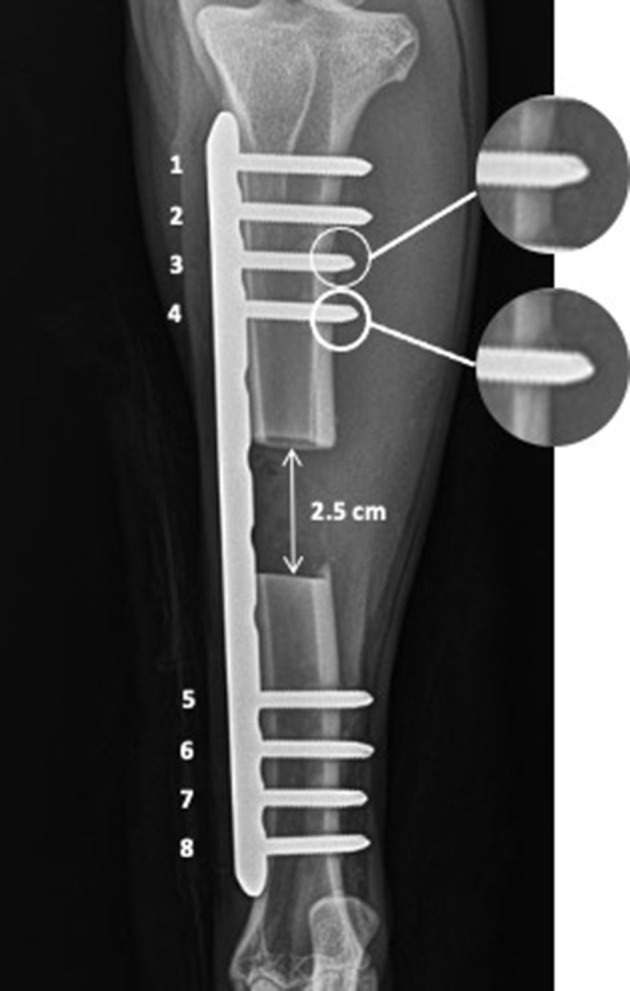
The objective of this study was to evaluate changes in peak reverse torque (PRT) of the locking head screws that occur over time. A locking plate construct, consisting of an 8-hole locking plate and 8 locking screws, was used to stabilize a tibia segmental bone defect in a goat model. PRT was measured after periods of 3, 6, 9, and 12 months of ambulation. PRT for each screw was determined during plate removal. Statistical analysis revealed that after 6 months of loading, locking screws placed in position no. 4 had significantly less PRT as compared with screws placed in position no. 5 ( < 0.05). There were no statistically significant differences in PRT between groups as a factor of time ( > 0.05). Intracortical fractures occurred during the placement of 151 out of 664 screws (22.7%) and were significantly more common in the screw positions closest to the osteotomy (positions 4 and 5, < 0.05). Periosteal and endosteal bone reactions and locking screw backout occurred significantly more often in the proximal bone segments ( < 0.05). Screw backout significantly, negatively influenced the PRT of the screws placed in positions no. 3, 4, and 5 ( < 0.05). The locking plate-screw constructs provided stable fixation of 2.5-cm segmental tibia defects in a goat animal model for up to 12 months.
本研究的目的是评估锁定头螺钉的峰值反向扭矩(PRT)随时间的变化。采用由一块8孔锁定钢板和8枚锁定螺钉组成的锁定钢板结构,在山羊模型中稳定胫骨节段性骨缺损。在行走3、6、9和12个月后测量PRT。在取出钢板时确定每枚螺钉的PRT。统计分析显示,在加载6个月后,与置于5号位置的螺钉相比,置于4号位置的锁定螺钉的PRT显著降低(<0.05)。作为时间因素,各组之间的PRT无统计学显著差异(>0.05)。在664枚螺钉中有151枚(22.7%)在置入过程中发生皮质内骨折,且在最靠近截骨处的螺钉位置(4号和5号位置)更为常见(<0.05)。骨膜和骨内膜骨反应以及锁定螺钉退出在近端骨段中显著更常发生(<0.05)。螺钉退出对置于3号、4号和5号位置的螺钉的PRT有显著的负面影响(<0.05)。锁定钢板-螺钉结构在山羊动物模型中为2.5 cm的胫骨节段性缺损提供了长达12个月的稳定固定。