Grzeskowiak Remigiusz M, Schumacher Jim, Dhar Madhu S, Harper David P, Mulon Pierre-Yves, Anderson David E
Large Animal Clinical Sciences, University of Tennessee College of Veterinary Medicine, Knoxville, TN, United States.
The Center for Renewable Carbon, Institute of Agriculture, University of Tennessee, Knoxville, TN, United States.
Front Surg. 2020 Dec 21;7:601244. doi: 10.3389/fsurg.2020.601244. eCollection 2020.
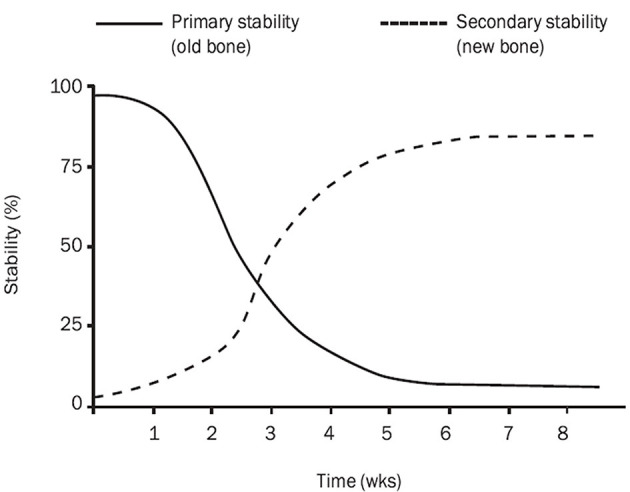
The interface between a surgical implant and tissue consists of a complex and dynamic environment characterized by mechanical and biological interactions between the implant and surrounding tissue. The implantation process leads to injury which needs to heal over time and the rapidity of this process as well as the property of restored tissue impact directly the strength of the interface. Bleeding is the first and most relevant step of the healing process because blood provides growth factors and cellular material necessary for tissue repair. Integration of the implants placed in poorly vascularized tissue such as articular cartilage is, therefore, more challenging than compared with the implants placed in well-vascularized tissues such as bone. Bleeding is followed by the establishment of a provisional matrix that is gradually transformed into the native tissue. The ultimate goal of implantation is to obtain a complete integration between the implant and tissue resulting in long-term stability. The stability of the implant has been defined as primary (mechanical) and secondary (biological integration) stability. Successful integration of an implant within the tissue depends on both stabilities and is vital for short- and long-term surgical outcomes. Advances in research aim to improve implant integration resulting in enhanced implant and tissue interface. Numerous methods have been employed to improve the process of modifying both stability types. This review provides a comprehensive discussion of current knowledge regarding implant-tissue interfaces within bone and cartilage as well as novel approaches to strengthen the implant-tissue interface. Furthermore, it gives an insight into the current state-of-art biomechanical testing of the stability of the implants. Current knowledge reveals that the design of the implants closely mimicking the native structure is more likely to become well integrated. The literature provides however several other techniques such as coating with a bioactive compound that will stimulate the integration and successful outcome for the patient.
外科植入物与组织之间的界面由一个复杂且动态的环境组成,其特征是植入物与周围组织之间的机械和生物相互作用。植入过程会导致损伤,损伤需要随着时间愈合,而这个过程的速度以及修复组织的特性直接影响界面的强度。出血是愈合过程的第一步也是最关键的一步,因为血液提供了组织修复所需的生长因子和细胞物质。因此,与放置在血管丰富的组织(如骨骼)中的植入物相比,放置在血管化不良的组织(如关节软骨)中的植入物的整合更具挑战性。出血之后是建立临时基质,该基质会逐渐转化为天然组织。植入的最终目标是使植入物与组织完全整合,从而实现长期稳定性。植入物的稳定性已被定义为初级(机械)稳定性和次级(生物整合)稳定性。植入物在组织内的成功整合取决于这两种稳定性,并且对于短期和长期手术结果都至关重要。研究进展旨在改善植入物的整合,从而增强植入物与组织的界面。已经采用了许多方法来改进改变这两种稳定性类型的过程。本综述全面讨论了关于骨和软骨内植入物 - 组织界面的当前知识以及加强植入物 - 组织界面的新方法。此外,它还深入了解了当前植入物稳定性的生物力学测试的最新情况。当前的知识表明,紧密模仿天然结构的植入物设计更有可能实现良好的整合。然而,文献还提供了其他几种技术,例如用生物活性化合物涂层,这将刺激整合并为患者带来成功的结果。