Long Erping, Wu Xiaohang, Ding Xiaohu, Yang Yahan, Wang Xun, Guo Chong, Zhang Xiayin, Chen Kexin, Yu Tongyong, Wu Dongxuan, Zhao Xutu, Liu Zhenzhen, Liu Yizhi, Lin Haotian
State Key Laboratory of Ophthalmology, Zhongshan Ophthalmic Center, Sun Yat-sen University, Guangzhou, China.
Zhongshan School of Medicine, Sun Yat-sen University, Guangzhou, China.
Ann Transl Med. 2021 Apr;9(7):554. doi: 10.21037/atm-20-6663.
Myopia is a complex disease caused by a combination of multiple pathogenic factors. Prevalence trends and developmental patterns of myopia exhibit substantial variability that cannot be clearly assessed using limited sample sizes. This study aims to determine the myopia prevalence over the past 60 years and trace the myopia development in a school-aged population using medical big data.
The refraction data from electronic medical records in eight hospitals in South China were collected from January 2005 to October 2018; including patients' year of birth, refraction status, and age at the exam. All optometry tests were performed in accordance with standard procedures by qualified senior optometrists. The cross-sectional datasets (individuals with a single examination) and longitudinal datasets (individuals with multiple examinations) were analyzed respectively. SAS statistical software was used to extract and statistically analyse all target data and to identify prevalence trends and developmental patterns related to myopia.
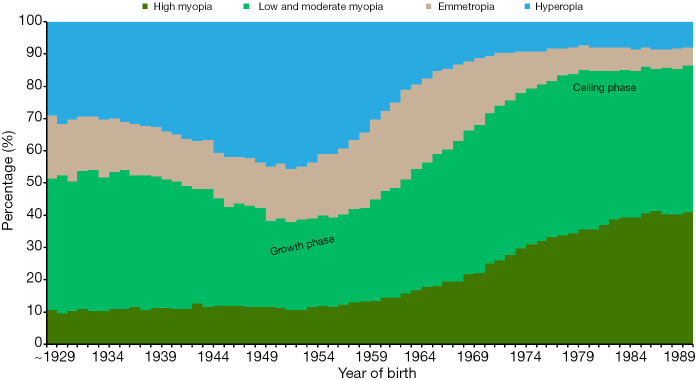
In total, 1,112,054 cross-sectional individual refraction records and 774,645 longitudinal records of 273,006 individuals were collected. The myopia prevalence significantly increased among individuals who were born after the 1960s and showed a steep rise until reaching a peak of 80% at the 1980s. Regarding developmental patterns, the cross-sectional data demonstrated that the myopia prevalence increased dramatically from 23.13% to 82.83% aging from 5 to 11, and the prevalence stabilized at the age of 20. The longitudinal data confirmed the results that the age of myopic onset was 7.47±1.67 years, the age of myopia stabilized at 17.14±2.61 years, and the degree of myopia stabilized at -4.35±3.81 D.
The medical big data used in this study demonstrated prevalence trends of myopia over the past 60 years and revealed developmental patterns in the onset, progression and stability of myopia in China.
近视是一种由多种致病因素共同作用引起的复杂疾病。近视的患病率趋势和发展模式存在很大差异,使用有限的样本量无法清楚地评估。本研究旨在利用医学大数据确定过去60年的近视患病率,并追踪学龄人群的近视发展情况。
收集了2005年1月至2018年10月中国南方八家医院电子病历中的验光数据,包括患者的出生年份、验光状态和检查时的年龄。所有验光检查均由合格的高级验光师按照标准程序进行。分别对横断面数据集(单次检查的个体)和纵向数据集(多次检查的个体)进行分析。使用SAS统计软件提取并统计分析所有目标数据,以确定与近视相关的患病率趋势和发展模式。
共收集了273,006名个体的1,112,054条横断面个体验光记录和774,645条纵向记录。20世纪60年代以后出生的个体近视患病率显著增加,并呈急剧上升趋势,直到20世纪80年代达到80%的峰值。关于发展模式,横断面数据表明,近视患病率从5岁至11岁时的23.13%急剧增加到82.83%,并在20岁时稳定下来。纵向数据证实了以下结果:近视发病年龄为7.47±1.67岁,近视稳定年龄为17.14±2.61岁,近视度数稳定在-4.35±3.81D。
本研究中使用的医学大数据展示了过去60年近视的患病率趋势,并揭示了中国近视在发病、进展和稳定方面的发展模式。