Narayan Sasha Karan, Hontscharuk Rayisa, Danker Sara, Guerriero Jess, Carter Angela, Blasdel Gaines, Bluebond-Langner Rachel, Ettner Randi, Radix Asa, Schechter Loren, Berli Jens Urs
Department of Surgery, Oregon Health and Science University, Portland, OR, USA.
Department of Plastic and Reconstructive Surgery, Rush University Medical Center, Chicago, IL, USA.
Ann Transl Med. 2021 Apr;9(7):605. doi: 10.21037/atm-20-6204.
A rare, but consequential, risk of gender affirming surgery (GAS) is post-operative regret resulting in a request for surgical reversal. Studies on regret and surgical reversal are scarce, and there is no standard terminology regarding either etiology and/or classification of the various forms of regret. This study includes a survey of surgeons' experience with patient regret and requests for reversal surgery, a literature review on the topic of regret, and expert, consensus opinion designed to establish a classification system for the etiology and types of regret experienced by some patients.
This anonymous survey was sent to the 154 surgeons who registered for the 2016 World Professional Association for Transgender Health (WPATH) conference and the 2017 USPATH conference. Responses were analyzed using descriptive statistics. A MeSH search of the gender-affirming outcomes literature was performed on PubMed for relevant studies pertaining to regret. Original research and review studies that were thought to discuss regret were included for full text review.
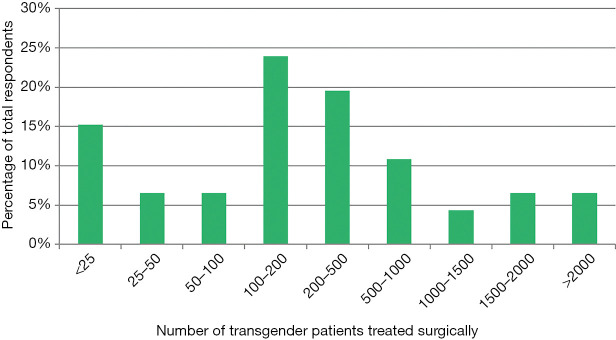
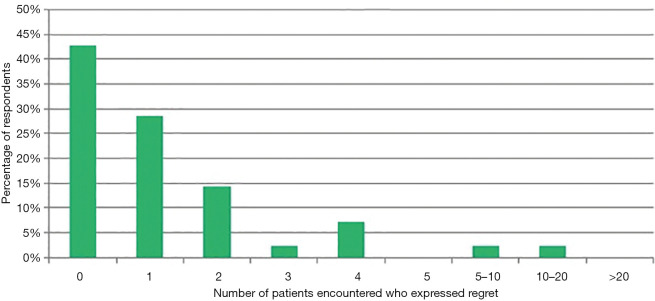
The literature is inconsistent regarding etiology and classification of regret following GAS. Of the 154 surgeons queried, 30% responded to our survey. Cumulatively, these respondents treated between 18,125 and 27,325 individuals. Fifty-seven percent of surgeons encountered at least one patient who expressed regret, with a total of 62 patients expressing regret (0.2-0.3%). Etiologies of regret were varied and classified as either: (I) true gender-related regret (42%), (II) social regret (37%), and (III) medical regret (8%). The surgeons' experience with patient regret and request for reversal was consistent with the existing literature.
In this study, regret following GAS was rare and was consistent with the existing literature. Regret can be classified as true gender-related regret, social regret and medical regret resulting from complications, function, pre-intervention decision making. Guidelines in transgender health should offer preventive strategies as well as treatment recommendations, should a patient experience regret. Future studies and scientific discourse are encouraged on this important topic.
性别肯定手术(GAS)存在一种罕见但后果严重的风险,即术后后悔并要求进行手术逆转。关于后悔和手术逆转的研究很少,而且对于各种形式后悔的病因和/或分类没有标准术语。本研究包括对外科医生处理患者后悔及逆转手术请求的经验进行调查、对后悔主题的文献综述,以及旨在为部分患者经历的后悔病因和类型建立分类系统的专家共识意见。
这项匿名调查发送给了注册参加2016年世界跨性别健康专业协会(WPATH)会议和2017年美国跨性别健康专业协会(USPATH)会议的154名外科医生。使用描述性统计分析回复。在PubMed上对性别肯定手术结果文献进行医学主题词(MeSH)搜索,以查找与后悔相关的研究。纳入被认为讨论后悔的原始研究和综述研究进行全文审查。
关于性别肯定手术后后悔的病因和分类,文献并不一致。在154名被询问的外科医生中,30%回复了我们的调查。这些受访者累计治疗了18125至27325名个体。57%的外科医生遇到过至少一名表达后悔的患者,共有62名患者表达了后悔(0.2 - 0.3%)。后悔的病因各不相同,分为:(I)真正与性别相关的后悔(42%),(II)社会方面的后悔(37%),以及(III)医学方面的后悔(8%)。外科医生处理患者后悔及逆转手术请求的经验与现有文献一致。
在本研究中,性别肯定手术后的后悔很罕见,且与现有文献一致。后悔可分为真正与性别相关的后悔、社会方面的后悔以及因并发症、功能、干预前决策导致的医学方面的后悔。跨性别健康指南应提供预防策略以及治疗建议,以防患者出现后悔。鼓励就这一重要主题开展未来研究和科学讨论。