Wei Sheng Nan, Li Yan Fen, Jeong Eun Chan, Kim Hak Jin, Kim Jong Geun
Graduate School of International Agricultural Technology, Seoul National University, Pyeongchang 25354, Korea.
Research Institute of Eco-friendly Livestock Science, GBST, Seoul National University, Pyeongchang 25354, Korea.
J Anim Sci Technol. 2021 Jan;63(1):91-103. doi: 10.5187/jast.2021.e7. Epub 2021 Jan 31.
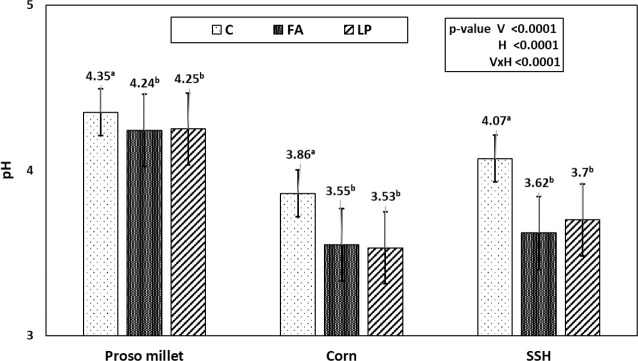
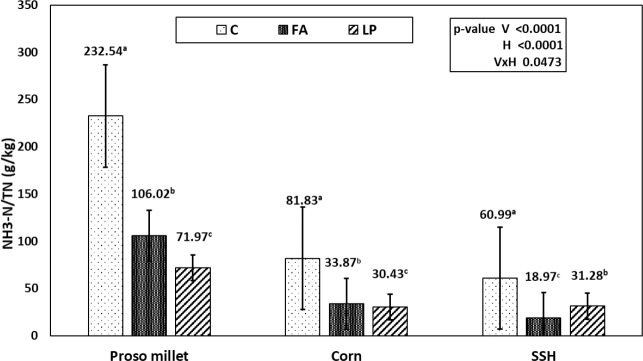
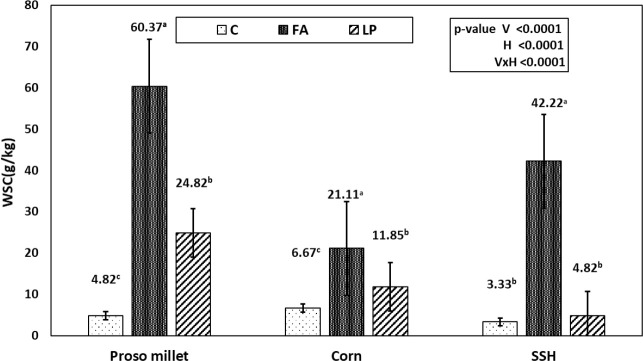
To improve the fermentation quality of silage and reduce the nutrients loss of raw materials during the ensiling process, silage additives are widely used. The effect of additives on silage is also affected by the species of crop. Therefore, this study was designed to explore the effects of formic acid (FA) and lactic acid bacterial inoculant on the quality of main summer crop silage. The experiment was consisted on split-plot design with three replications. The experiment used the main summer forage crops of proso millet ("Geumsilchal"), silage corn ("Gwangpyeongok"), and a sorghum-sudangrass hybrid ("Turbo-gold"). Treatments included silage with Lactic acid bacterial Inoculant ( [LP], 1.0 × 10 CFU/g fresh matter), with FA (98%, 5 mL/kg), and a control (C, without additive). All silages were stored for 60 days after preparation. All additives significantly increased the crude protein content and dry matter digestibility (IVDMD) of the silages and also reduced the content of ammonia nitrogen (NH-N) and pH. Corn had the highest content of IVDMD, total digestible nutrients and relative feed value among silages. Compared with the control, irrespective of whether FA or LP was added, the water soluble carbohydrate (WSC) of three crops was largely preserved and the WSC content in the proso millet treated with FA was the highest. The treatment of LP significantly increased the lactic acid content of the all silage, while the use of FA significantly increased the content of acetic acid ( < 0.05). The highest count of lactic acid bacteria (LAB) was detected in the LP treatment of corn. In all FA treatment groups, the total microorganism and mold numbers were significantly lower than those of the control and LP groups ( < 0.05). In conclusion, both additives improved the fermentation quality and nutritional composition of the main summer forage crops. The application of FA effectively inhibited the fermentation of the three crops, whereas LAB promoted fermentation. So, both FA and LP can improve the quality of various species of silage.
为提高青贮饲料的发酵品质,减少青贮过程中原料养分损失,青贮添加剂被广泛应用。添加剂对青贮饲料的效果也受作物种类影响。因此,本研究旨在探讨甲酸(FA)和乳酸菌接种剂对主要夏季作物青贮饲料品质的影响。试验采用裂区设计,重复3次。试验选用了主要夏季饲料作物黍稷(“锦实杂”)、青贮玉米(“光平玉”)和高粱-苏丹草杂交种(“Turbo-金”)。处理包括添加乳酸菌接种剂([LP],1.0×10 CFU/g鲜物质)的青贮饲料、添加FA(98%,5 mL/kg)的青贮饲料和对照(C,不添加添加剂)。所有青贮饲料制备后储存60天。所有添加剂均显著提高了青贮饲料的粗蛋白含量和干物质消化率(IVDMD),同时降低了氨态氮(NH-N)含量和pH值。玉米青贮饲料的IVDMD、总可消化养分和相对饲用价值含量最高。与对照相比,无论添加FA还是LP,三种作物的水溶性碳水化合物(WSC)均得到大量保留,且FA处理的黍稷中WSC含量最高。LP处理显著提高了所有青贮饲料的乳酸含量,而使用FA显著提高了乙酸含量(<0.05)。玉米的LP处理中检测到的乳酸菌(LAB)数量最高。在所有FA处理组中,总微生物和霉菌数量均显著低于对照和LP组(<0.05)。总之,两种添加剂均改善了主要夏季饲料作物的发酵品质和营养成分。FA的应用有效抑制了三种作物的发酵,而LAB促进了发酵。因此,FA和LP均可提高各种青贮饲料的品质。