Department of Endocrinology, Hematology, and Gerontology, Graduate School of Medicine, Chiba University, Chiba, Japan.
Department of Diabetes, Metabolism and Endocrinology, Tokyo Medical University, Tokyo, Japan.
J Diabetes Investig. 2021 Nov;12(11):2036-2045. doi: 10.1111/jdi.13575. Epub 2021 Jun 6.
AIMS/INTRODUCTION: The relationship between glycated hemoglobin (HbA1c) and cardiovascular events in older adults was investigated using a Japanese administrative medical database.
Anonymized medical data on patients with diabetes mellitus aged ≥65 years for the period from January 2010 to December 2019 were extracted from the EBM Provider database. The primary end-point was a composite of cardiovascular events, whereas the other end-points included severe hypoglycemia and fracture. The association between cardiovascular events and HbA1c at the index date (i.e., approximately 10 months after initial diabetes mellitus diagnosis) was evaluated using the Cox proportional hazards model.
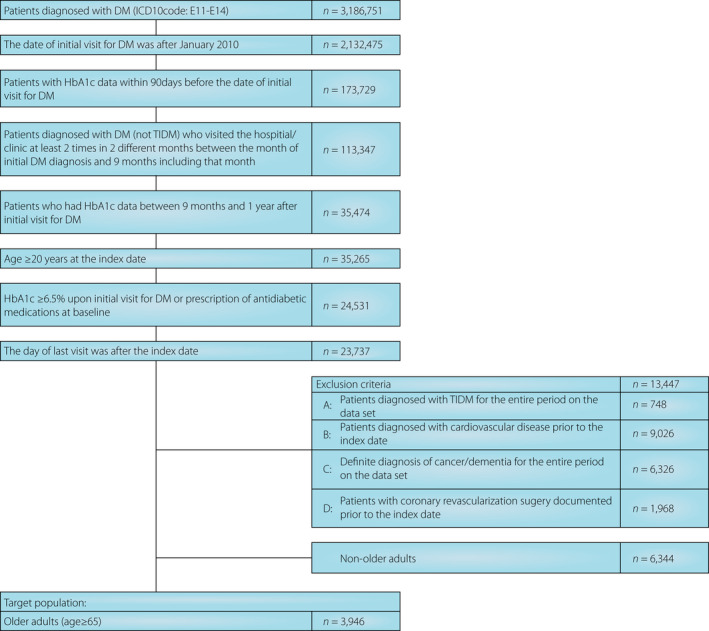
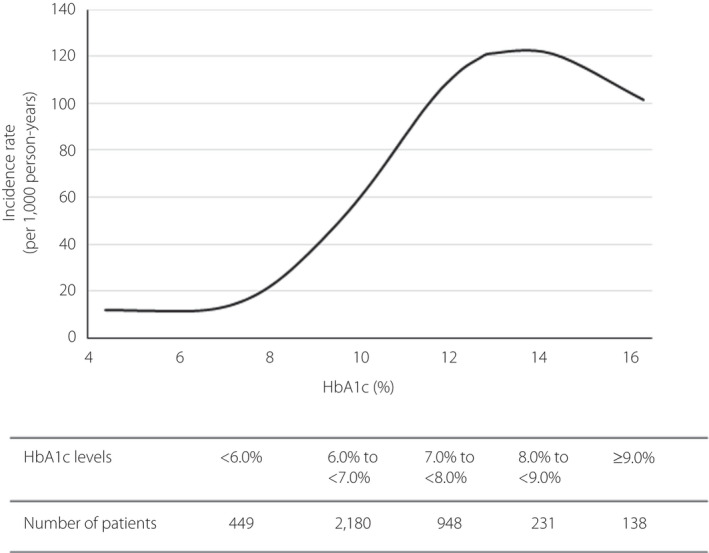
Among the 3,186,751 patients in the database, 3,946 older adults with diabetes mellitus were eligible for inclusion and were subsequently grouped according to HbA1c quartiles at the index date. Cardiovascular events occurred in 142 patients. Patients with HbA1c in the highest quartile had significantly higher risk of hospitalization for cardiovascular disease than those with HbA1c in the lowest quartile (hazard ratio 1.948; 95% confidence interval 1.252-3.031, P = 0.003). However, the events risk was similar across subgroups with HbA1c <7.2%. The incidence of hypoglycemia and fracture was not significantly associated with the level of glycemic control.
Among older adults with diabetes mellitus, those with poor glycemic control were at higher risk for cardiovascular events compared with those with better glycemic control. However, strict glycemic control had no effect on cardiovascular risk in patients with HbA1c <7.2%.
目的/引言:本研究利用日本行政医疗数据库调查了糖化血红蛋白(HbA1c)与老年患者心血管事件之间的关系。
从 EBM Provider 数据库中提取了 2010 年 1 月至 2019 年 12 月期间年龄≥65 岁的糖尿病患者的匿名医疗数据。主要终点为心血管事件的复合终点,次要终点包括严重低血糖和骨折。使用 Cox 比例风险模型评估了索引日期(即首次诊断为糖尿病后约 10 个月)HbA1c 与心血管事件之间的关系。
在数据库的 3186751 名患者中,有 3946 名老年糖尿病患者符合纳入标准,并根据索引日期的 HbA1c 四分位距进行分组。发生了 142 例心血管事件。HbA1c 最高四分位距的患者发生心血管疾病住院的风险显著高于 HbA1c 最低四分位距的患者(风险比 1.948;95%置信区间 1.252-3.031,P=0.003)。然而,HbA1c<7.2%的亚组之间的事件风险相似。低血糖和骨折的发生率与血糖控制水平无显著相关性。
与血糖控制较好的患者相比,老年糖尿病患者中血糖控制较差者发生心血管事件的风险更高。然而,HbA1c<7.2%的患者中严格的血糖控制对心血管风险没有影响。