Department of Family and Community Medicine, University of California, San Francisco, San Francisco, CA
Oregon Research Institute, Eugene, OR.
Diabetes Care. 2021 Jul;44(7):1472-1479. doi: 10.2337/dc20-2724. Epub 2021 May 14.
To explore associations between reductions in diabetes distress (DD) and improvements in glycemic outcomes among adults with type 1 diabetes (T1D) in the context of a DD randomized clinical trial.
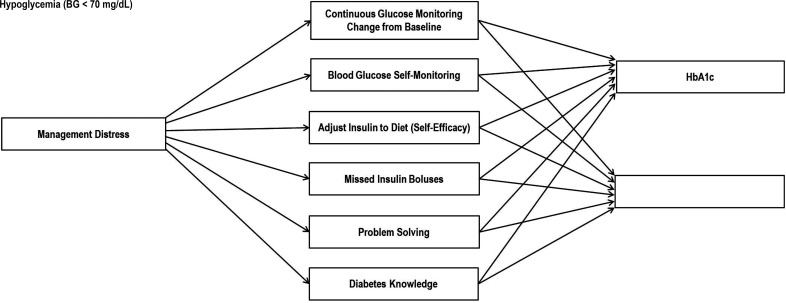
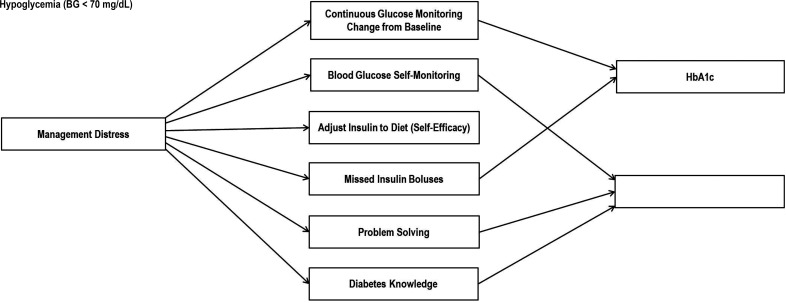
Adults with T1D ( = 301) participated in a two-arm trial aimed at reducing DD (DD-focused OnTrack group vs. education-oriented KnowIt group). Mean age was 45.1 years; mean baseline HbA was 8.8% (73 mmol/mol). Individuals were assessed at baseline and 9 months later on DD, self-care, HbA, and frequency of hypoglycemia. Structural equation models evaluated hypothesized pathways among changes in DD, self-care, and glycemic outcomes in the total sample and by intervention group.
Reductions in DD were significantly and independently associated with better self-care, including fewer missed insulin boluses, more frequent insulin adjustment, improved problem-solving skills, more blood glucose monitoring, and greater adoption of continuous glucose monitoring (all < 0.05). In turn, better self-care was linked with better glycemic outcomes, including fewer episodes of hypoglycemia and improved HbA over time. Fit indices indicated good fit of the model to the data (confirmatory fit index = 0.94, root mean square error of approximation = 0.05), with stronger and more meaningful associations for OnTrack than for KnowIt.
In the context of an intervention to reduce DD for adults with T1D, results indicate that reductions in DD do not affect glycemic outcomes directly but through improvements in self-care behavior. Findings support the importance of integrating disease management with DD interventions to maximize improvements in glycemic outcomes.
在一项糖尿病困扰(DD)随机临床试验的背景下,探讨 1 型糖尿病(T1D)成人的 DD 减少与血糖结果改善之间的关联。
301 名 T1D 成人参加了一项为期 2 组的试验,旨在降低 DD(DD 为重点的 OnTrack 组与以教育为导向的 KnowIt 组)。平均年龄为 45.1 岁;平均基线 HbA 为 8.8%(73mmol/mol)。个体在基线和 9 个月后评估 DD、自我护理、HbA 和低血糖发作频率。结构方程模型评估了总样本和干预组中 DD、自我护理和血糖结果变化之间的假设途径。
DD 的减少与更好的自我护理显著且独立相关,包括更少的胰岛素剂量遗漏、更频繁的胰岛素调整、改善解决问题的能力、更多的血糖监测和更广泛地采用连续血糖监测(均<0.05)。反过来,更好的自我护理与更好的血糖结果相关,包括更少的低血糖发作和随时间推移 HbA 的改善。拟合指数表明模型对数据的拟合良好(验证性拟合指数=0.94,均方根误差近似值=0.05),与 KnowIt 相比,OnTrack 的关联更强且更有意义。
在针对 T1D 成人降低 DD 的干预背景下,结果表明,DD 的减少不会直接影响血糖结果,而是通过改善自我护理行为。研究结果支持将疾病管理与 DD 干预相结合以最大程度提高血糖结果的重要性。