Shanghai Key Laboratory of Regulatory Biology, Institute of Biomedical Sciences and School of Life Sciences, East China Normal University, Shanghai, China.
iHuman Institute, ShanghaiTech University, Shanghai, China.
J Biol Chem. 2021 Jan-Jun;296:100776. doi: 10.1016/j.jbc.2021.100776. Epub 2021 May 14.
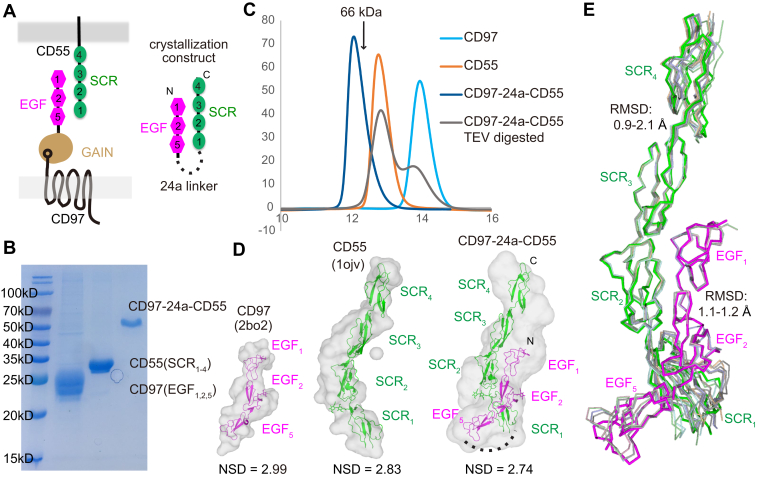
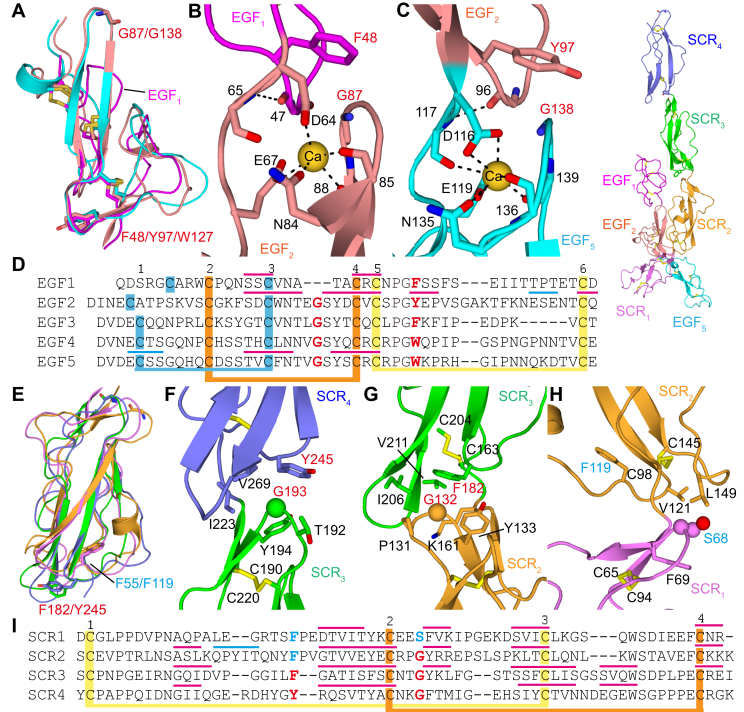
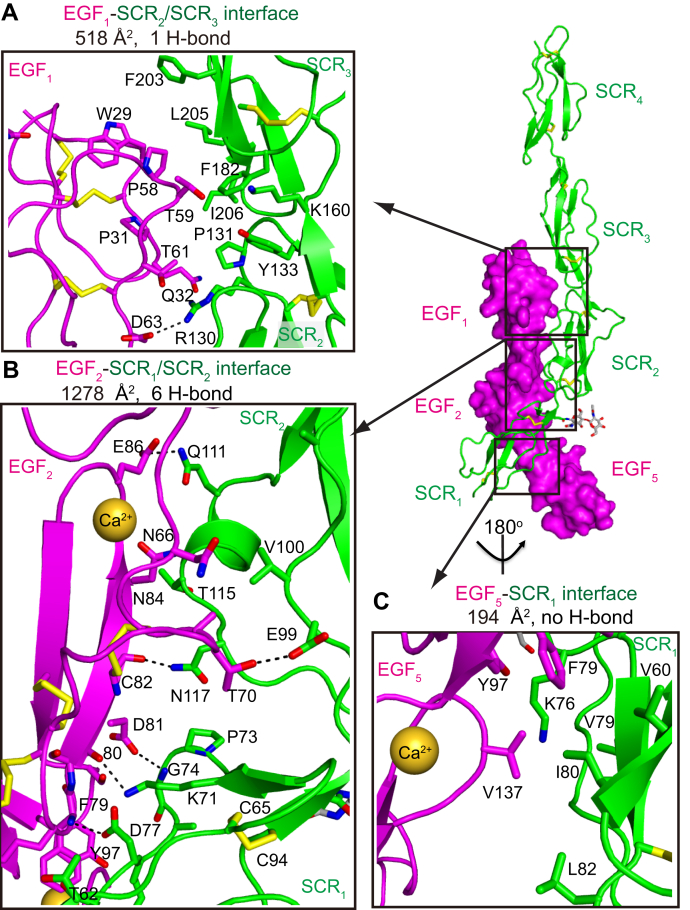
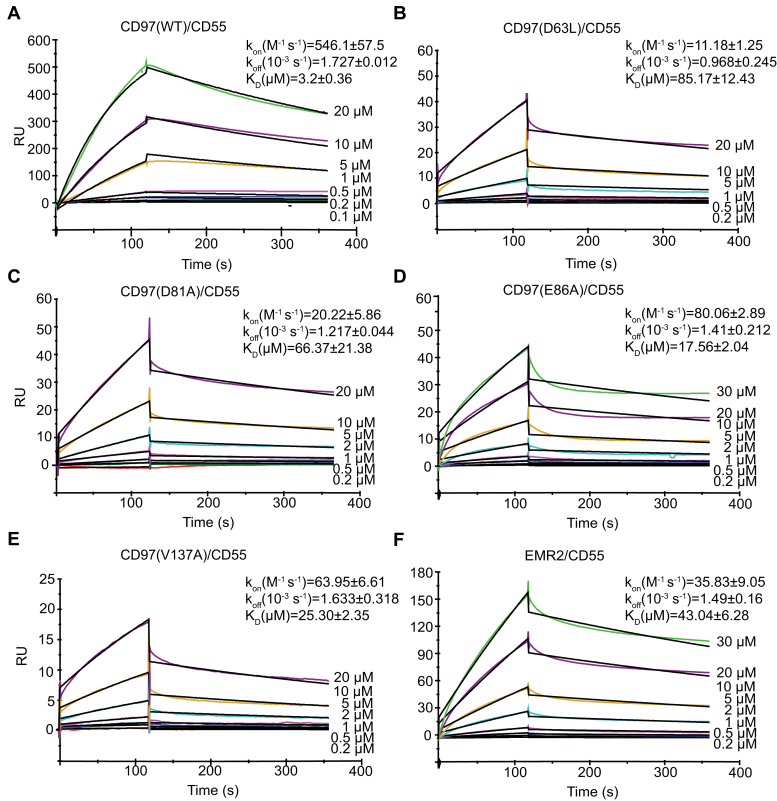
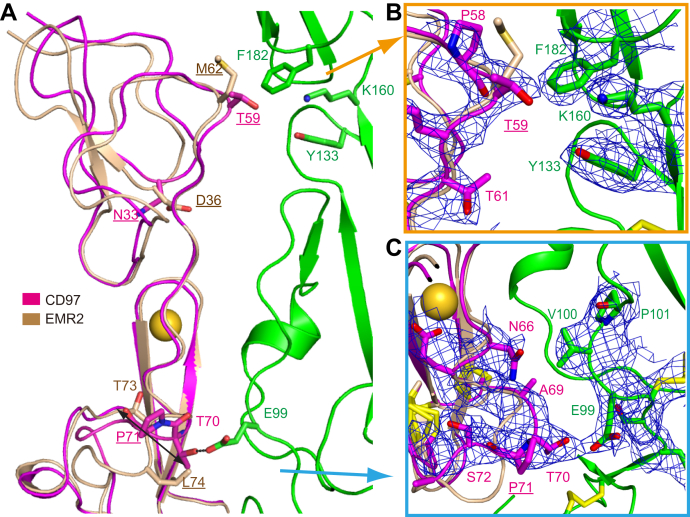
The adhesion G protein-coupled receptor CD97 and its ligand complement decay-accelerating factor CD55 are important binding partners in the human immune system. Dysfunction in this binding has been linked to immune disorders such as multiple sclerosis and rheumatoid arthritis, as well as various cancers. Previous literatures have indicated that the CD97 includes 3 to 5 epidermal growth factor (EGF) domains at its N terminus and these EGF domains can bind to the N-terminal short consensus repeat (SCR) domains of CD55. However, the details of this interaction remain elusive, especially why the CD55 binds with the highest affinity to the shortest isoform of CD97 (EGF). Herein, we designed a chimeric expression construct with the EGF domains of CD97 and the SCR domains of CD55 connected by a flexible linker and determined the complex structure by crystallography. Our data reveal that the two proteins adopt an overall antiparallel binding mode involving the SCR domains of CD55 and all three EGF domains of CD97. Mutagenesis data confirmed the importance of EGF in the interaction and explained the binding specificity between CD55 and CD97. The architecture of CD55-CD97 binding mode together with kinetics suggests a force-resisting shearing stretch geometry when forces applied to the C termini of both proteins in the circulating environment. The potential of the CD55-CD97 complex to withstand tensile force may provide a basis for the mechanosensing mechanism for activation of adhesion G protein-coupled receptors.
黏附 G 蛋白偶联受体 CD97 及其配体补体衰变加速因子 CD55 是人体免疫系统中的重要结合伴侣。这种结合的功能障碍与多发性硬化症和类风湿性关节炎等免疫紊乱以及各种癌症有关。先前的文献表明,CD97 的 N 端含有 3 到 5 个表皮生长因子(EGF)结构域,这些 EGF 结构域可以与 CD55 的 N 端短共有序列重复(SCR)结构域结合。然而,这种相互作用的细节仍然难以捉摸,特别是为什么 CD55 与 CD97 的最短同工型(EGF)结合具有最高的亲和力。在此,我们设计了一个嵌合表达构建体,其中 CD97 的 EGF 结构域和 CD55 的 SCR 结构域通过柔性接头连接,并通过晶体学确定了复合物的结构。我们的数据表明,两种蛋白质采用总体上反平行的结合模式,涉及 CD55 的 SCR 结构域和 CD97 的所有三个 EGF 结构域。突变数据证实了 EGF 在相互作用中的重要性,并解释了 CD55 和 CD97 之间的结合特异性。CD55-CD97 结合模式的结构和动力学表明,当在循环环境中施加于两种蛋白质的 C 末端的力时,存在抵抗剪切拉伸的几何形状。CD55-CD97 复合物抵抗拉伸力的潜力可能为粘附 G 蛋白偶联受体激活的机械感觉机制提供了基础。