University of Maryland School of Medicine, 701 W. Pratt St., 4th Floor, Baltimore, MD 21201, United States.
University of Maryland School of Medicine, 701 W. Pratt St., 4th Floor, Baltimore, MD 21201, United States.
Neurosci Biobehav Rev. 2021 Aug;127:520-530. doi: 10.1016/j.neubiorev.2021.05.008. Epub 2021 May 13.
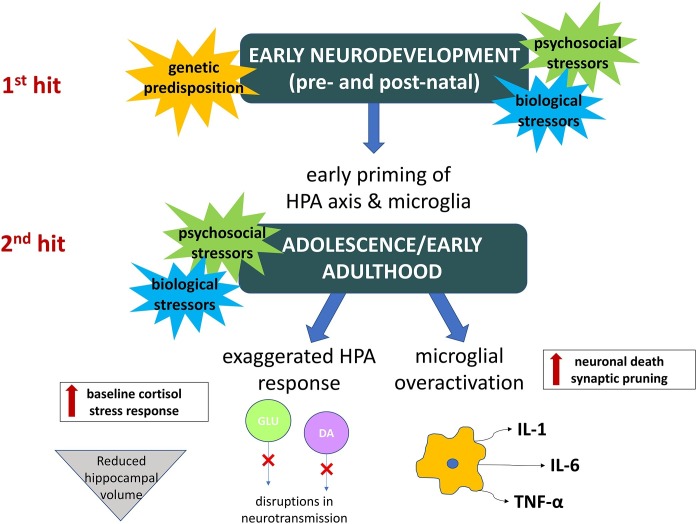
The historical association between respiratory infections and neuropsychiatric symptoms dates back centuries, with more recent literature highlighting a link between viral infections and schizophrenia. Maternal influenza infection during pregnancy has been associated with the development of schizophrenia in offspring. Viral infections in neonates, children, and adolescents have also been associated with later development of schizophrenia. Neuroinvasive and/or systemic infections are thought to increase risk for psychopathology via inflammatory mechanisms, particularly when exposure occurs during critical neurodevelopmental windows. Several human coronaviruses (HCoVs) have been associated with psychotic disorders and increasing reports of the neuropsychiatric manifestations of COVID-19 suggest it has neuroinvasive properties similar to those of other HCoVs. These properties, in conjunction with its ability to generate a massive inflammatory response, suggest that COVID-19 may also contribute to future psychopathology. This review will summarize the psychopathogenic mechanisms of viral infections and discuss the neuroinvasive and inflammatory properties of COVID-19 that could contribute to the development of psychotic disorders, with a focus on in utero, neonatal, and childhood exposure.
呼吸道感染与神经精神症状之间的历史关联可以追溯到几个世纪前,最近的文献强调了病毒感染与精神分裂症之间的联系。母亲在怀孕期间感染流感会导致后代患上精神分裂症。新生儿、儿童和青少年的病毒感染也与后来发展为精神分裂症有关。人们认为,神经侵袭性和/或全身感染会通过炎症机制增加患精神病理学的风险,尤其是在关键的神经发育窗口期发生暴露时。几种人类冠状病毒(HCoV)与精神病障碍有关,越来越多的关于 COVID-19 的神经精神表现的报告表明,它具有类似于其他 HCoV 的神经侵袭特性。这些特性,以及它产生大规模炎症反应的能力,表明 COVID-19 也可能导致未来的精神病理学。本综述将总结病毒感染的发病机制,并讨论 COVID-19 的神经侵袭和炎症特性,这些特性可能导致精神病障碍的发生,重点讨论宫内、新生儿和儿童时期的暴露。