Department of Otorhinolaryngology-Head & Neck Surgery, Fukui, Japan.
Nippon Medical School, Musashi Kosugi Hospital, Kanagawa, Japan.
Allergy. 2022 Jan;77(1):186-196. doi: 10.1111/all.14906. Epub 2021 Jun 4.
The human monoclonal antibody dupilumab blocks interleukin (IL)-4 andIL-13, key and central drivers of type 2 inflammation. Dupilumab, on background mometasone furoate nasal spray (MFNS), improved outcomes in the phase III SINUS-52 study (NCT02898454) in patients with severe chronic rhinosinusitis with nasal polyps (CRSwNP). This posthoc analysis of SINUS-52 examined whether eosinophilic status of CRSwNP was a predictor of dupilumab efficacy.
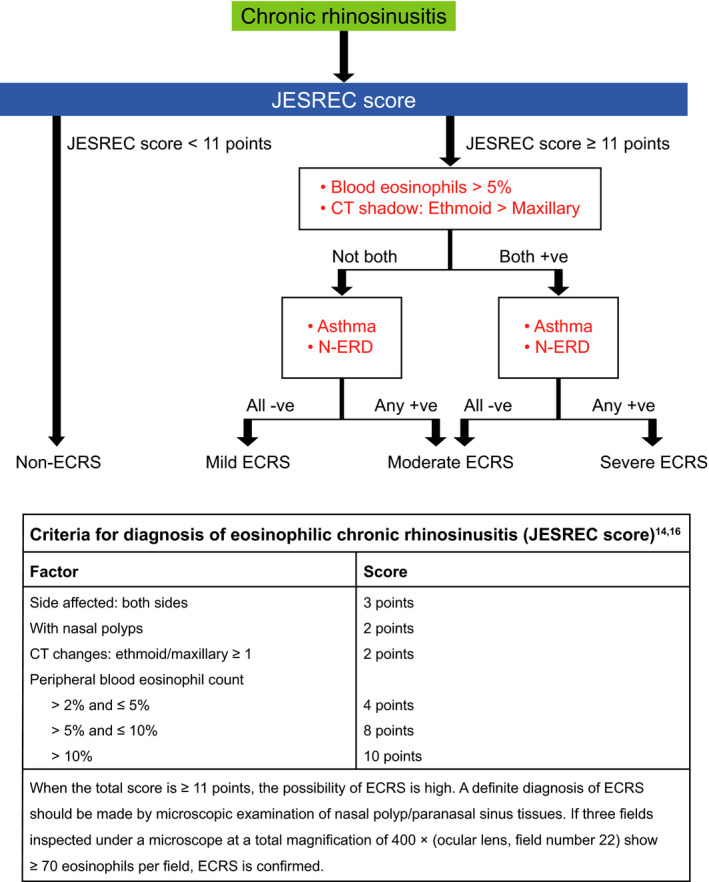
Patients were randomized 1:1:1 to dupilumab 300 mg every 2 weeks (q2w) until week 52; dupilumab 300 mg q2w until Week 24, then 300 mg every 4 weeks until week 52; or placebo (MFNS) until week 52. Coprimary endpoints were change from baseline in nasal polyps score (NPS), nasal congestion (NC), and Lund-Mackay score assessed by CT (LMK-CT) at week 24. Patients (n = 438) were stratified by eosinophilic chronic rhinosinusitis (ECRS) status according to the Japanese Epidemiological Survey of Refractory Eosinophilic Rhinosinusitis algorithm.
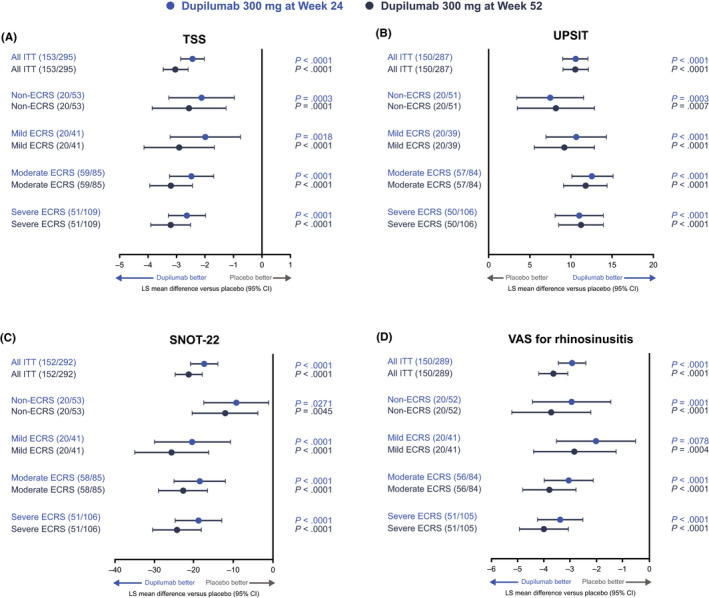
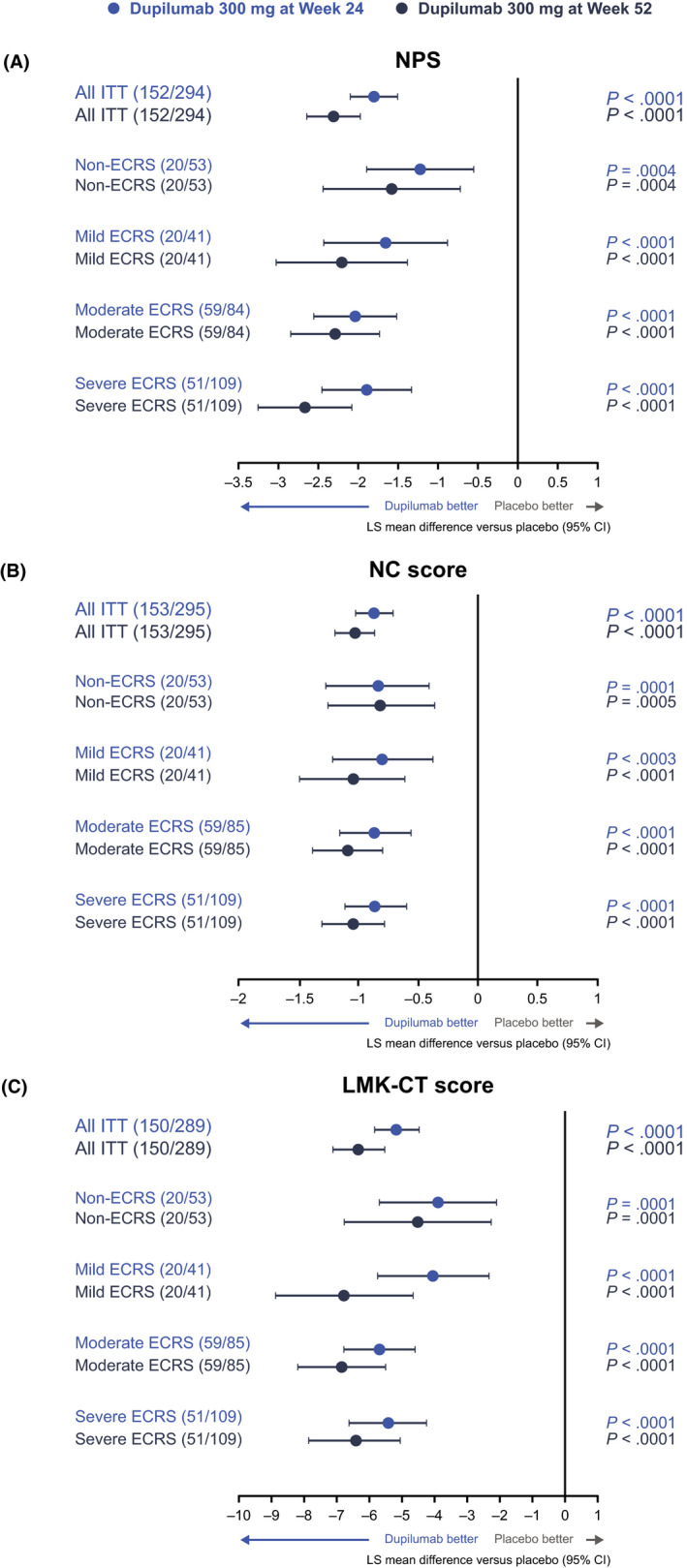
Dupilumab significantly improved NPS, NC, and LMK-CT scores versus placebo at week 24 in all ECRS subgroups (p < 0.001), with improvements maintained or increased at week 52 (p < 0.001). There was no significant interaction between ECRS subgroup (non-/mild or moderate/severe) and dupilumab treatment effect for all endpoints at weeks 24 and 52 (p > 0.05), except LMK-CT at week 24 (p = 0.0275). Similar results were seen for the secondary endpoints. Dupilumab was well tolerated across all ECRS subgroups.
Dupilumab produced consistent improvement in symptoms of severe CRSwNP irrespective of ECRS status. Therefore, blood eosinophil level may not be a suitable biomarker for dupilumab efficacy in CRSwNP.
人源化单克隆抗体度普利尤单抗可阻断白细胞介素(IL)-4 和 IL-13,这两种细胞因子是 2 型炎症的关键和主要驱动因素。在 III 期 SINUS-52 研究(NCT02898454)中,度普利尤单抗联合糠酸莫米松鼻喷雾剂(MFNS)治疗重度慢性鼻-鼻窦炎伴鼻息肉(CRSwNP)患者,改善了患者的结局。本项 SINUS-52 研究的事后分析旨在评估 CRSwNP 的嗜酸性粒细胞状态是否可预测度普利尤单抗的疗效。
患者按 1:1:1 的比例随机分配至度普利尤单抗 300mg,每 2 周(q2w)1 次(直至第 52 周);度普利尤单抗 300mg q2w,直至第 24 周,然后每 4 周 1 次(直至第 52 周);或安慰剂(MFNS)至第 52 周。主要终点是在第 24 周时,鼻息肉评分(NPS)、鼻塞(NC)和 CT 评估的 Lund-Mackay 评分(LMK-CT)较基线的变化。根据日本难治性嗜酸性粒细胞性鼻-鼻窦炎的流行病学调查算法,患者(n=438)根据嗜酸性慢性鼻-鼻窦炎(ECRS)状态进行分层。
在所有 ECRS 亚组中,与安慰剂相比,度普利尤单抗在第 24 周时显著改善了 NPS、NC 和 LMK-CT 评分(p<0.001),并且在第 52 周时这些改善仍持续或增加(p<0.001)。在第 24 周和第 52 周时,所有终点的 ECRS 亚组(非/轻度或中/重度)与度普利尤单抗治疗效果之间均无显著的交互作用(p>0.05),除了第 24 周的 LMK-CT(p=0.0275)。次要终点也观察到了相似的结果。在所有 ECRS 亚组中,度普利尤单抗均具有良好的耐受性。
无论 ECRS 状态如何,度普利尤单抗均能持续改善重度 CRSwNP 的症状。因此,血液嗜酸性粒细胞计数可能不是预测 CRSwNP 中度普利尤单抗疗效的合适生物标志物。