Gras-Valentí Paula, Mora-Muriel Juan G, Chico-Sánchez Pablo, Algado-Sellés Natividad, Soler-Molina Victor M, Hernández-Maldonado María, Lameiras-Azevedo Ana S, Jiménez Sepúlveda Natali J, Gómez Sotero Isel L, Villanueva-Ruiz César O, Barrenengoa-Sañudo Julio, Fuster-Pérez Marina, Cánovas-Jávega Sandra, Cerezo-Milan Patricia, Monerris-Palmer Miranda, Llorens-Soriano Pere, Merino-Lucas Esperanza, Rodríguez-Diaz Juan C, Gil-Carbonell Joan, Sánchez-Martínez Rosario, Pastor-Cesteros Rogelio, Mena-Esquivias Luis, Galiana-Ivars Maria, Jaime-Sánchez Francisco A, Margarit-Ferri Cesar, Gonzalez-deDios Javier, Lloret German, García-Alonso Miguel A, Sánchez-Vela Pablo, Sánchez-Payá José
From the Epidemiology Unit, Preventive Medicine Service.
Internal Medicine Service.
J Patient Saf. 2021 Jun 1;17(4):323-330. doi: 10.1097/PTS.0000000000000852.
Although recommendations to prevent COVID-19 healthcare-associated infections (HAIs) have been proposed, data on their effectivity are currently limited.
The aim was to evaluate the effectivity of a program of control and prevention of COVID-19 in an academic general hospital in Spain.
We captured the number of COVID-19 cases and the type of contact that occurred in hospitalized patients and healthcare personnel (HCP). To evaluate the impact of the continuous use of a surgical mask among HCP, the number of patients with COVID-19 HAIs and accumulated incidence of HCP with COVID-19 was compared between the preintervention and intervention periods.
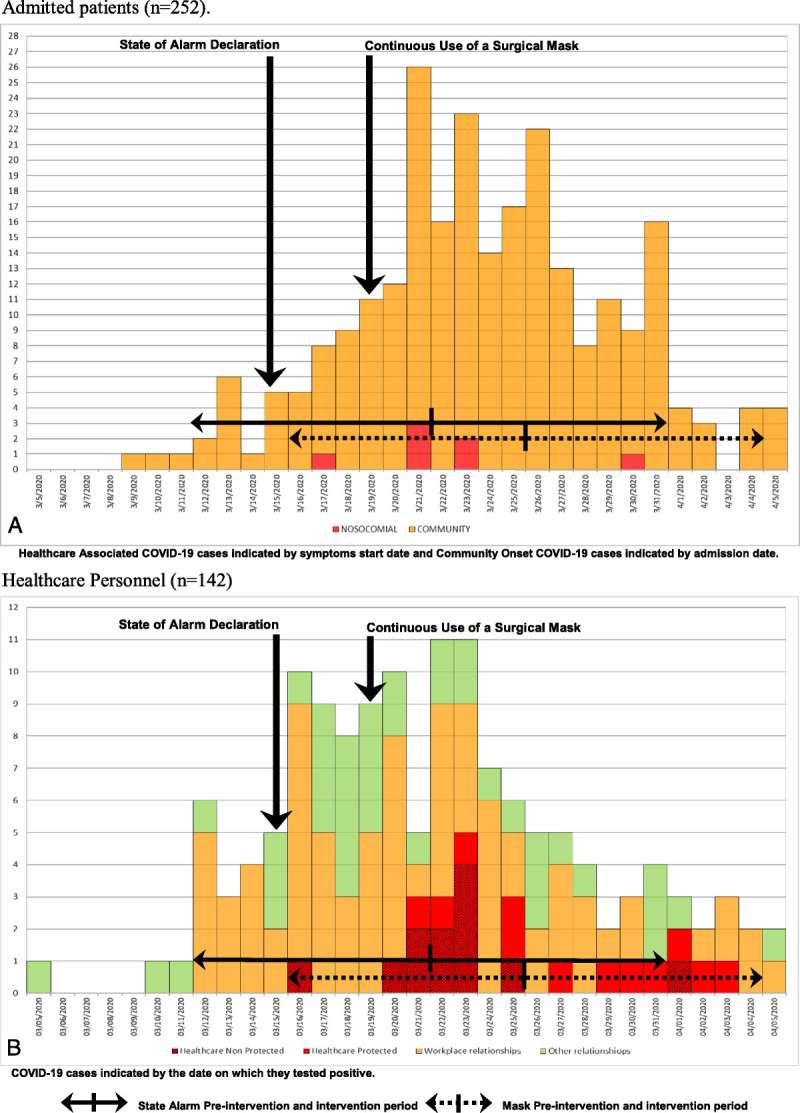
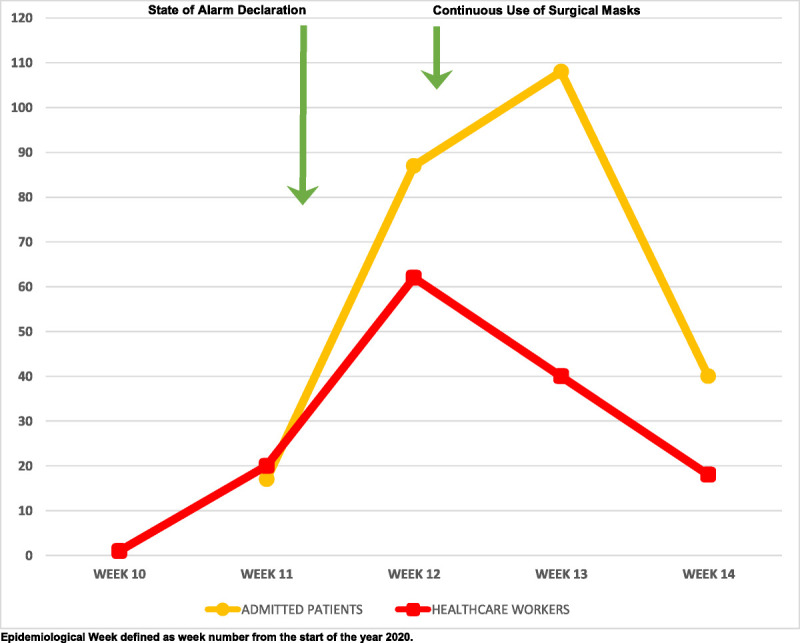
Two hundred fifty-two patients with COVID-19 have been admitted to the hospital. Seven of them had an HAI origin (6 in the preintervention period and 1 in the intervention period). One hundred forty-two HCP were infected with SARS-CoV-2. Of them, 22 (15.5%) were attributed to healthcare (2 in the emergency department and none in the critical care departments), and 120 (84.5%) were attributed to social relations in the workplace or during their non-work-related personal interactions. The accumulated incidence during the preintervention period was 22.3 for every 1000 HCP and 8.2 for every 1000 HCP during the intervention period. The relative risk was 0.37 (95% confidence interval, 0.25 to 0.55) and the attributable risk was -0.014 (95% confidence interval, -0.020 to -0.009).
A program of control and prevention of HAIs complemented with the recommendation for the continuous use of a surgical mask in the workplace and social environments of HCP effectively decreased the risk of COVID-19 HAIs in admitted patients and HCP.
尽管已经提出了预防新型冠状病毒肺炎(COVID-19)医疗相关感染(HAIs)的建议,但目前关于其有效性的数据有限。
旨在评估西班牙一家学术综合医院的COVID-19防控计划的有效性。
我们记录了住院患者和医护人员(HCP)中COVID-19病例的数量以及发生的接触类型。为了评估医护人员持续佩戴外科口罩的影响,比较了干预前和干预期间COVID-19医院获得性感染患者的数量以及感染COVID-19的医护人员的累积发病率。
252例COVID-19患者已入院。其中7例感染源为医院获得性感染(干预前期6例,干预期1例)。142名医护人员感染了严重急性呼吸综合征冠状病毒2(SARS-CoV-2)。其中,22例(15.5%)归因于医疗护理(急诊科2例,重症监护病房无),120例(84.5%)归因于工作场所的社交关系或非工作相关的个人互动。干预前期每1000名医护人员的累积发病率为22.3,干预期间为每1000名医护人员8.2。相对风险为0.37(95%置信区间,0.25至0.55),归因风险为-0.014(95%置信区间,-0.020至-0.009)。
一项医院获得性感染防控计划,辅以在医护人员的工作场所和社交环境中持续佩戴外科口罩的建议,有效降低了住院患者和医护人员感染COVID-19医院获得性感染的风险。