Department of Nuclear Medicine, The First Affiliated Hospital of Shandong First Medical University & Shandong Provincial Qianfoshan Hospital, Jinan 250014, China.
Biomedical Sciences College & Shandong Medicinal Biotechnology Centre, Shandong First Medical University & Shandong Academy of Medical Sciences, Jinan 250062, China.
Int J Biol Sci. 2021 Apr 16;17(7):1708-1715. doi: 10.7150/ijbs.58888. eCollection 2021.
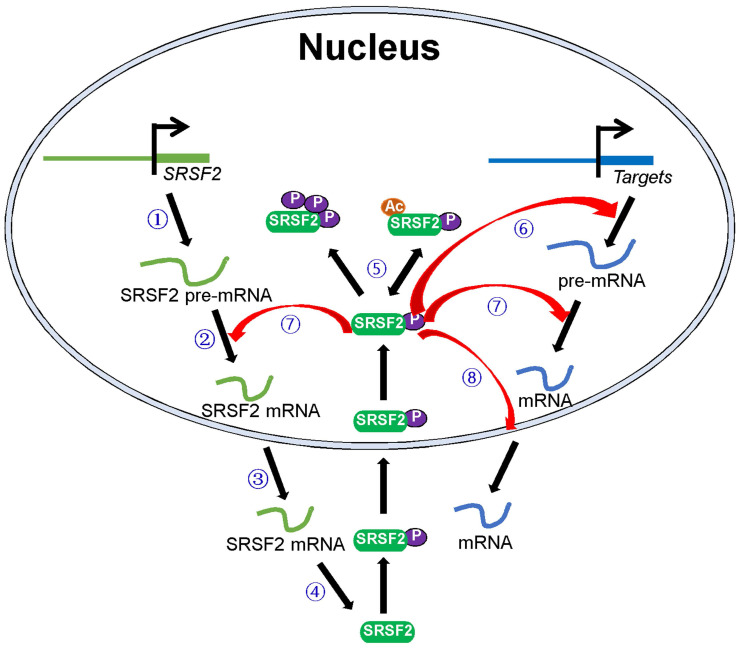
Serine/arginine-rich splicing factor 2 (SRSF2) is a splicing factor that is widely expressed in a variety of mammalian cell types. Increasing evidence has confirmed that SRSF2 plays vital roles in a number of biological and pathological processes. Therefore, it is important to understand how its expression is regulated, and how it regulates the expression of its target genes. Recently, we found that SRSF2 expression could be upregulated by herpes simplex virus-1 (HSV-1) infection and that altered SRSF2 expression, in turn, epigenetically regulates the transcription of HSV-1 genes. Further studies on T cell exhaustion demonstrated that upregulated SRSF2 in exhausted T cells elevated the levels of multiple immune checkpoint molecules by associating with the acyl-transferases, P300 and CBP, and by altering histone modification near the transcription start sites of these genes, thereby influencing signal transducer and activator of transcription 3 binding to these gene promoters. These findings suggest that SRSF2 acts as an important sensor and effector during disease progression. Here, we discuss the molecules that regulate gene expression and their associated mechanisms, and the mechanisms via which SRSF2 regulates the expression of target genes, thus providing novel insights into the central role of SRSF2 in gene regulation.
丝氨酸/精氨酸丰富剪接因子 2(SRSF2)是一种剪接因子,广泛表达于多种哺乳动物细胞类型中。越来越多的证据证实,SRSF2 在许多生物学和病理学过程中发挥着重要作用。因此,了解其表达如何受到调控以及它如何调控其靶基因的表达非常重要。最近,我们发现单纯疱疹病毒 1(HSV-1)感染可上调 SRSF2 的表达,而 SRSF2 表达的改变又通过表观遗传调控 HSV-1 基因的转录。进一步研究 T 细胞耗竭表明,在耗竭的 T 细胞中上调的 SRSF2 通过与酰基转移酶 P300 和 CBP 结合,并改变这些基因转录起始位点附近的组蛋白修饰,从而影响信号转导和转录激活因子 3 与这些基因启动子的结合,从而上调多个免疫检查点分子的水平。这些发现表明 SRSF2 在疾病进展过程中充当重要的传感器和效应器。在这里,我们讨论了调控基因表达的分子及其相关机制,以及 SRSF2 调控靶基因表达的机制,从而为 SRSF2 在基因调控中的核心作用提供了新的见解。