Nies Yong Hui, Mohamad Najib Nor Haliza, Lim Wei Ling, Kamaruzzaman Mohd Amir, Yahaya Mohamad Fairuz, Teoh Seong Lin
Department of Anatomy, Faculty of Medicine, Universiti Kebangsaan Malaysia Medical Centre, Kuala Lumpur, Malaysia.
Department of Biological Sciences, School of Medical and Life Sciences, Sunway University, Selangor, Malaysia.
Front Neurosci. 2021 Apr 30;15:660379. doi: 10.3389/fnins.2021.660379. eCollection 2021.
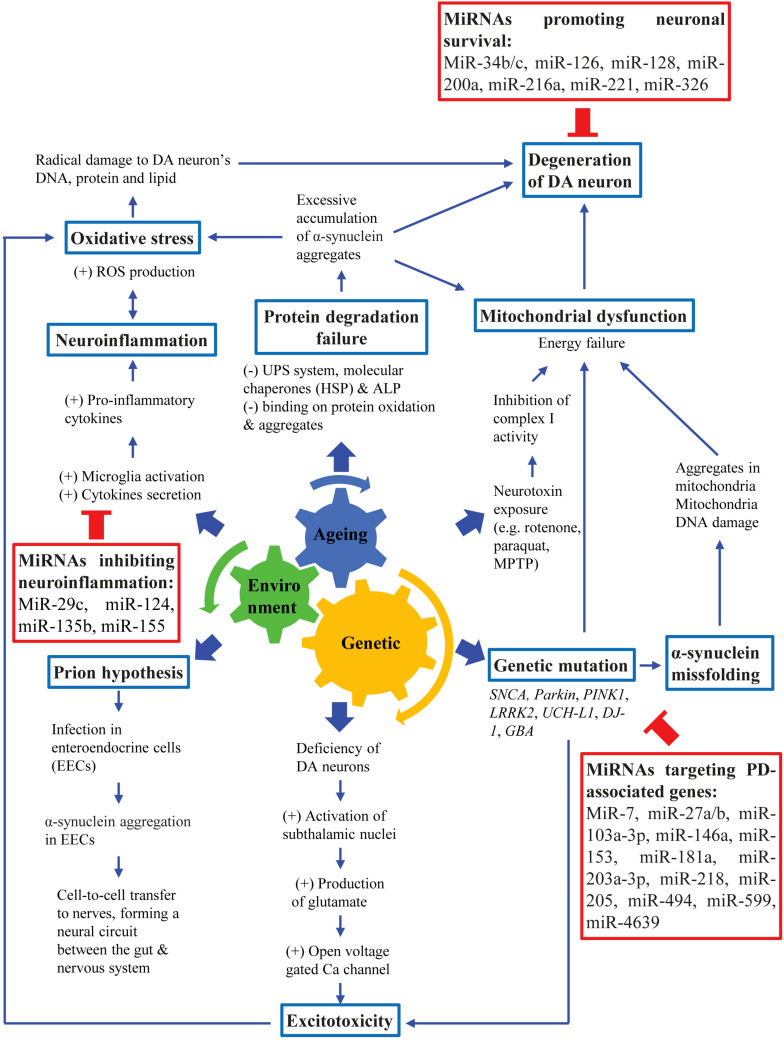
Parkinson's disease (PD) is a severely debilitating neurodegenerative disease, affecting the motor system, leading to resting tremor, cogwheel rigidity, bradykinesia, walking and gait difficulties, and postural instability. The severe loss of dopaminergic neurons in the substantia nigra pars compacta causes striatal dopamine deficiency and the presence of Lewy bodies indicates a pathological hallmark of PD. Although the current treatment of PD aims to preserve dopaminergic neurons or to replace dopamine depletion in the brain, it is notable that complete recovery from the disease is yet to be achieved. Given the complexity and multisystem effects of PD, the underlying mechanisms of PD pathogenesis are yet to be elucidated. The advancement of medical technologies has given some insights in understanding the mechanism and potential treatment of PD with a special interest in the role of microRNAs (miRNAs) to unravel the pathophysiology of PD. In PD patients, it was found that striatal brain tissue and dopaminergic neurons from the substantia nigra demonstrated dysregulated miRNAs expression profiles. Hence, dysregulation of miRNAs may contribute to the pathogenesis of PD through modulation of PD-associated gene and protein expression. This review will discuss recent findings on PD-associated miRNAs dysregulation, from the regulation of PD-associated genes, dopaminergic neuron survival, α-synuclein-induced inflammation and circulating miRNAs. The next section of this review also provides an update on the potential uses of miRNAs as diagnostic biomarkers and therapeutic tools for PD.
帕金森病(PD)是一种严重致残的神经退行性疾病,影响运动系统,导致静止性震颤、齿轮样强直、运动迟缓、行走和步态困难以及姿势不稳。黑质致密部多巴胺能神经元的严重丧失导致纹状体多巴胺缺乏,而路易小体的存在是PD的病理标志。尽管目前PD的治疗旨在保护多巴胺能神经元或补充大脑中的多巴胺缺乏,但值得注意的是,该疾病尚未实现完全康复。鉴于PD的复杂性和多系统影响,PD发病机制的潜在机制尚未阐明。医学技术的进步为理解PD的机制和潜在治疗提供了一些见解,尤其关注微小RNA(miRNA)在揭示PD病理生理学中的作用。在PD患者中,发现纹状体脑组织和黑质中的多巴胺能神经元表现出miRNA表达谱失调。因此,miRNA的失调可能通过调节与PD相关的基因和蛋白质表达而导致PD的发病机制。本综述将讨论关于与PD相关的miRNA失调的最新发现,包括与PD相关基因的调节、多巴胺能神经元存活、α-突触核蛋白诱导的炎症以及循环miRNA。本综述的下一部分还提供了关于miRNA作为PD诊断生物标志物和治疗工具的潜在用途的最新信息。