Department of Neurology, Innsbruck Medical University, Innsbruck, Austria.
Department for Medical Genetics, Molecular, and Clinical Pharmacology, Innsbruck Medical University, Innsbruck, Austria.
Ann Neurol. 2020 Oct;88(4):712-722. doi: 10.1002/ana.25864. Epub 2020 Aug 31.
The objective of this study was to assess the efficacy and safety of nabilone, a synthetic tetrahydrocannabinol analogue, as a treatment for non-motor symptoms (NMS) in Parkinson's disease (PD).
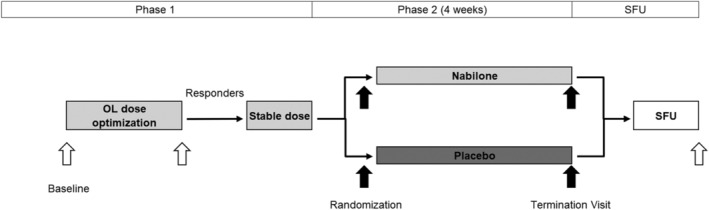
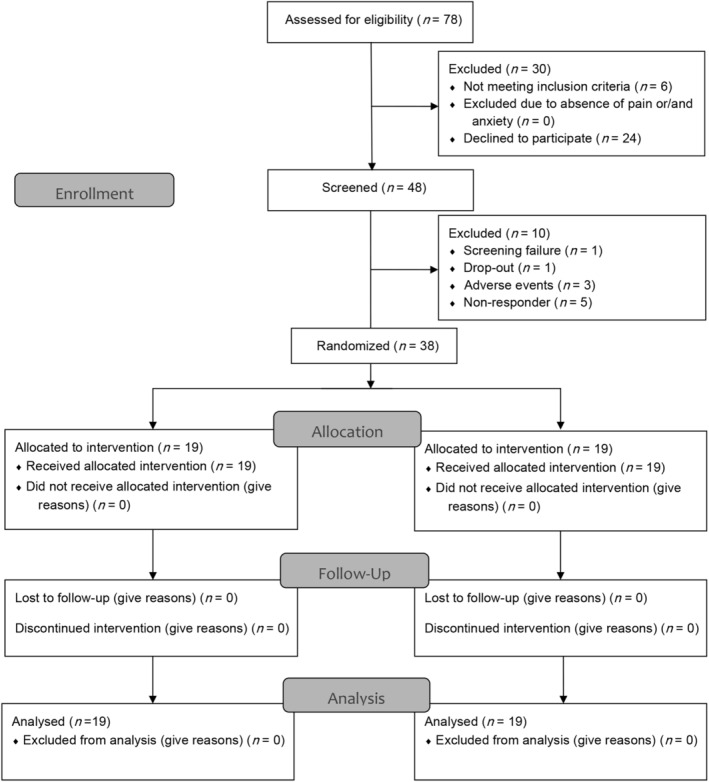
This was a phase II placebo-controlled, double-blind, parallel-group, enriched enrollment randomized withdrawal trial conducted at the Medical University Innsbruck. A random sample of 47 patients with PD with stable motor disease and disturbing NMS defined by a score of ≥4 points on the Movement Disorder Society - Unified PD Rating Scale-I (MDS-UPDRS-I) underwent open-label nabilone titration (0.25 mg once daily to 1 mg twice daily, phase I). Responders were randomized 1:1 to continue with nabilone or switch to placebo for 4 weeks (phase II). The primary efficacy criterion was the change of the MDS-UPDRS-I between randomization and week 4. Safety was analyzed in all patients who received at least one nabilone dose.
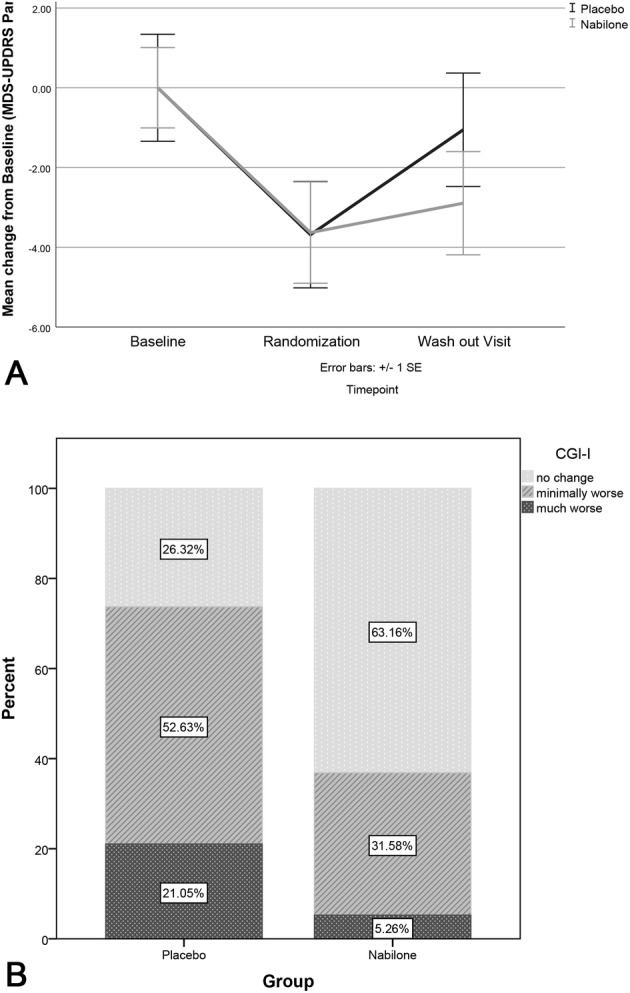
Between October 2017 and July 2019, 19 patients received either nabilone (median dose = 0.75 mg) or placebo. At week 4, mean change of the MDS-UPDRS-I was 2.63 (95% confidence interval [CI] 1.53 to 3.74, p = 0.002, effect size = 1.15) in the placebo versus 1.00 (95% CI -0.16 to 2.16, p = 0.280, effect size = 0.42) in the nabilone-group (difference: 1.63, 95% CI 0.09 to 3.18, p = 0.030, effect size = 0.66). Seventy-seven percent of patients had adverse events (AEs) during open-label titration, most of them were transient. In the double-blind phase, similar proportions of patients in each group had AEs (42% in the placebo group and 32% in the nabilone group). There were no serious AEs.
Our results highlight the potential efficacy of nabilone for patients with PD with disturbing NMS, which appears to be driven by positive effects on anxious mood and night-time sleep problems.
ClinicalTrials.gov (NCT03769896) and EudraCT (2017-000192-86). ANN NEUROL 2020;88:712-722.
本研究旨在评估合成四氢大麻酚类似物纳布隆治疗帕金森病(PD)非运动症状(NMS)的疗效和安全性。
这是一项在因斯布鲁克医科大学进行的 II 期安慰剂对照、双盲、平行组、富集入组随机撤药试验。一项由 47 例稳定运动疾病且 NMS 评分≥4 分(MDS-UPDRS-I 运动障碍协会统一 PD 评定量表)的 PD 患者组成的随机样本接受了纳布隆的开放标签滴定(0.25mg 每日一次至 1mg 每日两次,I 期)。应答者以 1:1 的比例随机继续接受纳布隆或切换至安慰剂 4 周(II 期)。主要疗效标准是随机化至第 4 周时 MDS-UPDRS-I 的变化。对至少接受一次纳布隆剂量的所有患者进行安全性分析。
2017 年 10 月至 2019 年 7 月,19 例患者接受了纳布隆(中位数剂量=0.75mg)或安慰剂治疗。在第 4 周时,安慰剂组的 MDS-UPDRS-I 平均变化为 2.63(95%置信区间 [CI] 1.53 至 3.74,p=0.002,效应大小=1.15),纳布隆组为 1.00(95% CI -0.16 至 2.16,p=0.280,效应大小=0.42)(差异:1.63,95% CI 0.09 至 3.18,p=0.030,效应大小=0.66)。77%的患者在开放标签滴定期间出现不良事件(AE),大多数为短暂性的。在双盲阶段,每组患者出现 AE 的比例相似(安慰剂组为 42%,纳布隆组为 32%)。无严重 AE。
我们的结果突出了纳布隆治疗有干扰 NMS 的 PD 患者的潜在疗效,这似乎是由于对焦虑情绪和夜间睡眠问题的积极影响。
ClinicalTrials.gov(NCT03769896)和 EudraCT(2017-000192-86)。神经病学年鉴 2020;88:712-722。