Wu Xiaoli, Bai Fan, Wang Yunlei, Zhang Lu, Liu Lixu, Chen Yudong, Li Hanzhi, Zhang Tong
Department of Neurorehabilitation, Rehabilitation Medicine of Capital Medical University, China Rehabilitation Research Centre, Beijing, China.
China Rehabilitation Science Institute of China Rehabilitation Research Centre, Beijing, China.
Front Neurol. 2021 Apr 30;12:664610. doi: 10.3389/fneur.2021.664610. eCollection 2021.
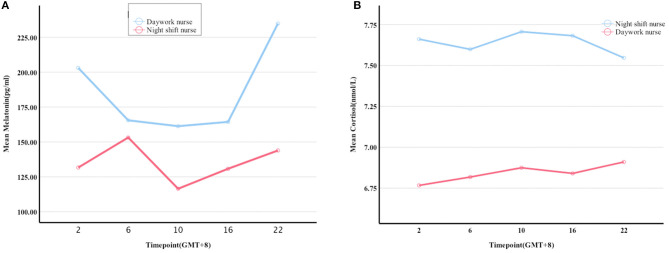
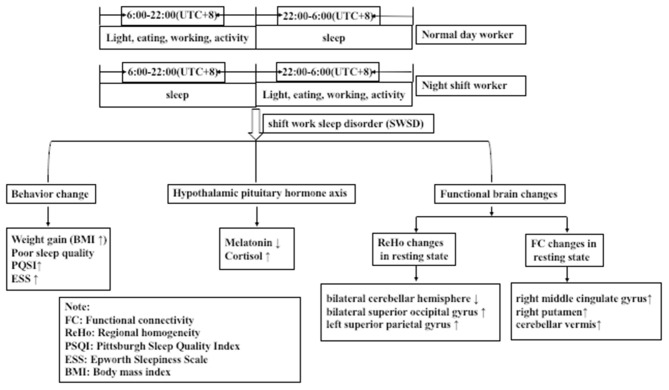
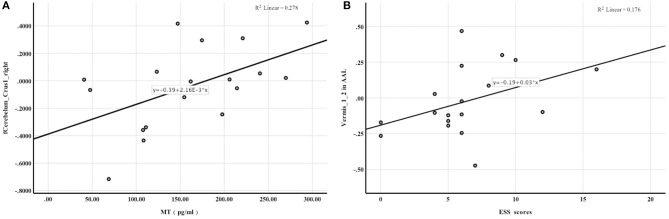
Shift work is associated with a decrease in melatonin level and perturbation of the circadian rhythm; however, it is unknown if these lead to functional brain changes. In this study, we investigated whether circadian rhythm disorders caused by shift work are related to changes in brain functional connectivity (FC) and regional homogeneity (ReHo) using whole-brain resting-state functional magnetic resonance imaging (fMRI). This prospective case-control study included nine female night shift nurses and nine age-matched female day work nurses with normal sleep rhythms. To assess sleep quality and mood, participants were asked to complete questionnaires. Serum melatonin and cortisol levels were measured. ReHo of whole-brain resting-state function and seed-based FC of the bilateral hypothalamus were compared between groups. Variables that differed significantly between groups were used to examine the association between questionnaire scores and hormone levels and fMRI data. The night shift nurses had significantly lower sleep quality and melatonin levels; lower ReHo activation in the bilateral cerebellar hemisphere and higher ReHo in the bilateral occipital lobe and left parietal lobe; and higher FC from the hypothalamus to the right cingulate gyrus, right putamen, and vermis than did the day shift nurses. Activation of the right cerebellar hemisphere left superior parietal gyrus, and the right superior occipital gyrus was correlated with sleep quality scores. Moreover, activation of the right cerebellar hemisphere ( = 0.583, = 0.011) was correlated with melatonin levels, and higher sleepiness scores were associated with stronger FC between the hypothalamus and vermis ( = 0.501, = 0.034). Circadian rhythm disorder caused by night shift work can lead to a decrease in sleep quality and melatonin level, as well as a series of changes in brain FC and ReHo.
轮班工作与褪黑素水平降低和昼夜节律紊乱有关;然而,尚不清楚这些是否会导致大脑功能改变。在本研究中,我们使用全脑静息态功能磁共振成像(fMRI),研究了轮班工作引起的昼夜节律紊乱是否与脑功能连接(FC)和局部一致性(ReHo)的变化有关。这项前瞻性病例对照研究纳入了9名睡眠节律正常的女性夜班护士和9名年龄匹配的女性白班护士。为了评估睡眠质量和情绪,参与者被要求完成问卷调查。测量血清褪黑素和皮质醇水平。比较两组之间全脑静息态功能的ReHo和双侧下丘脑基于种子点的FC。两组之间有显著差异的变量用于检验问卷得分与激素水平和fMRI数据之间的关联。夜班护士的睡眠质量和褪黑素水平显著较低;双侧小脑半球的ReHo激活较低,双侧枕叶和左侧顶叶的ReHo较高;与白班护士相比,从下丘脑到右侧扣带回、右侧壳核和蚓部的FC更高。右侧小脑半球、左侧顶上小叶和右侧枕上回的激活与睡眠质量得分相关。此外,右侧小脑半球的激活(r = 0.583,P = 0.011)与褪黑素水平相关,更高的嗜睡得分与下丘脑和蚓部之间更强的FC相关(r = 0.501,P = 0.034)。夜班工作引起的昼夜节律紊乱可导致睡眠质量和褪黑素水平下降,以及脑FC和ReHo的一系列变化。