Jiang Zhuang, Zhang Jiajia, Wang Ying, Huang Xuan, Yao Qingxiu, Feng Yanmei, Huang Shujian, Wang Hui, Yin Shankai
Department of Otolaryngology-Head and Neck Surgery, Shanghai Jiao Tong University Affiliated Sixth People's Hospital, Shanghai, China.
Otolaryngology Institute of Shanghai Jiao Tong University, Shanghai, China.
Front Neurol. 2021 Apr 29;12:667804. doi: 10.3389/fneur.2021.667804. eCollection 2021.
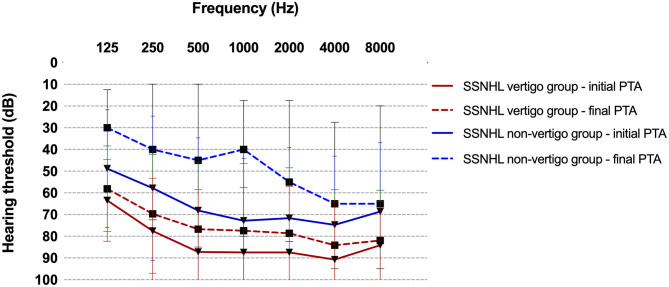
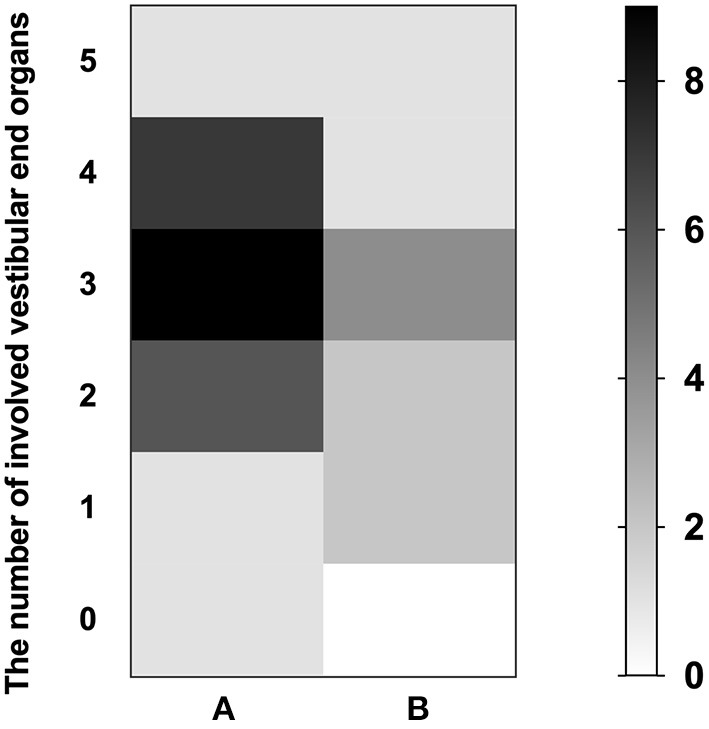
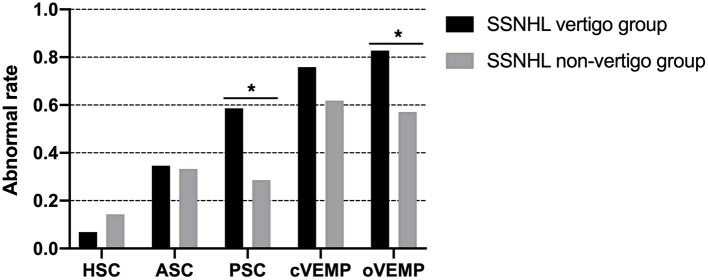
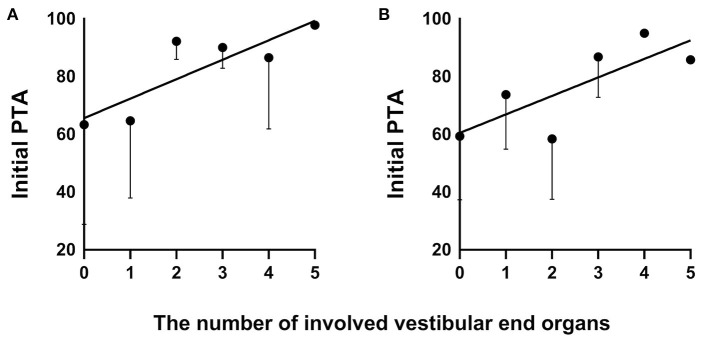
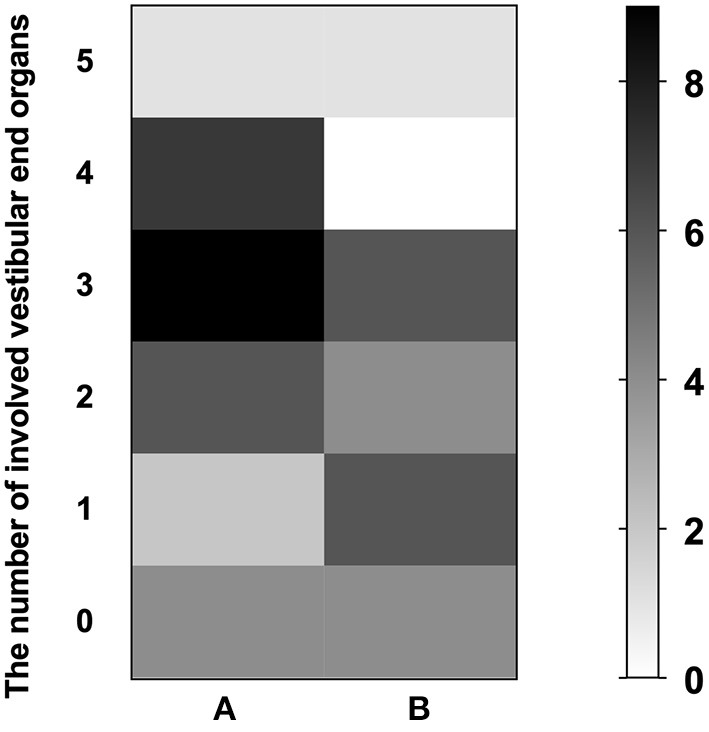
We aimed to identify the relationship between vertigo symptoms and the involvement of vestibular dysfunction in sudden sensorineural hearing loss (SSNHL) and the contribution of audiogram classification. A total of 50 patients with unilateral SSNHL were retrospectively divided into the vertigo group and non-vertigo group depending on the presence of vertigo. The involved vestibular end organs (VEOs) were verified by a battery of vestibular function tests including video head impulse test (vHIT), cervical vestibular-evoked myogenic potential (cVEMP), and ocular VEMP (oVEMP). The correlations of audiogram configurations, initial pure-tone average (PTA), number of involved VEOs, prognosis (complete recovery rate), and vestibular functions were analyzed between the two groups. Additionally, the vestibular functions in a subgroup of profound SSNHL patients were further compared within groups with or without vertigo. Significant differences in the initial audiogram configurations ( = 0.033) and the abnormal rates of the posterior semicircular canal (PSC) ( = 0.035) and oVEMP ( = 0.046) were found between the two groups. The number of involved VEOs was related to the initial PTA in the vertigo group ( = 0.002, = 0.541) and non-vertigo group ( = 0.042, = 0.446). The prognosis was related to the abnormal rate of cVEMP and the number of involved VEOs in both vertigo group ( = 0.008, = 0.482; = 0.039, = 0.385, respectively) and non-vertigo group ( = 0.016, = 0.520; = 0.022, = 0.495, respectively), and it was especially related to the audiogram configurations in the vertigo group ( < 0.001, = 0.692). However, after classification by audiogram configurations, there was no statistical difference in the abnormal rates of all vestibular function tests or the number of involved VEOs between the profound SSNHL patients with or without vertigo. The relationship between the involvement of vestibular dysfunction and vertigo symptoms in patients with SSNHL was significantly different before and after audiogram classification. When evaluating the vestibular dysfunction in SSNHL patients, more attention should be paid to the audiogram configuration.
我们旨在确定突发性感音神经性听力损失(SSNHL)中眩晕症状与前庭功能障碍受累之间的关系以及听力图分类的作用。根据是否存在眩晕,将50例单侧SSNHL患者回顾性地分为眩晕组和非眩晕组。通过一系列前庭功能测试,包括视频头脉冲试验(vHIT)、颈前庭诱发肌源性电位(cVEMP)和眼VEMP(oVEMP),来验证受累的前庭终器(VEOs)。分析了两组之间听力图形态、初始纯音平均听阈(PTA)、受累VEOs数量、预后(完全恢复率)和前庭功能的相关性。此外,在极重度SSNHL患者亚组中,进一步比较了有或无眩晕组之间的前庭功能。两组之间在初始听力图形态(P = 0.033)、后半规管(PSC)异常率(P = 0.035)和oVEMP异常率(P = 0.046)方面存在显著差异。眩晕组(P = 0.002,r = 0.541)和非眩晕组(P = 0.042,r = 0.446)中受累VEOs数量与初始PTA相关。眩晕组(分别为P = 0.008,r = 0.482;P = 0.