Jauregi Leire, Epelde Lur, Alkorta Itziar, Garbisu Carlos
Department of Conservation of Natural Resources, NEIKER-Basque Institute for Agricultural Research and Development, Basque Research and Technology Alliance (BRTA), Derio, Spain.
Department of Biochemistry and Molecular Biology, University of the Basque Country (UPV/EHU), Bilbao, Spain.
Front Microbiol. 2021 Apr 28;12:666854. doi: 10.3389/fmicb.2021.666854. eCollection 2021.
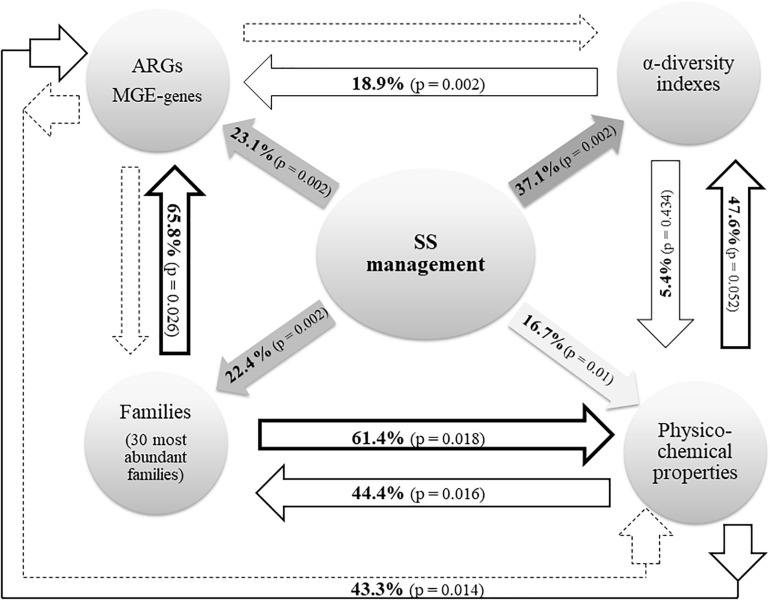
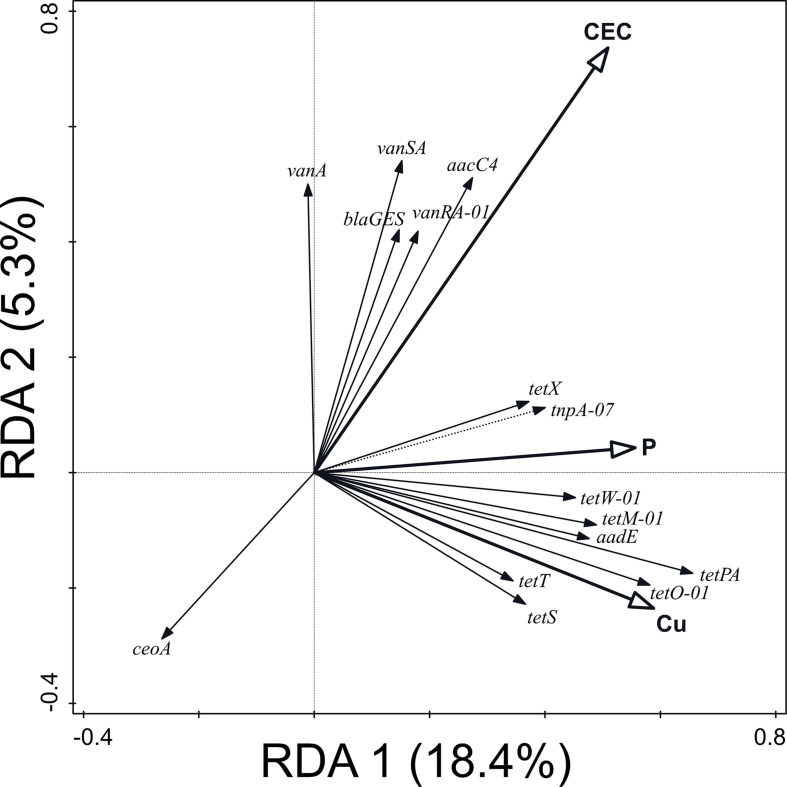
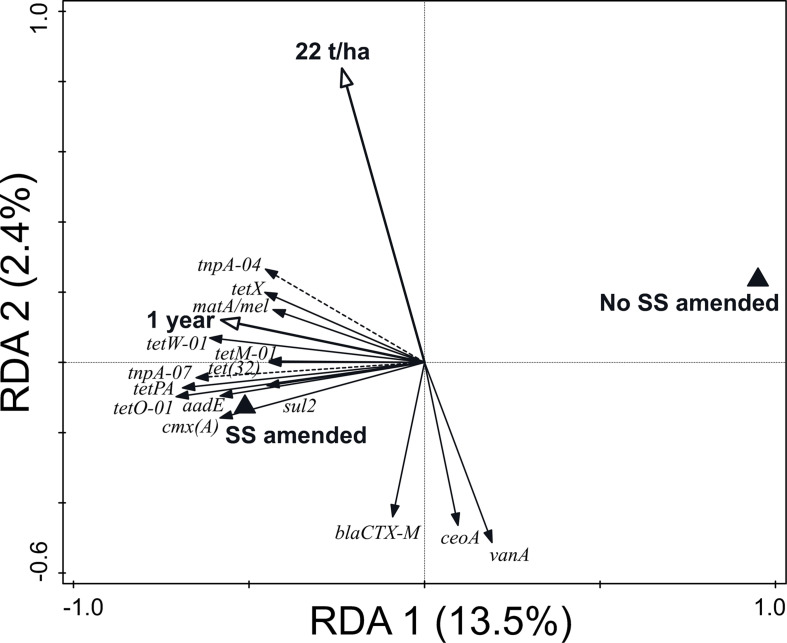
The application of sewage sludge (SS) to agricultural soil can help meet crop nutrient requirements and enhance soil properties, while reusing an organic by-product. However, SS can be a source of antibiotic resistance genes (ARGs) and mobile genetic elements (MGEs), resulting in an increased risk of antibiotic resistance dissemination. We studied the effect of the application of thermally-dried anaerobically-digested SS on (i) soil physicochemical and microbial properties, and (ii) the relative abundance of 85 ARGs and 10 MGE-genes in soil. Soil samples were taken from a variety of SS-amended agricultural fields differing in three factors: dose of application, dosage of application, and elapsed time after the last application. The relative abundance of both ARGs and MGE-genes was higher in SS-amended soils, compared to non-amended soils, particularly in those with a more recent SS application. Some physicochemical parameters (i.e., cation exchange capacity, copper concentration, phosphorus content) were positively correlated with the relative abundance of ARGs and MGE-genes. Sewage sludge application was the key factor to explain the distribution pattern of ARGs and MGE-genes. The 30 most abundant families within the soil prokaryotic community accounted for 66% of the total variation of ARG and MGE-gene relative abundances. Soil prokaryotic α-diversity was negatively correlated with the relative abundance of ARGs and MGE-genes. We concluded that agricultural soils amended with thermally-dried anaerobically-digested sewage sludge showed increased risk of antibiotic resistance dissemination.
将污水污泥(SS)施用于农业土壤有助于满足作物养分需求并改善土壤性质,同时还能实现有机副产品的再利用。然而,污水污泥可能是抗生素抗性基因(ARGs)和移动遗传元件(MGEs)的来源,从而增加抗生素抗性传播的风险。我们研究了热干燥厌氧消化污水污泥的施用对(i)土壤理化性质和微生物特性,以及(ii)土壤中85种抗生素抗性基因和10种移动遗传元件基因相对丰度的影响。土壤样本取自多种施用污水污泥的农田,这些农田在三个因素上存在差异:施用量、施用剂量以及上次施用后的时间。与未施用污水污泥的土壤相比,施用污水污泥的土壤中抗生素抗性基因和移动遗传元件基因的相对丰度更高,尤其是在最近施用污水污泥的土壤中。一些理化参数(即阳离子交换容量、铜浓度、磷含量)与抗生素抗性基因和移动遗传元件基因的相对丰度呈正相关。污水污泥的施用是解释抗生素抗性基因和移动遗传元件基因分布模式的关键因素。土壤原核生物群落中最丰富的30个科占抗生素抗性基因和移动遗传元件基因相对丰度总变异的66%。土壤原核生物的α多样性与抗生素抗性基因和移动遗传元件基因的相对丰度呈负相关。我们得出结论,用热干燥厌氧消化污水污泥改良的农业土壤显示出抗生素抗性传播风险增加。