Hu Yuanliang, Lei Xinyi, Zhang Xiaomin, Guan Tongwei, Wang Luyao, Zhang Zongjie, Yu Xiang, Tu Junming, Peng Nan, Liang Yunxiang, Zhao Shumiao
Hubei Key Laboratory of Edible Wild Plants Conservation and Utilization, College of Life Sciences, Hubei Normal University, Huangshi, China.
State Key Laboratory of Agricultural Microbiology, College of Life Science and Technology, Huazhong Agricultural University, Wuhan, China.
Front Microbiol. 2021 Apr 29;12:673670. doi: 10.3389/fmicb.2021.673670. eCollection 2021.
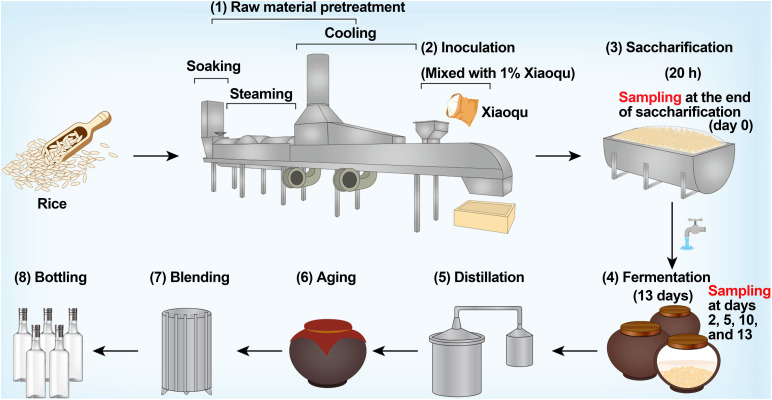
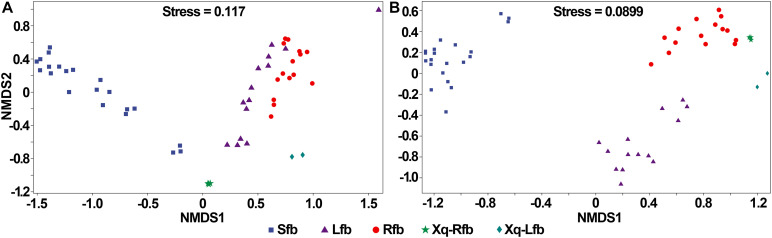
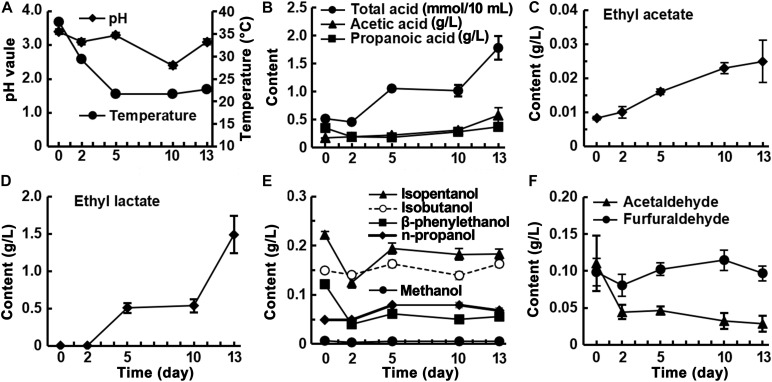
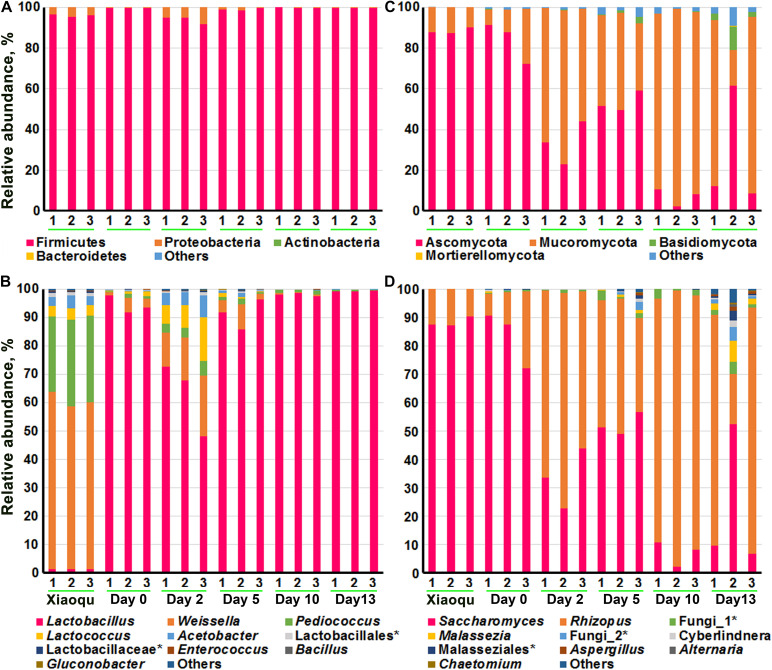
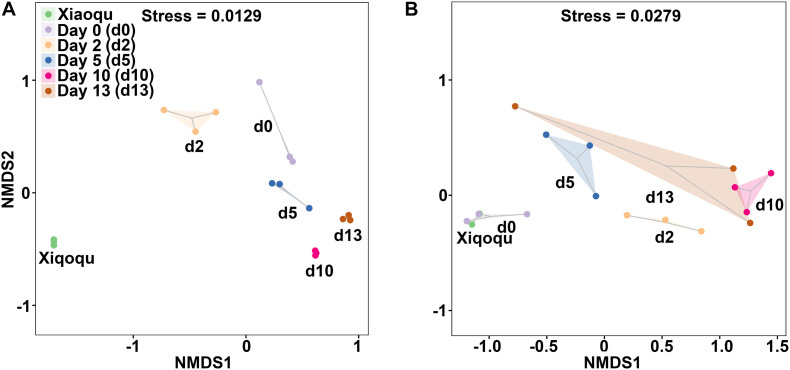
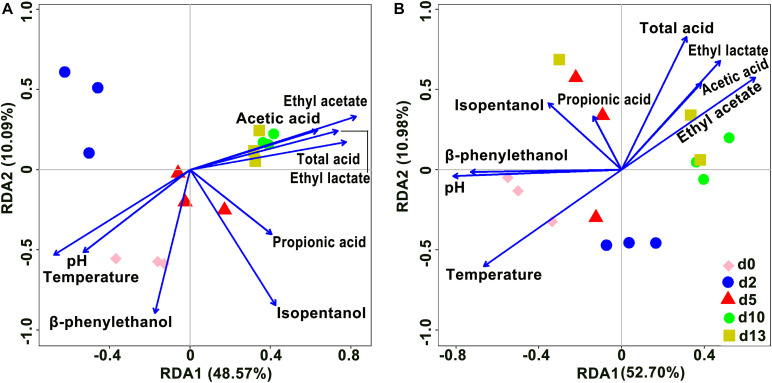
Rice-flavor baijiu is one of the four basic flavor types of Chinese baijiu. Microbial composition plays a key role in the classification of baijiu flavor types and the formation of flavor substances. In this study, we used high-throughput sequencing technology to study the changes of microbial community in the production of rice-flavor baijiu, and compared the microbial community characteristics during production of rice-, light-, and strong-flavor baijiu. The results showed that the species diversity of bacteria was much higher than that of fungi during the brewing of rice-flavor baijiu. The bacterial diversity index first increased and then decreased, while the diversity of fungi showed an increasing trend. A variety of major microorganisms came from the environment and raw rice materials; the core bacteria were , , , , , etc., among which was dominant (62.88-99.23%). The core fungi were (7.06-83.50%) and (15.21-90.89%). Temperature and total acid content were the main physicochemical factors affecting the microbial composition. Non-metric multidimensional scaling analysis showed that during the fermentation of rice-, light-, and strong-flavor baijiu, their microbial communities formed their own distinct systems, with considerable differences among different flavor types. Compared with the other two flavor types of baijiu, in the brewing process of rice-flavor baijiu, microbial species were fewer and dominant microorganisms were prominent, which may be the main reason for the small variety of flavor substances in rice-flavor baijiu. This study provides a theoretical basis for the production of rice-flavor baijiu, and lays a foundation for studying the link between baijiu flavor formation and microorganisms.
米香型白酒是中国白酒四大基本香型之一。微生物组成在白酒香型分类和风味物质形成中起关键作用。本研究利用高通量测序技术研究米香型白酒生产过程中微生物群落的变化,并比较了米香型、清香型和浓香型白酒生产过程中的微生物群落特征。结果表明,在米香型白酒酿造过程中,细菌的物种多样性远高于真菌。细菌多样性指数先升高后降低,而真菌多样性呈上升趋势。多种主要微生物来源于环境和原料大米;核心细菌有芽孢杆菌属、乳杆菌属、醋酸菌属、魏斯氏菌属、片球菌属等,其中芽孢杆菌属占主导地位(62.88 - 99.23%)。核心真菌是曲霉属(7.06 - 83.50%)和酵母属(15.21 - 90.89%)。温度和总酸含量是影响微生物组成的主要理化因素。非度量多维标度分析表明,在米香型、清香型和浓香型白酒发酵过程中,它们的微生物群落形成了各自独特的系统,不同香型之间存在显著差异。与其他两种香型白酒相比,在米香型白酒酿造过程中,微生物种类较少且优势微生物突出,这可能是米香型白酒风味物质种类较少的主要原因。本研究为米香型白酒的生产提供了理论依据,为研究白酒风味形成与微生物之间的联系奠定了基础。