Zhai Guang-Yao, Qie Shu-Yan, Guo Qian-Yun, Qi Yue, Zhou Yu-Jie
Department of Cardiology, Beijing Anzhen Hospital, Capital Medical University, Beijing Institute of Heart Lung and Blood Vessel Disease, Beijing Key Laboratory of Precision Medicine of Coronary Atherosclerotic Disease, Clinical Center for Coronary Heart Disease, Capital Medical University, Beijing, China.
Department of Rehabilitation, Beijing Rehabilitation Hospital of Capital Medical University, Beijing, China.
J Geriatr Cardiol. 2021 Apr 28;18(4):271-280. doi: 10.11909/j.issn.1671-5411.2021.04.003.
M1 polarization of macrophages is an important pathological process in myocardial ischemia reperfusion injury, which is the major obstacle for the treatment of acute myocardial infarction. Currently, the strategies and mechanisms of inhibiting M1 polarization are poorly explored. This study aims to investigate the role of soluble death receptor 5-Fc (sDR5-Fc) in regulating M1 polarization of macrophages under extreme conditions and explore the mechanisms from the aspect of glycolysis.
Extreme conditions were induced in RAW264.7 cells. Real-time quantitative polymerase chain reaction and western blot were used to detect the expression of mRNA and proteins, respectively. Cell counting kit-8 was used to investigate the proliferation activity of cells. Expression levels of inflammatory cytokines were determined by enzyme-linked immunosorbent assay.
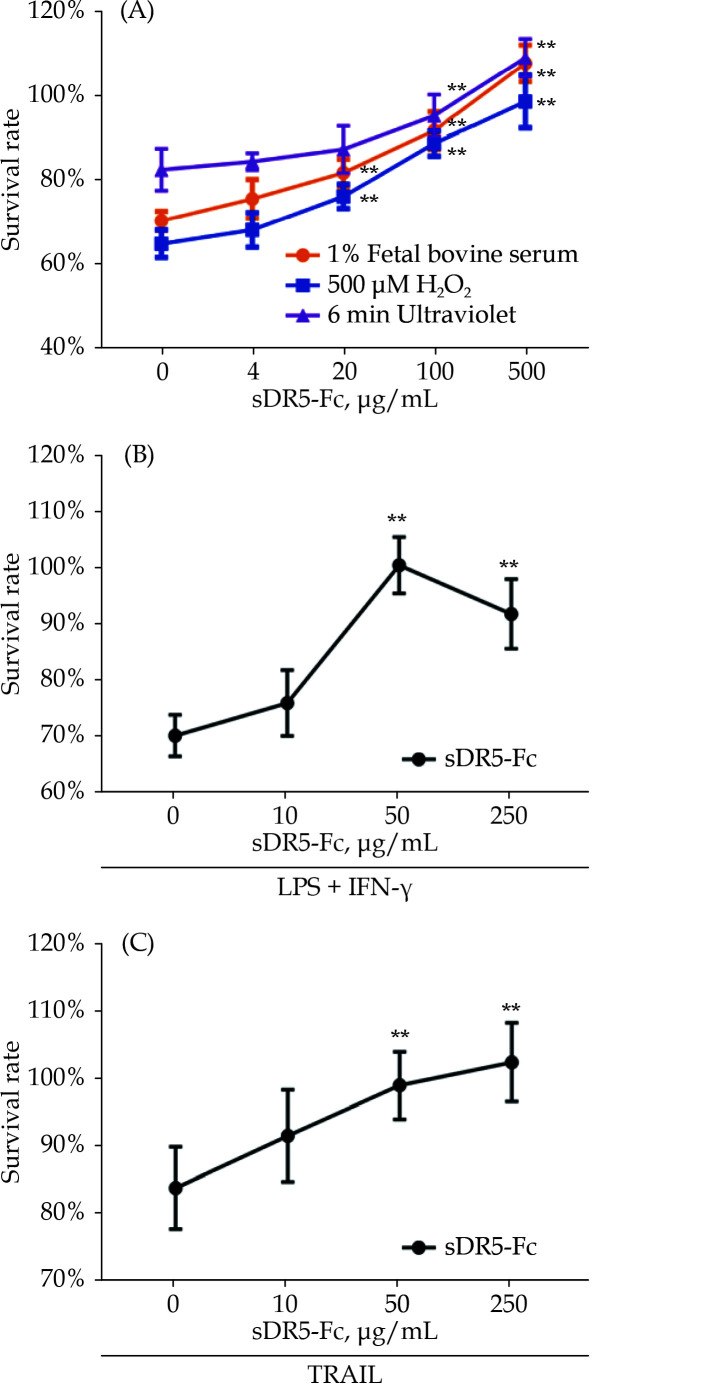
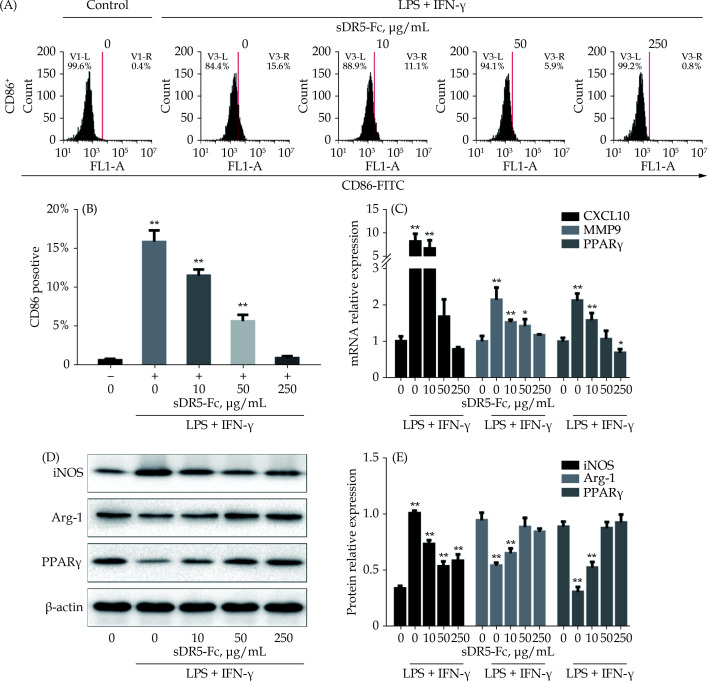
We found that sDR5-Fc rescues the proliferation of macrophages under extreme conditions, including nutrition deficiency, excessive peroxide, and ultraviolet irradiation. In addition, administration of sDR5-Fc inhibits the M1 polarization of macrophages induced by lipopolysaccharide (LPS) and interferon-gamma (IFN-γ), as the expression of M1 polarization markers CD86, CXC motif chemokine ligand 10, matrix metalloproteinase 9, and tumor necrosis factor-α, as well as the secretion of inflammatory factors interleukin (IL)-1β and IL-6, were significantly decreased. By further investigation of the mechanisms, the results showed that sDR5-Fc can recover the LPS and IFN-γ induced pH reduction, lactic acid elevation, and increased expression of hexokinase 2 and glucose transporter 1, which were markers of glycolysis in macrophages.
sDR5-Fc inhibits the M1 polarization of macrophages by blocking the glycolysis, which provides a new direction for the development of strategies in the treatment of myocardial ischemia reperfusion injury.
巨噬细胞的M1极化是心肌缺血再灌注损伤中的一个重要病理过程,而心肌缺血再灌注损伤是急性心肌梗死治疗的主要障碍。目前,抑制M1极化的策略和机制尚未得到充分探索。本研究旨在探讨可溶性死亡受体5-Fc(sDR5-Fc)在极端条件下调节巨噬细胞M1极化中的作用,并从糖酵解方面探索其机制。
在RAW264.7细胞中诱导极端条件。分别使用实时定量聚合酶链反应和蛋白质免疫印迹法检测mRNA和蛋白质的表达。使用细胞计数试剂盒-8研究细胞的增殖活性。通过酶联免疫吸附测定法测定炎性细胞因子的表达水平。
我们发现sDR5-Fc可挽救极端条件下巨噬细胞的增殖,这些极端条件包括营养缺乏、过氧化物过量和紫外线照射。此外,给予sDR5-Fc可抑制脂多糖(LPS)和干扰素-γ(IFN-γ)诱导的巨噬细胞M1极化,因为M1极化标志物CD86、CXC基序趋化因子配体10、基质金属蛋白酶9和肿瘤坏死因子-α的表达以及炎性因子白细胞介素(IL)-1β和IL-6的分泌均显著降低。通过进一步研究机制,结果表明sDR5-Fc可恢复LPS和IFN-γ诱导的pH降低、乳酸升高以及己糖激酶2和葡萄糖转运蛋白1表达增加,这些都是巨噬细胞糖酵解的标志物。
sDR5-Fc通过阻断糖酵解抑制巨噬细胞的M1极化,这为心肌缺血再灌注损伤治疗策略的开发提供了新方向。