Wang Jia, Carper Dana L, Burdick Leah H, Shrestha Him K, Appidi Manasa R, Abraham Paul E, Timm Collin M, Hettich Robert L, Pelletier Dale A, Doktycz Mitchel J
Biosciences Division, Oak Ridge National Laboratory, Oak Ridge, TN, USA.
Graduate School of Genome Science and Technology, University of Tennessee, Knoxville, TN, USA.
Comput Struct Biotechnol J. 2021 Apr 9;19:1917-1927. doi: 10.1016/j.csbj.2021.03.034. eCollection 2021.
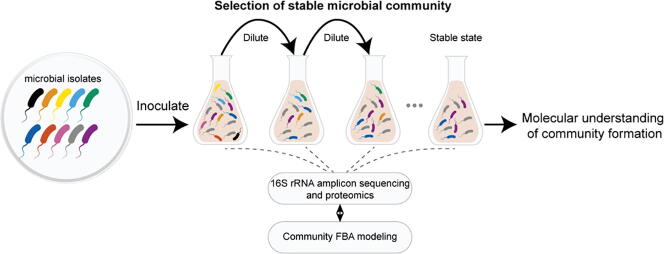
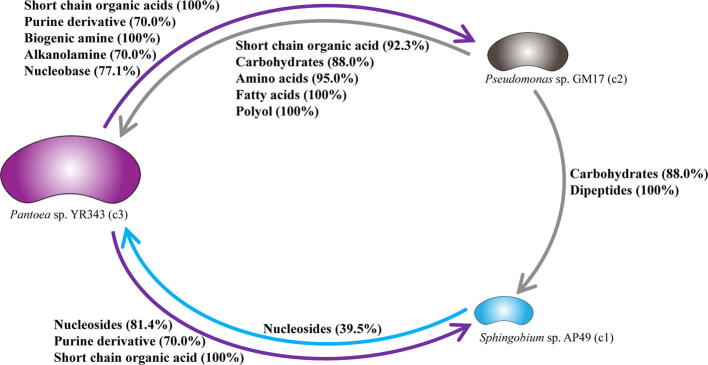
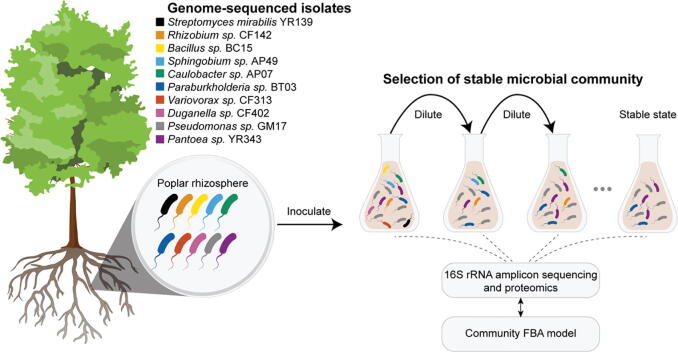
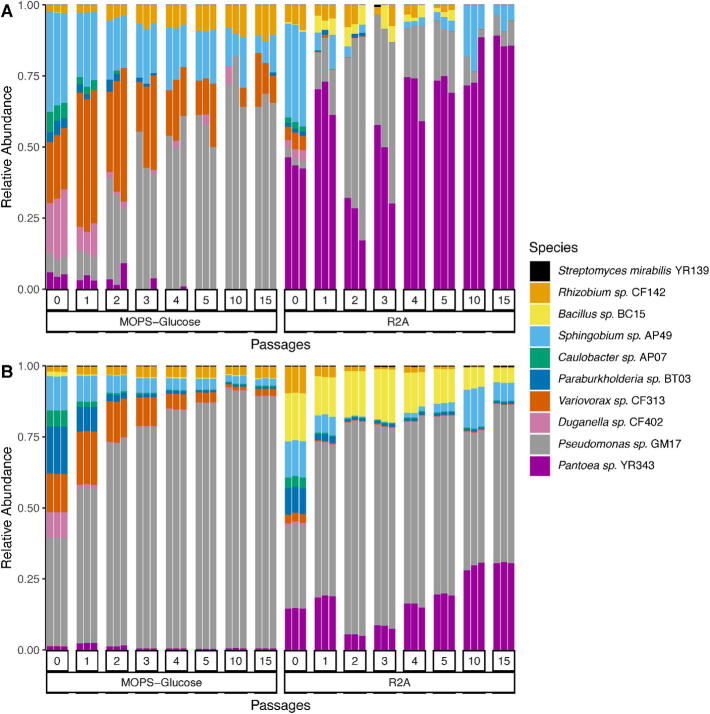
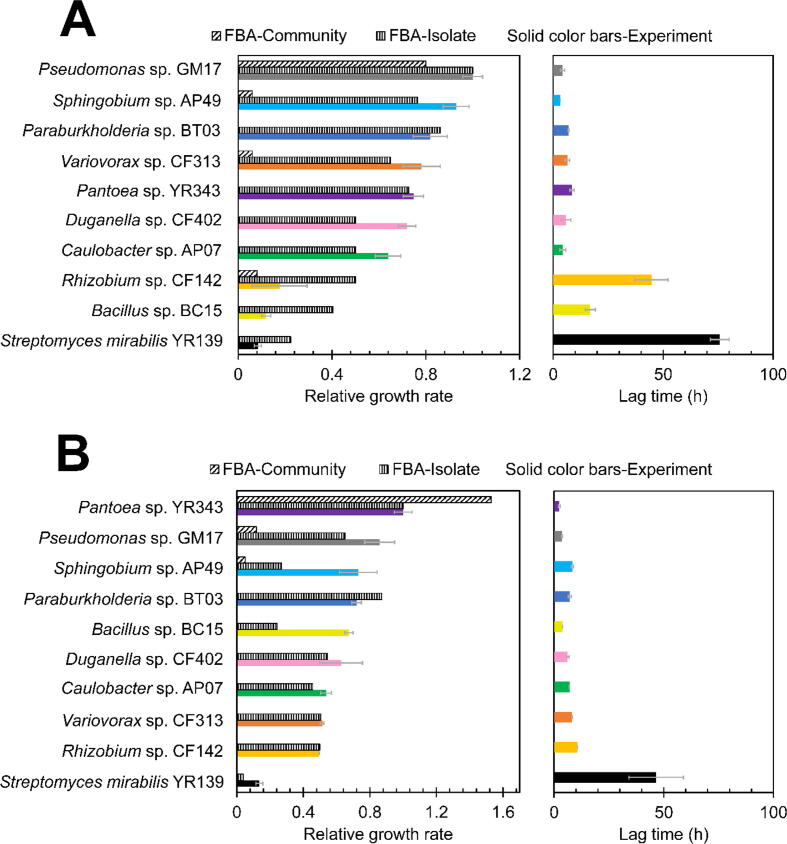
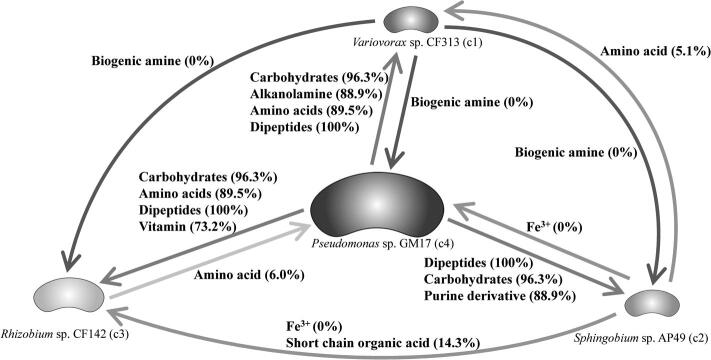
Microbial communities colonize plant tissues and contribute to host function. How these communities form and how individual members contribute to shaping the microbial community are not well understood. Synthetic microbial communities, where defined individual isolates are combined, can serve as valuable model systems for uncovering the organizational principles of communities. Using genome-defined organisms, systematic analysis by computationally-based network reconstruction can lead to mechanistic insights and the metabolic interactions between species. In this study, 10 bacterial strains isolated from the rhizosphere were combined and passaged in two different media environments to form stable microbial communities. The membership and relative abundances of the strains stabilized after around 5 growth cycles and resulted in just a few dominant strains that depended on the medium. To unravel the underlying metabolic interactions, flux balance analysis was used to model microbial growth and identify potential metabolic exchanges involved in shaping the microbial communities. These analyses were complemented by growth curves of the individual isolates, pairwise interaction screens, and metaproteomics of the community. A fast growth rate is identified as one factor that can provide an advantage for maintaining presence in the community. Final community selection can also depend on selective antagonistic relationships and metabolic exchanges. Revealing the mechanisms of interaction among plant-associated microorganisms provides insights into strategies for engineering microbial communities that can potentially increase plant growth and disease resistance. Further, deciphering the membership and metabolic potentials of a bacterial community will enable the design of synthetic communities with desired biological functions.
微生物群落定殖于植物组织并对宿主功能有贡献。这些群落如何形成以及个体成员如何塑造微生物群落尚不清楚。将特定的单个分离株组合而成的合成微生物群落,可作为揭示群落组织原则的有价值模型系统。利用基因组定义的生物体,通过基于计算的网络重建进行系统分析,可深入了解物种间的机制性见解和代谢相互作用。在本研究中,将从根际分离的10株细菌菌株组合,并在两种不同的培养基环境中传代,以形成稳定的微生物群落。菌株的成员组成和相对丰度在约5个生长周期后稳定下来,结果仅产生了少数几种取决于培养基的优势菌株。为了揭示潜在的代谢相互作用,通量平衡分析被用于模拟微生物生长并识别参与塑造微生物群落的潜在代谢交换。这些分析通过单个分离株的生长曲线、成对相互作用筛选以及群落的元蛋白质组学得到补充。快速生长速率被确定为在群落中维持存在的一个优势因素。最终的群落选择也可能取决于选择性拮抗关系和代谢交换。揭示植物相关微生物之间的相互作用机制,为工程化微生物群落以潜在提高植物生长和抗病性的策略提供了见解。此外,解读细菌群落的成员组成和代谢潜力将有助于设计具有所需生物学功能的合成群落。