Bekele Firomsa, Hajure Mohammedamin
Department of Pharmacy, College of Health Science, Mettu University, Mettu, Ethiopia.
Department of Psychiatry, College of Health Science, Mettu University, Mettu, Ethiopia.
SAGE Open Med. 2021 Apr 25;9:20503121211012512. doi: 10.1177/20503121211012512. eCollection 2021.
The mental health of the health care professionals is more likely to be affected by the coronavirus disease-19 compared to the general population. Accordingly, the current study aimed to summarize the magnitudes and determinants of the psychological impact of coronavirus among health care professionals.
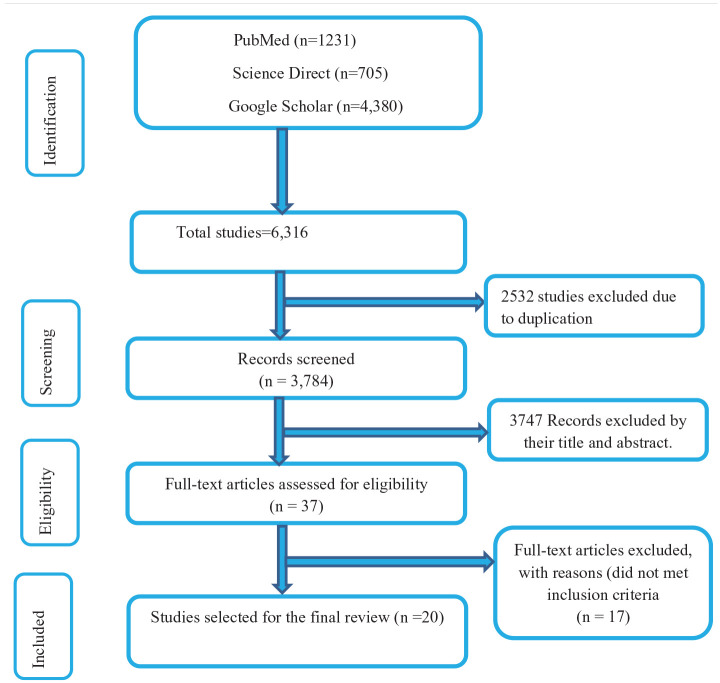
The studies from Medline via PubMed, Science Direct, and Google Scholar were searched from 5 September to 19 October 2020. The review was conducted as per PRISMA-2009 (Preferred Reporting Items for Systematic Reviews and Meta-analyses).
Initially, 6316 articles were searched from three databases (PubMed, Science Direct, and Google Scholar). Finally, 20 articles were filtered to be included in our review. Among different types of psychological impact, stress was reported that lies within the range from 5.2% to 100%, anxiety was reported from 11.1% to 100%, depression was from 10.6% to 58%, and insomnia was from 28.75% to 34%. Several factors were related to the negative psychological state of health care workers due to coronavirus disease-19 like educational level, occupation, gender, age, working environment, work experience, legal status, ethnicity, psychological comorbidity, social support, personal/family exposure, and feeling of health care providers.
The most common psychological impacts among health care workers were anxiety and stress. Besides different sociodemographic factors that determine the psychological impacts, front-line health care workers and participants having psychological comorbidity have a high risk of negative psychological state impacts as compared to their counterparts. Therefore, special attention should tend to health care workers directly involved in the prevention and management of coronavirus disease-19 and having a different risk of mental health condition.
与普通人群相比,医护人员的心理健康更易受到新型冠状病毒肺炎的影响。因此,本研究旨在总结冠状病毒对医护人员心理影响的程度及其决定因素。
于2020年9月5日至10月19日在PubMed、Science Direct和谷歌学术搜索Medline数据库中的研究。本综述按照PRISMA - 2009(系统评价和Meta分析的首选报告项目)进行。
最初从三个数据库(PubMed、Science Direct和谷歌学术)检索到6316篇文章。最终筛选出20篇文章纳入本综述。在不同类型的心理影响中,报告的压力范围为5.2%至100%,焦虑为11.1%至100%,抑郁为10.6%至58%,失眠为28.75%至34%。新型冠状病毒肺炎导致医护人员出现负面心理状态与多个因素有关,如教育水平、职业、性别、年龄、工作环境、工作经验、法律地位、种族、心理合并症、社会支持、个人/家庭暴露情况以及医护人员自身感受。
医护人员中最常见的心理影响是焦虑和压力。除了决定心理影响的不同社会人口学因素外,一线医护人员和有心理合并症的参与者相比其他人员出现负面心理状态影响的风险更高。因此,应特别关注直接参与新型冠状病毒肺炎预防和管理且心理健康状况存在不同风险的医护人员。