Wang Qian, Salehjahromi Morteza, Yu Hengyong
Department of Electrical and Computer Engineering, University of Massachusetts at Lowell, Lowell, MA 01854, USA.
IEEE Access. 2021;9:58537-58548. doi: 10.1109/access.2021.3071492. Epub 2021 Apr 7.
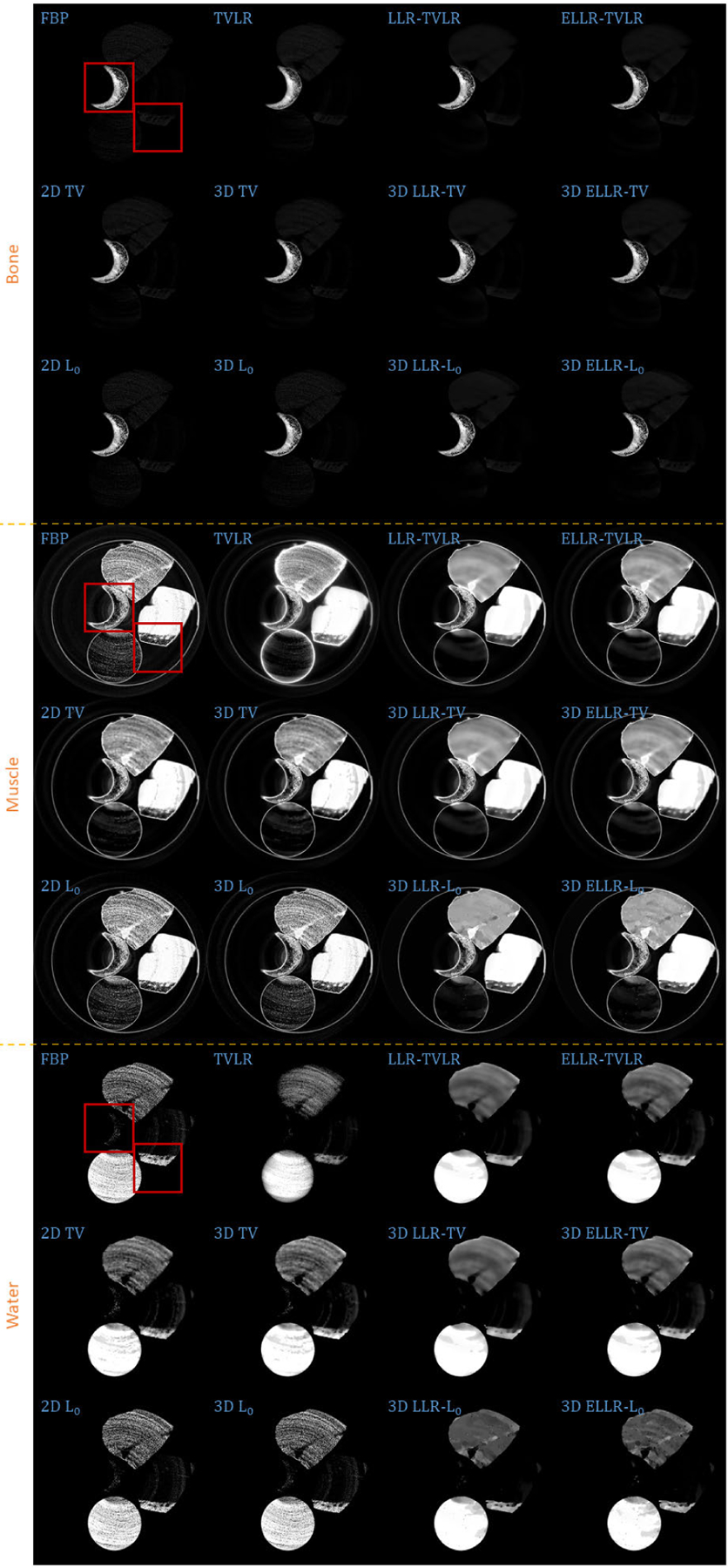
Spectral computed tomography (CT) is extension of the conventional single spectral CT (SSCT) along the energy dimension, which achieves superior energy resolution and material distinguishability. However, for the state-of-the-art photon counting detector (PCD) based spectral CT, because the emitted photons with a fixed total number for each X-ray beam are divided into several energy bins, the noise level is increased in each reconstructed channel image, and it further leads to an inaccurate material decomposition. To improve the reconstructed image quality and decomposition accuracy, in this work, we first employ a refined locally linear transform to convert the structural similarity among two-dimensional (2D) spectral CT images to a spectral-dimension gradient sparsity. By combining the gradient sparsity in the spatial domain, a global three-dimensional (3D) gradient sparsity is constructed, then measured with -, - and trace-norm, respectively. For each sparsity measurement, we propose the corresponding optimization model, develop the iterative algorithm, and verify the effectiveness and superiority with real datasets.
光谱计算机断层扫描(CT)是传统单光谱CT(SSCT)在能量维度上的扩展,它具有卓越的能量分辨率和物质区分能力。然而,对于基于最新光子计数探测器(PCD)的光谱CT,由于每个X射线束发射的固定总数的光子被划分为几个能量区间,每个重建通道图像中的噪声水平都会增加,进而导致物质分解不准确。为了提高重建图像质量和分解精度,在这项工作中,我们首先采用一种改进的局部线性变换,将二维(2D)光谱CT图像之间的结构相似性转换为光谱维度梯度稀疏性。通过结合空间域中的梯度稀疏性,构建一个全局三维(3D)梯度稀疏性,然后分别用 - 、 - 和迹范数进行测量。对于每种稀疏性测量,我们提出相应的优化模型,开发迭代算法,并使用真实数据集验证其有效性和优越性。