Wei Muhong, Li Can, Dai Yu, Zhou Haolong, Cui Yuan, Zeng Yun, Huang Qin, Wang Qi
MOE Key Lab of Environment and Health, Department of Epidemiology and Biostatistics, School of Public Health, Tongji Medical College, Huazhong University of Science and Technology, Wuhan, China.
Department of Nuclear Medicine, Union Hospital, Tongji Medical College, Huazhong University of Science and Technology, Wuhan, China.
Front Cell Infect Microbiol. 2021 Apr 30;11:630372. doi: 10.3389/fcimb.2021.630372. eCollection 2021.
Accumulative evidence suggests that gut microbiota play an important role in bone remodeling and hence bone health maintenance. This study aimed to explore the association of gut microbiota with the risk of osteoporosis and to identify potential disease-related taxa, which may be promising targets in osteoporosis prevention and treatment in the future.
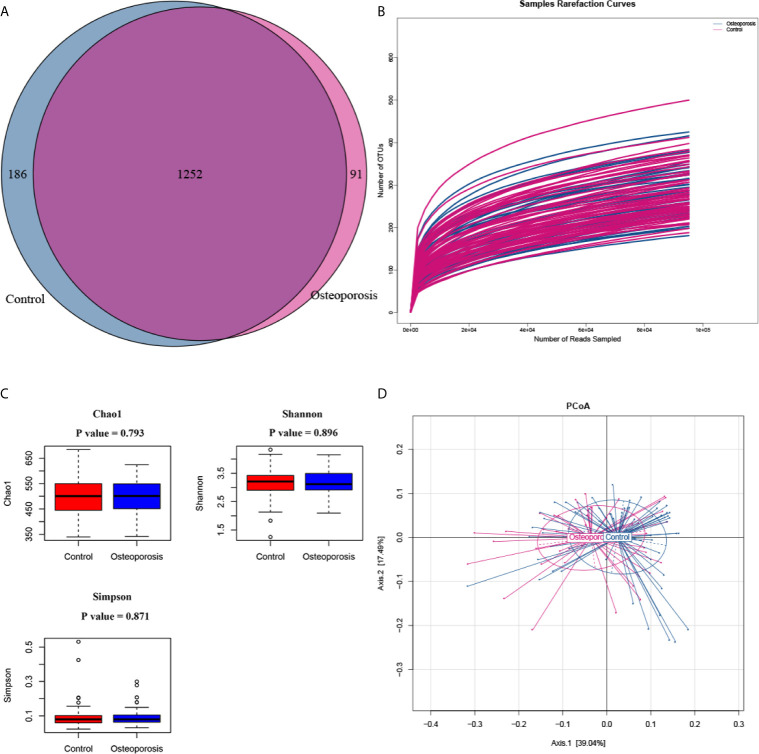
Absolute quantification 16S ribosomal RNA gene sequencing was used to detect absolute and relative abundances of gut microbiota in 44 patients with osteoporosis and 64 controls. In combination with one of our previous studies, a total of 175 samples were involved in the relative abundance analysis.
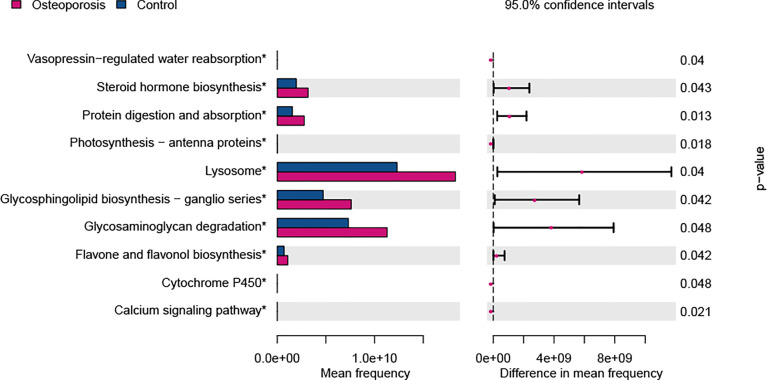
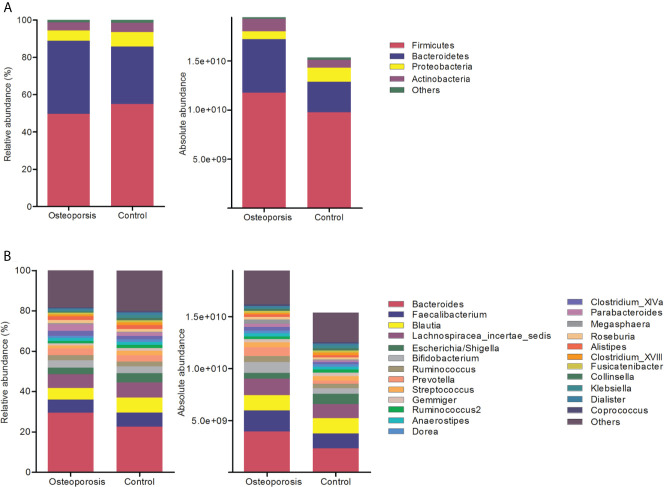
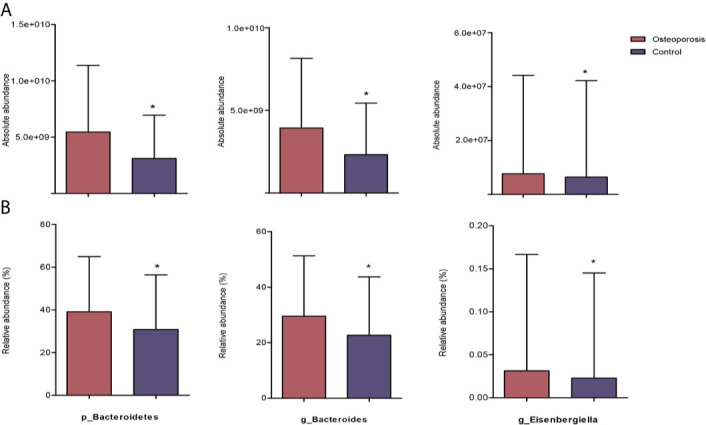
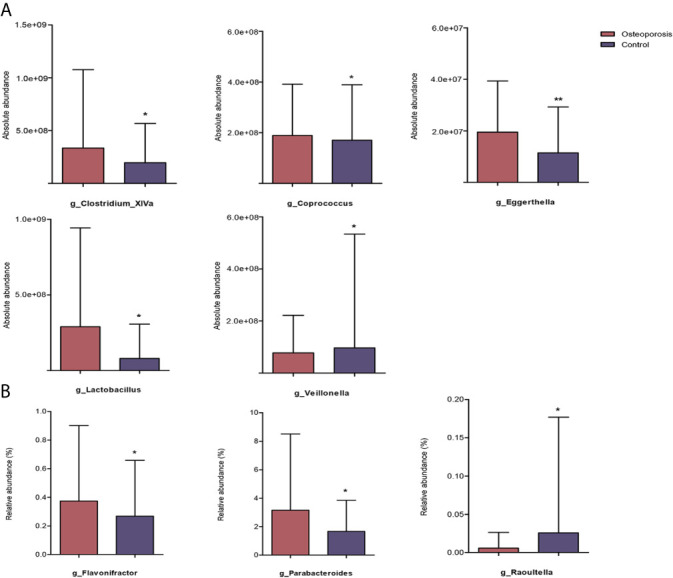
Compared with the controls, the patients with osteoporosis had higher absolute and relative abundances of Bacteroidetes phylum, and and genera. The absolute abundances of , , , and genera increased, and that of the genus decreased in the osteoporosis group. As for relative abundance, that of the and genera increased, whereas that of the genus decreased in the osteoporosis group. Controlling for potential confounders, the associations of , , and genera with the risk of osteoporosis did not maintain significance. Ridge regression analysis suggested that is associated with reduced bone mineral density (BMD) and T-score at lumbar spines, and is associated with increased BMD at the femoral neck. Functional predictions revealed that 10 Kyoto Encyclopedia of Genes and Genomes pathways were enriched in the osteoporosis group.
Gut microbiota compositions may contribute to the risk of osteoporosis. Several specific taxa and functional pathways are identified to associate with reduced bone density, thus providing epidemiologic evidence for the potential role of aberrant gut microbiota in osteoporosis pathogenesis.
越来越多的证据表明,肠道微生物群在骨重塑以及由此维持骨骼健康方面发挥着重要作用。本研究旨在探讨肠道微生物群与骨质疏松症风险之间的关联,并识别潜在的疾病相关分类群,这些分类群可能是未来骨质疏松症预防和治疗中有前景的靶点。
采用绝对定量16S核糖体RNA基因测序检测44例骨质疏松症患者和64例对照者肠道微生物群的绝对和相对丰度。结合我们之前的一项研究,共有175个样本参与相对丰度分析。
与对照组相比,骨质疏松症患者拟杆菌门以及相关属的绝对和相对丰度更高。骨质疏松症组中,相关属的绝对丰度增加,而相关属的绝对丰度降低。至于相对丰度,骨质疏松症组中相关属的相对丰度增加,而相关属的相对丰度降低。在控制潜在混杂因素后,相关属与骨质疏松症风险的关联不再具有统计学意义。岭回归分析表明,与腰椎骨密度(BMD)和T值降低有关,而与股骨颈BMD增加有关。功能预测显示,骨质疏松症组中有10条京都基因与基因组百科全书通路富集。
肠道微生物群组成可能与骨质疏松症风险有关。已确定几种特定的分类群和功能通路与骨密度降低有关,从而为异常肠道微生物群在骨质疏松症发病机制中的潜在作用提供了流行病学证据。